Thank you for reading this post, don't forget to subscribe!
To sponsor an immigrant in the United States, first determine whether you qualify to sponsor a family member, support an eligible immigration application, or hire a foreign worker. Family sponsorship often starts with Form I-130, followed by the required green card application and, in most cases, Form I-864 to show financial support.
In the United States, immigrant sponsorship is a legal process that can help an eligible foreign national obtain permanent residence or another qualifying immigration benefit. The right process depends on your relationship with the person, your immigration status, and the reason they want to move to the country. A U.S. citizen, a lawful permanent resident, and an employer do not have the same sponsorship options.
If you are asking how do I sponsor an immigrant, begin by identifying the immigration category that fits your situation. A U.S. citizen may petition for certain relatives, while a green card holder can petition for a more limited group of family members. Employers may sponsor eligible workers through employment-based immigration. A friend generally cannot file a family-based immigrant petition simply because they want to help someone move to America.
Sponsorship can involve forms, government fees, supporting records, waiting periods, and financial duties. An approved petition does not automatically give the immigrant a green card or permission to enter the United States. This guide explains the main options, the steps to follow, the financial rules, and the mistakes to avoid. Immigration rules and form editions can change, so confirm the current requirements with U.S. Citizenship and Immigration Services before filing.
What Does It Mean to Sponsor an Immigrant in the USA?
Sponsoring an immigrant means taking a formal role in a process that may allow a person to immigrate to the United States. The sponsor may file a petition based on a qualifying family relationship, submit a financial commitment, or act as an employer seeking to hire an eligible foreign worker. These roles are related, but they are not interchangeable.
In family-based immigration, the petitioner asks the government to recognize a qualifying relationship. In many cases, a separate financial sponsorship form is also required. The immigrant must still meet the rules for the requested benefit, including any applicable admissibility, documentation, medical examination, and visa requirements.
Some people use the word sponsor to describe anyone who helps an immigrant. However, paying expenses, writing an invitation letter, or offering a place to live does not by itself qualify someone to petition for an immigrant visa. The correct route depends on the legal category, not just the sponsor’s willingness to help.
Source: batrakovalaw.com
Family-based sponsorship
An eligible U.S. citizen or lawful permanent resident files a petition for a qualifying relative, subject to the rules for that relationship.
Financial sponsorship
A qualifying sponsor signs the required affidavit of support when applicable and accepts the legal duties described in that form.
Employment-based sponsorship
An eligible U.S. employer may petition for a foreign worker under an appropriate employment-based immigration category.
Humanitarian and other pathways
Some immigrants qualify through separate humanitarian or special programs that do not follow the ordinary family sponsorship process.
Can I Sponsor Anyone I Want?
No. U.S. immigration law limits who can file a family-based immigrant petition. A desire to help a friend, partner, employee, or distant relative is not enough on its own. You must use a category that legally covers the relationship or circumstances.
For example, a U.S. citizen may generally petition for a spouse, an eligible child, a parent if the citizen is at least 21, or a sibling if the citizen is at least 21. A lawful permanent resident may generally petition for a spouse and eligible unmarried children, but not for parents or siblings. Specific age, marital-status, relationship, and classification rules apply.
Check the legal relationship
Confirm that your relationship is covered by the relevant immigration category before starting an application.
Separate the petition from financial support
Being eligible to petition and meeting the income requirements for an affidavit of support are two different questions.
Who Can Sponsor an Immigrant in the United States?
Your eligibility depends on the type of immigration benefit the person seeks. For most family-based petitions, the petitioner must be a U.S. citizen or lawful permanent resident and must have a qualifying relationship with the intended immigrant. A financial sponsor signing Form I-864 generally must be at least 18 years old, be a U.S. citizen, U.S. national, or lawful permanent resident as permitted by the rules, and have a U.S. domicile.
A sponsor’s immigration status does not guarantee approval. The government reviews the petition, supporting evidence, and the immigrant’s eligibility. Some categories have annual visa limits, and certain applicants must wait until an immigrant visa becomes available.
If you are not a U.S. citizen or green card holder, do not assume you can file a family petition. You may still be able to provide practical support, but any formal role must fit the rules of the specific immigration program.
Source: images.template.net
U.S. citizens
May petition for eligible spouses, children, parents, and siblings. The rules and waiting periods differ by relationship and age.
Lawful permanent residents
May petition for eligible spouses and unmarried children. They generally cannot petition for parents, married children, or siblings through the ordinary family preference categories available to citizens.
U.S. employers
May sponsor qualified foreign workers when the employer, job, and applicant meet the requirements of an employment-based category.
Joint financial sponsors
In eligible family-based cases, another person may help meet the financial requirement by submitting a separate qualifying affidavit of support. A joint sponsor does not replace the petitioner’s required eligibility.
Can I Sponsor a Friend or Boyfriend or Girlfriend?
A friend cannot file a family-based immigrant petition solely because of the friendship. Likewise, an unmarried romantic partner generally does not qualify as a spouse for an ordinary marriage-based petition. A qualifying fiancé or fiancée of a U.S. citizen may be eligible for a separate K-1 visa process if the legal requirements are met.
A friend may be able to help with an eligible immigrant’s financial sponsorship as a joint sponsor, depending on the case and the applicable rules. That role is different from filing the petition. A visitor invitation letter may explain a proposed visit, but it does not guarantee a visa and is not a substitute for an immigrant petition.
For a friend
Check whether the person qualifies through a family relationship, employment, or another lawful immigration category.
For an unmarried partner
Review the fiancé visa requirements or wait until a legally valid marriage exists before considering a spouse-based petition.
For a visitor
Use the applicable temporary visitor visa or Visa Waiver Program rules, if eligible, rather than treating a visit as permanent immigration.
How Do I Sponsor an Immigrant Through Family-Based Immigration?
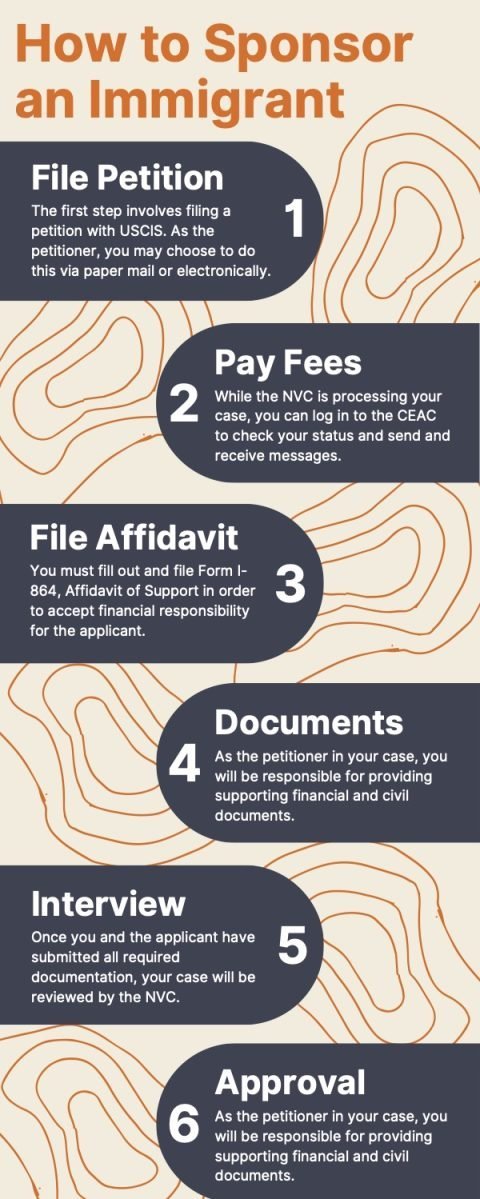
For an eligible relative, the usual first step is filing Form I-130, Petition for Alien Relative, with U.S. Citizenship and Immigration Services. This form asks the government to recognize the family relationship. It does not, by itself, grant a green card, work authorization, or permission to enter the United States.
The next steps depend on whether the relative is inside or outside the United States, whether they qualify to adjust status, and whether an immigrant visa is immediately available. An eligible applicant inside the country may be able to file Form I-485, Application to Register Permanent Residence or Adjust Status. An applicant abroad usually proceeds through consular processing after the petition and visa availability requirements are met.
Do not assume that every relative can file all forms at the same time. Immediate relatives of U.S. citizens may often submit the petition and adjustment application together when otherwise eligible. Other family preference categories may have to wait for a visa number. The Visa Bulletin and the official USCIS filing instructions help determine which steps are available.
Source: batrakovalaw.com
Step 1: Confirm the category
Identify the exact family relationship and check whether your citizenship or permanent resident status permits a petition for that person.
Step 2: Gather relationship evidence
Collect the appropriate birth, marriage, adoption, divorce, or other civil records that establish the qualifying relationship.
Step 3: Complete Form I-130
Use the current form and instructions, provide complete and truthful information, and submit the required filing fee or a valid fee-waiver request when permitted.
Step 4: Follow the correct processing route
Determine whether adjustment of status or consular processing applies, and follow the instructions from USCIS or the National Visa Center as the case progresses.
Step 5: Complete financial and immigrant applications
Submit the required affidavit of support, civil records, immigrant visa or adjustment forms, and any requested evidence.
Step 6: Attend required appointments
The immigrant may need a biometrics appointment, medical examination, or interview, depending on the application and processing route.
What Documents Do I Need to Sponsor a Family Member?
The required records depend on the relationship and the applicant’s circumstances. Use the official checklist for the specific form and case rather than sending a large collection of unrelated documents. Records in another language may need a complete English translation that meets the applicable requirements.
Proof of your status
Examples include a U.S. passport, naturalization certificate, birth certificate showing U.S. citizenship, or permanent resident card, as appropriate.
Proof of relationship
Examples include marriage certificates, birth certificates, adoption records, and legal records of name changes or prior marriages when relevant.
Financial evidence
Depending on the process, you may need federal tax information, income records, employment evidence, and proof of assets or household support.
Immigrant’s records
The applicant may need a passport, civil documents, photographs, medical examination results, police certificates where required, and other case-specific records.
What Happens After Form I-130 Is Approved?
Approval means USCIS has accepted the qualifying relationship for the petition, but it does not necessarily mean the relative can immigrate immediately. The next step may involve waiting for a visa number, submitting documents to the National Visa Center, applying for adjustment of status, or attending a consular interview.
Keep your mailing address and contact details current with the relevant agency. Respond to requests for evidence or notices by the stated deadline. Check official case-status tools and keep copies of all submissions, receipts, and correspondence.
If the relative is abroad
Follow National Visa Center instructions when the case becomes eligible for that stage, submit required documents, and prepare for the immigrant visa interview.
If the relative is in the United States
Confirm eligibility to adjust status before filing Form I-485. Entry history, immigration status, and other legal issues can affect eligibility.
How Much Income Do I Need to Sponsor an Immigrant?
For most family-based immigrant visa cases requiring Form I-864, the sponsor generally must show income at or above 125% of the applicable Federal Poverty Guidelines for the sponsor’s household size. Certain active-duty U.S. military sponsors petitioning for a spouse or child may qualify for a 100% guideline. The exact threshold depends on the applicable guideline, household size, and relevant rules.
There is no single income amount that works for every sponsor. A household of two has a different threshold from a household of five. Household size may include the sponsor, spouse, qualifying children, tax dependents, the intending immigrant, certain derivative applicants, and people covered by other affidavits of support that remain in effect.
If your income is too low, you may have options. A qualifying joint sponsor can submit a separate Form I-864, or an eligible household member may be able to contribute income using Form I-864A. Assets may also be considered under the applicable rules. These options do not remove the petitioner’s basic eligibility requirements, including the applicable domicile requirement.
Source: i.ytimg.com
Check the current poverty guidelines
Use the official USCIS or Department of State guidance applicable to the filing and confirm the current income threshold for your household size.
Calculate household size carefully
Do not count only the people who live in your home. Tax dependents and existing sponsorship obligations may affect the calculation.
Use reliable financial records
Review your most recent federal tax return or IRS transcript and provide current income evidence when required.
Consider a joint sponsor when necessary
A joint sponsor must independently meet the relevant eligibility and financial rules and submit the required documents.
What Is Form I-864, Affidavit of Support?
Form I-864 is a legally enforceable financial commitment used in many family-based immigration cases and certain employment-based cases. By signing it, the sponsor agrees to accept the responsibilities set out in the affidavit. This is more than a general promise to help with rent, food, or other living expenses.
The obligation generally continues until the sponsored immigrant becomes a U.S. citizen, earns or receives credit for 40 qualifying quarters of work under Social Security rules, loses permanent resident status and departs the United States in circumstances that end the obligation, obtains a qualifying new adjustment of status in removal proceedings, or dies. The sponsor’s death also ends the sponsor’s personal obligation. Divorce alone does not end an affidavit of support obligation.
The exact legal consequences depend on the facts and applicable law. Certain public benefits may lead to a reimbursement request under the statute, and a sponsored immigrant may have rights to enforce the financial support obligation. Read the form instructions carefully and consider legal advice before signing if you are unsure about the commitment.
Form I-864
The standard affidavit of support used in many family-based cases and some other qualifying cases.
Form I-864EZ
A simplified version that may be available when the case and income evidence meet its specific eligibility conditions.
Form I-864A
A contract that may allow a qualifying household member’s income or assets to be counted under the applicable rules.
Form I-864W
A request for exemption from the affidavit requirement in qualifying circumstances, such as certain applicants who meet the statutory work-credit rules.
Can I Sponsor an Immigrant If I Do Not Earn Enough?
Possibly. A shortage in your income does not automatically mean the case must end. First, check whether all income and eligible assets have been documented correctly. If you still fall short, review whether a joint sponsor or qualifying household member can help meet the financial standard.
A joint sponsor usually must meet the relevant age, status, domicile, and income requirements independently. The original petitioner generally still has to submit the required affidavit even when a joint sponsor is used. Do not assume that a joint sponsor can correct every eligibility problem.
Review eligible assets
Certain assets may help meet the financial requirement, but valuation, ownership, accessibility, and applicable asset-to-income rules matter.
Review household member income
Check whether the household member qualifies and whether Form I-864A is required.
Ask a qualified adviser when needed
If income, domicile, tax records, or household size is complex, obtain advice before submitting a financial form.
How Do I Sponsor an Immigrant Through Employment?
If you own or represent a U.S. business and want to hire a foreign worker permanently, employment-based immigration may be the appropriate route. The process depends on the worker’s qualifications, the offered position, and the applicable immigrant visa category. It is different from filing a family petition and generally does not use Form I-130.
Some employment-based categories require a permanent job offer and a labor certification from the U.S. Department of Labor. The employer may need to test the labor market and complete the required certification process before filing Form I-140, Immigrant Petition for Alien Workers. Other categories have different rules or may allow the worker to self-petition.
An employer should confirm the requirements before promising sponsorship. A job offer alone does not guarantee a green card, and the employee must qualify for the relevant category. The employer must also comply with applicable labor, recruitment, recordkeeping, and immigration rules.
Source: alheejra.com
Step 1: Identify the worker category
Review the available employment-based categories and determine which one fits the position and the worker’s education, skills, experience, or other qualifications.
Step 2: Determine whether labor certification is needed
Check the Department of Labor requirements for the selected category and complete the required process when applicable.
Step 3: File the immigrant petition
When required, submit Form I-140 with the relevant certification and supporting evidence.
Step 4: Complete the immigrant’s application
After the petition and visa-availability requirements are met, the worker may proceed through adjustment of status or consular processing, depending on eligibility and location.
Can a Small Business Sponsor a Foreign Worker?
A small business may be able to sponsor an eligible worker, but the employer must meet the requirements for the specific category and show that the job offer and supporting evidence are genuine. The size of the business alone does not establish eligibility or guarantee approval.
Before starting, assess whether the role is permanent when required, whether the business can pay the offered wage, and whether it can provide accurate records. Immigration counsel can help employers understand labor certification, recruitment, prevailing wage, and petition requirements.
Document the business and job
Keep accurate business records, job duties, wage details, and evidence required for the selected category.
Follow labor rules
Where required, follow the Department of Labor process and retain the records specified by law.
How Much Does It Cost to Sponsor an Immigrant?
The total cost depends on the immigration category, the forms required, the applicant’s location, and whether professional help is used. A family-based case may include a petition filing fee, an immigrant visa or adjustment application fee, financial sponsorship processing, a medical examination, translation costs, and travel expenses. Employment-based cases may also involve labor certification, petition, and employer-related costs.
Government fees can change. Some forms have different fee rules depending on whether the applicant files online or on paper, and certain applicants may qualify for a fee waiver when the rules allow it. Always use the official fee schedule and the current instructions for each form instead of relying on an old blog post or a third-party estimate.
The sponsor and immigrant should agree in advance on who will pay each lawful expense. In employment cases, special rules may restrict an employer’s ability to shift certain required recruitment or labor certification costs to a worker. Do not assume every expense can legally be passed to the immigrant.
Source: warrenlawfirm.net
Government filing fees
Check the current fee for every required form on the relevant agency’s official website before filing.
Medical and document costs
Budget for the required medical examination, translations, civil records, photographs, and any authorized document services.
Travel and settlement
An immigrant applying abroad may need to budget for travel, initial housing, transport, and other living expenses.
Legal assistance
An attorney’s fee is separate from government fees. Ask for a written scope of work and fee agreement before hiring counsel.
How Can I Avoid Paying the Wrong Fees?
Start with the official USCIS fee information for forms handled by USCIS and the Department of State instructions for immigrant visa processing fees. Verify the fee again on the day you file because a previous fee amount may no longer apply.
Use the official payment method and follow the filing location instructions. A fee paid to the wrong agency, a missing payment, or an incorrect filing package may delay the case or result in rejection. Keep receipts and copies of payment confirmations.
Use official websites
Look for current instructions on USCIS.gov and Travel.State.gov rather than relying only on search snippets or unofficial calculators.
Check for fee exemptions
Confirm whether a waiver or exemption applies to the specific form and applicant before assuming no payment is due.
How Long Does Immigrant Sponsorship Take?
There is no single processing time for every immigrant sponsorship case. The timeline depends on the petition type, the family relationship or employment category, the applicant’s country and location, agency workload, visa availability, and whether the government requests more evidence. Some categories have no annual numerical limit for the relevant relationship, while others are subject to visa limits and waiting lists.
A petition approval and a green card approval are separate events. After a family petition is approved, a relative in a preference category may still need to wait for an immigrant visa number. Applicants processing abroad may then complete National Visa Center document review and a consular interview. Applicants inside the United States may have a separate adjustment-of-status process if eligible.
Use official processing-time tools for the relevant application and check the Department of State Visa Bulletin when a preference category applies. Treat any estimated date as an estimate, not a promise. Missing documents, incorrect forms, security checks, interview scheduling, and requests for evidence can extend the process.
Source: batrakovalaw.com
Check USCIS processing times
Use the form type and processing location shown in the official tool to understand the current estimate for the relevant stage.
Check visa availability
Review the Visa Bulletin and the applicable priority date rules for family preference and employment-based categories.
Respond to notices on time
Read each request carefully, submit the requested information by the deadline, and retain proof of delivery or online submission.
What If My Sponsorship Case Is Delayed?
First, confirm which agency currently holds the case and whether the delay is within the published processing estimate. Check the receipt number, online case status, notices, and any outstanding document requests. For a case at the National Visa Center, review the case instructions and document status in the official system.
If the case is outside normal processing times, use the agency’s official inquiry process when available. Do not submit duplicate petitions or applications without understanding the consequences. If a deadline has passed, a notice is unclear, or the delay involves a legal problem, consider consulting a qualified immigration attorney.
Find the current case location
Identify whether USCIS, the National Visa Center, a consulate, or another authority is responsible for the next step.
Review every notice
Check for requests for evidence, interview notices, fee instructions, and deadlines that may explain the delay.
Common Mistakes to Avoid When Sponsoring an Immigrant
The most common sponsorship problems arise when people choose the wrong category, misunderstand the financial commitment, use outdated forms, or assume that petition approval guarantees immigration. A careful review before filing can prevent avoidable delays and reduce the risk of rejection or other adverse outcomes.
Accuracy matters. Provide truthful answers and consistent information across forms and supporting records. If names, dates, prior marriages, addresses, or immigration history differ between documents, explain the discrepancy when required rather than trying to hide it.
Do not make travel, work, or relocation plans based only on a receipt notice or petition approval. The person must have the required immigration authorization before taking actions that depend on that status. Rules can differ significantly between temporary visas and permanent immigration.
Source: batrakovalaw.com
Choosing an ineligible relative
Confirm that the law permits you to petition for the person before paying a filing fee.
Using outdated forms
Download the current form edition and follow the correct filing address, signature, and payment instructions.
Underestimating the financial obligation
Read Form I-864 and its instructions before signing, because the commitment can continue for years and may be legally enforced.
Ignoring visa availability
Check whether the immigrant’s category has a waiting list and whether a visa number is available before assuming the person can proceed.
Using false or incomplete records
Submit genuine documents and accurate answers. Fraud or material misrepresentation can have serious immigration consequences.
Trusting guaranteed approval claims
No private agent can guarantee a government decision. Be cautious of anyone who asks you to lie, sign blank forms, or pay for a promised visa.
When Should I Speak With an Immigration Attorney?
Professional legal advice can be especially useful when the immigrant has a prior removal order, unlawful presence, a criminal record, previous visa fraud concerns, complex entry history, or a prior immigration denial. These issues may affect eligibility and can require careful analysis before a form is filed.
An attorney may also help when the relationship evidence is complex, the sponsor lives abroad, income and assets are difficult to calculate, or an employment case involves labor certification. Choose a licensed attorney authorized to practice law in the relevant jurisdiction. In the United States, certain accredited representatives may provide authorized immigration assistance through recognized nonprofit organizations.
Avoid relying on a notary public or an unlicensed consultant for legal advice. In many countries, the word notary has a different meaning from its use in the United States. A person who is not authorized to provide immigration legal services should not tell you which legal category to use or promise an outcome.
Get advice before filing
Seek qualified help when a mistake could affect admissibility, status, a deadline, or long-term financial duties.
Verify credentials
Check the attorney’s license or the representative’s authorization through the relevant official source.
Frequently Asked Questions
Q
Can I sponsor an immigrant if I am a green card holder?
Yes, a lawful permanent resident may generally petition for a spouse and eligible unmarried children. Green card holders cannot ordinarily petition for parents or siblings through the standard family-based categories available to U.S. citizens. The relative must also meet the requirements of the relevant category.
Q
Can I sponsor an immigrant if I am not a U.S. citizen?
You may be able to sponsor certain family members if you are a lawful permanent resident. Other immigration programs have their own eligibility rules. If you are neither a U.S. citizen nor a qualifying permanent resident, you generally cannot file an ordinary family-based immigrant petition just because you live or work in the United States.
Q
Can I sponsor an immigrant without a job?
Possibly, but you must still meet the financial sponsorship rules when Form I-864 is required. Eligible assets, qualifying household member income, or a joint sponsor may help in some cases. A lack of employment does not automatically determine eligibility, but the evidence must satisfy the applicable requirements.
Q
Can I sponsor an immigrant if I live outside the United States?
A U.S. citizen living abroad may be able to file a family petition, but a sponsor required to submit Form I-864 generally must meet the U.S. domicile requirement. Some citizens living abroad may qualify under rules for maintaining or reestablishing U.S. domicile. A joint sponsor cannot simply replace a petitioner’s failure to meet the basic sponsor requirements.
Q
Does sponsoring an immigrant make me responsible for all their debts?
No. Signing Form I-864 does not automatically make you responsible for every personal debt the immigrant incurs. However, the affidavit creates specific legal financial obligations, and some means-tested public benefits may trigger reimbursement rules. Read the form and applicable law carefully before signing.
Q
Can I sponsor an immigrant who is already in the United States?
In some cases, yes. An eligible relative may be able to pursue adjustment of status if the legal requirements are met. Entry history, immigration status, visa availability, and possible inadmissibility issues can affect eligibility. Filing a petition alone does not grant lawful status or protect someone from every immigration consequence.
Q
Can a friend sponsor an immigrant financially?
A friend may be able to serve as a joint financial sponsor in an eligible case if the applicable requirements are met. That person generally submits a separate affidavit of support and accepts its legal obligations. A friend cannot file a family petition based solely on friendship.
Q
Does an approved sponsorship petition guarantee a green card?
No. Petition approval is one step in the process. The immigrant must complete the required application or visa processing, meet the eligibility and admissibility rules, provide the required evidence, and receive the relevant final approval. Some applicants must also wait for an immigrant visa to become available.
✦ Wrapping Up
Conclusion
To sponsor an immigrant in the United States, start by identifying the right legal pathway. If the person is an eligible relative, family-based sponsorship usually begins with Form I-130. If the goal is to hire a foreign worker permanently, an employment-based category may be more suitable. Financial sponsorship is a separate responsibility that often requires Form I-864 and evidence that you meet the applicable income and domicile rules.
Before filing, confirm the relationship or employment category, gather genuine supporting documents, review current government fees, and check whether a visa is available. Keep copies of everything you submit and respond promptly to official notices. If the case involves prior immigration violations, complex finances, or questions about eligibility, obtain advice from a qualified immigration attorney.
💡 Key Takeaway
Visit USCIS.gov to identify the correct immigration category and download the current forms and instructions. For a family-based case, verify whether you can file Form I-130, review the applicable financial sponsorship requirements, and determine whether the immigrant will apply through adjustment of status or consular processing before submitting your application.