Thank you for reading this post, don't forget to subscribe!
sponsorship for employment is when a U.S. employer supports a foreign worker’s application for permission to work in the United States. Depending on the job and immigration category, the employer may need to file a petition, obtain labor certification, or complete other legal steps.
In the United States, getting a job and getting permission to work are two different things. A company may want to hire a skilled worker from another country, but the worker may need an employment-based visa or another form of work authorization before starting the job. Employment sponsorship is one way an employer and a foreign worker can complete the required immigration process.
For example, a U.S. technology company may want to hire a software engineer who lives abroad. If the engineer does not already have permission to work in the United States, the company may agree to sponsor the appropriate work visa. The exact process depends on the position, the worker’s qualifications, the employer, and the immigration category. Sponsorship does not guarantee visa approval or permanent residence.
This guide explains what sponsorship for employment means, which U.S. visa categories may involve employer support, how to find sponsoring employers, and what to check before accepting a job offer. It also covers common mistakes, possible costs, and warning signs that job seekers should recognize.
Sponsorship for employment is an arrangement in which an employer supports a foreign national’s application for permission to work in a particular country. In the United States, this often means that a company files an immigration petition or completes required labor-related steps so that a qualified worker can take a specific job.
The term is commonly used for employer-sponsored work visas and employment-based immigration. However, it is not one single visa or legal status. The requirements depend on the job, the employer, the worker’s background, and the immigration category that applies.
For many temporary work categories, the employer files a petition with U.S. Citizenship and Immigration Services, commonly called USCIS. Some categories also require action by the U.S. Department of Labor. If the worker is outside the United States, an approved petition may allow the worker to apply for the appropriate visa at a U.S. embassy or consulate.
Sponsorship is not the same as an ordinary job offer. An offer tells the worker that the employer wants to hire them. Sponsorship involves additional immigration steps when the worker needs them. The employer may agree to support the process, but government agencies decide whether the applicable requirements have been met.
Source: immi-usa.com
Employer support
The company agrees to take the required steps for an eligible immigration category, which may include filing petitions and supplying business or job information.
Worker eligibility
The applicant must meet the rules for the relevant category. Education, experience, nationality, job duties, and other factors may affect eligibility.
Government review
The relevant U.S. agencies review the applications and supporting documents. Employer support does not guarantee approval.
Job-specific permission
Many employer-sponsored categories limit the work a person may perform or the employer for whom they may work.
Who Is an Employment Sponsor?
An employment sponsor is generally a qualifying employer that takes the required steps to hire a foreign worker under an immigration category. Depending on the case, the sponsor may be a private company, a nonprofit organization, a university, or another eligible employer.
The employer must meet the requirements of the relevant program. It may need to show that the position is genuine, that the job meets the category’s rules, and that the worker will receive the required wages and working conditions. A company cannot simply declare someone eligible for a visa.
Private companies
Technology firms, manufacturers, hotels, and other businesses may sponsor workers when the position and employer qualify.
Universities and research organizations
Eligible institutions may sponsor certain researchers, professors, and other workers under suitable immigration categories.
Seasonal employers
Qualifying agricultural and nonagricultural employers may use temporary worker programs when their specific requirements are met.
Does Sponsorship Mean Permanent Residence?
No. Sponsorship can relate to temporary employment or permanent immigration. A temporary work visa may permit employment for a limited period under specific conditions. Permanent employment-based immigration may provide a route to lawful permanent resident status if the worker qualifies and the application is approved.
Some temporary workers may later qualify for an employment-based green card, but that outcome is not automatic. A worker must meet the separate requirements for the permanent immigration category, and the process may depend on employer support, labor certification, visa availability, and other legal rules.
Temporary sponsorship
Supports qualifying employment for a limited period, subject to the rules and duration of the visa category.
Permanent employment sponsorship
May support an application for an employment-based immigrant visa and, if approved, lawful permanent residence.
Types of U.S. Employment Sponsorship
The right sponsorship route depends on the work the person will perform and the immigration category’s requirements. Some visas cover specialized professional jobs, others cover seasonal work, and some allow qualifying employees to transfer within an international company.
For permanent employment, several immigrant visa categories may apply. Each has its own criteria, and some require an employer to complete labor certification before filing an immigrant petition. The following comparison is a starting point rather than a decision about any individual applicant’s eligibility.
Source: immigration.onlinejobshub.in
H-1B visa
Generally used for qualifying specialty occupations that require the application of specialized knowledge and at least a bachelor’s degree in a directly related specific specialty or its equivalent. Additional rules, caps, and exceptions may apply.
H-2A visa
For eligible foreign workers performing temporary or seasonal agricultural labor or services. The employer must meet the program’s labor and recruitment requirements.
H-2B visa
For eligible foreign workers performing temporary nonagricultural labor or services when the applicable program requirements are met. Annual limits and country-related rules may affect eligibility.
L-1 visa
May allow a qualifying international company to transfer certain executives, managers, or employees with specialized knowledge to a related U.S. office.
O-1 visa
For individuals who meet the demanding requirements for extraordinary ability or achievement in specified fields. A qualifying U.S. employer or agent generally files the petition.
EB-2 and EB-3 immigrant categories
These employment-based immigrant categories may lead to permanent residence for eligible professionals, skilled workers, and certain other qualified applicants. Many employer-sponsored cases require labor certification, although exceptions exist.
Temporary Work Visas
Temporary work visas are intended for employment that fits a defined nonimmigrant category. The permitted duration and type of work depend on the category, the approved petition, and the worker’s authorized period of stay.
An H-1B position, for example, must satisfy the specialty occupation rules. H-2A and H-2B employment must meet the requirements for temporary or seasonal labor. These programs are not interchangeable, so applicants should not assume that any job offer can be used for any work visa.
Best starting point
Identify the actual job duties and the employer’s proposed visa category before preparing an application.
Key limitation
A temporary work visa does not automatically provide permanent residence or unrestricted permission to work for any company.
Permanent Employment-Based Immigration
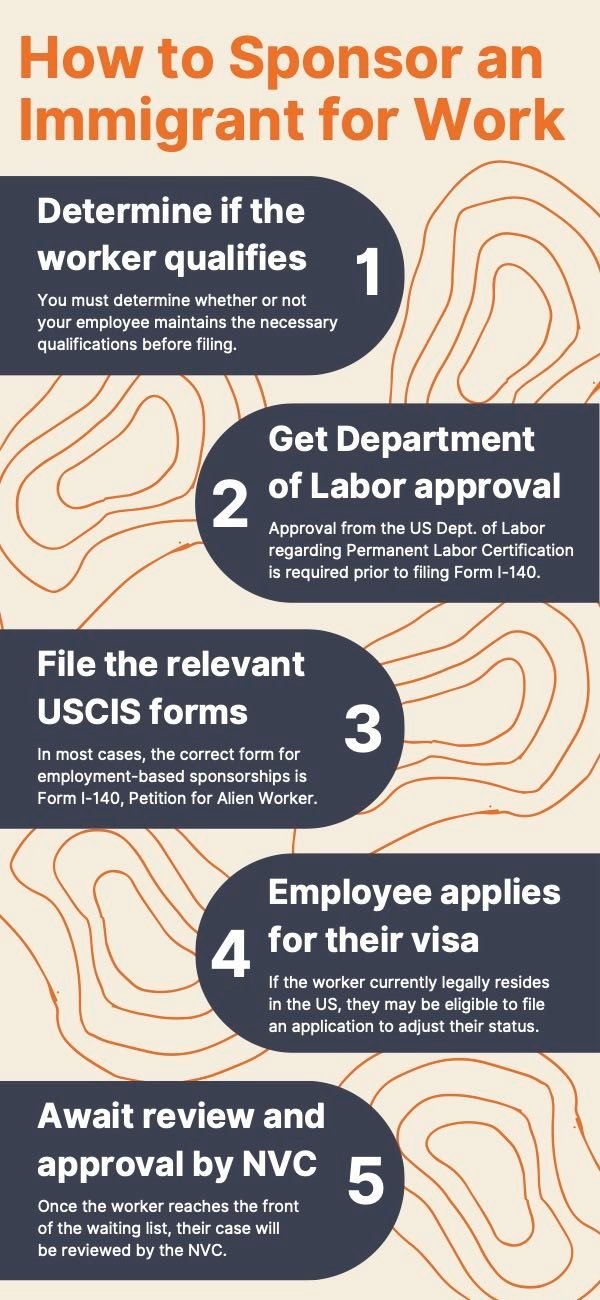
Permanent employment sponsorship may be available to workers who qualify for an immigrant visa category. In many standard EB-2 and EB-3 cases, the employer first obtains a prevailing wage determination and completes required recruitment and labor certification steps before filing Form I-140 with USCIS.
Not every employment-based case follows the same process. Certain categories may qualify for different procedures or exceptions, and some applicants may be able to self-petition under specific rules. The applicable category must be established before deciding which steps are necessary.
EB-2
Generally covers qualifying professionals with advanced degrees or individuals with exceptional ability, subject to the category’s rules. Certain applicants may seek a national interest waiver if they qualify.
EB-3
Generally covers qualifying skilled workers, professionals, and other workers who meet the relevant requirements.
Green card outcome
An approved employer petition does not by itself guarantee that an immigrant visa or green card is immediately available or ultimately granted.
How Does Employment Sponsorship Work in the United States?
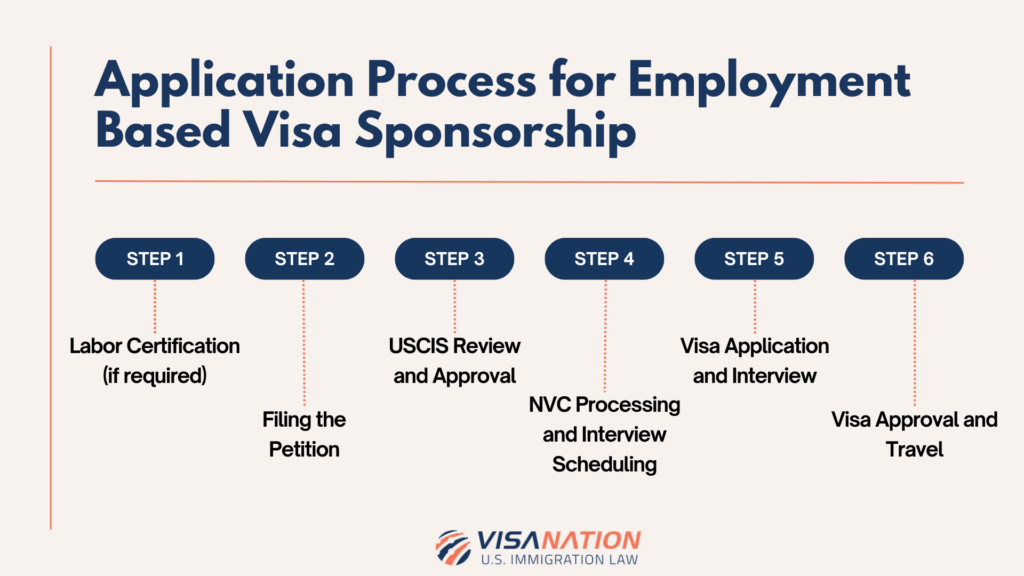
The process usually begins with a suitable job and an employer willing to sponsor the worker. The exact order of the remaining steps depends on the visa category. Some applications require Department of Labor action before USCIS can review the employer’s petition, while others follow different procedures.
The following sequence explains the common stages. It is not a universal checklist, because some steps may not apply to every category and certain applications require additional evidence or procedures.
Source: lawsb.com
Step 1: Find a suitable job
Look for a real position that matches your skills and qualifications. Check whether the employer is willing and legally able to sponsor workers under the relevant category.
Step 2: Confirm the visa category
The employer and worker should determine which category fits the job, the applicant’s background, and the intended duration of employment.
Step 3: Complete required labor procedures
Where required, the employer obtains a labor certification or completes another Department of Labor process. The rules differ for temporary and permanent employment.
Step 4: File the appropriate petition
The employer generally files Form I-129 for many temporary worker categories or Form I-140 for many employment-based immigrant cases, subject to the applicable category and exceptions.
Step 5: Wait for government review
USCIS may approve or deny the petition, reject an incomplete filing, or request additional evidence. A filing receipt is not the same as approval.
Step 6: Complete any required visa or status process
Depending on the applicant’s location and circumstances, the next step may include a visa application and interview abroad or an eligible change or extension of status in the United States.
Step 7: Confirm work authorization
Before beginning work, confirm that the worker has the required authorization and that the employment is permitted under the approved category and applicable rules.
What Documents May Be Needed?
The required documents vary by visa category and personal circumstances. Employers may need to provide business records, job descriptions, wage information, and evidence that the position meets program requirements. Workers may need to provide identity documents, educational records, employment history, and proof of qualifications.
Applicants should follow the current instructions for the specific forms involved. Submitting a large collection of unrelated documents does not replace the need to provide the correct evidence for each requirement.
Identity documents
A valid passport and other identity records when required for the relevant application.
Education and experience
Degrees, transcripts, professional licenses, employment letters, or other records that establish the qualifications required for the job.
Job information
The job title, duties, work location, wage, employment terms, and other details relevant to the visa category.
Immigration records
Existing visa documents, status records, approval notices, or prior immigration information when applicable.
What Happens After Approval?
Approval of an employer petition is a major step, but it may not be the last one. A worker outside the United States may still need to apply for a visa, attend an interview, and satisfy admission requirements. A worker already in the country must confirm whether the approved filing grants the requested change or extension of status.
Do not begin work merely because the employer says that paperwork has been submitted. Check the actual approval notice, the worker’s current status, and the rules that govern when employment may begin. Certain categories have specific exceptions, so the correct answer depends on the facts of the case.
Review the approval notice
Check the employer, classification, validity dates, and other terms that apply to the case.
Follow consular instructions
If applying abroad, use the relevant U.S. embassy or consulate’s official instructions for the visa application.
Keep copies
Maintain copies of approval notices, immigration documents, and relevant employment records.
How to Find Jobs That Offer Visa Sponsorship
The best way to find employment sponsorship is to search for genuine vacancies, check each employer’s sponsorship policy, and apply for positions that match your qualifications. A company may sponsor some roles but not others, so its general reputation does not prove that it will sponsor a particular applicant.
Start with official company career pages and reputable job boards. Search using terms such as visa sponsorship, H-1B sponsorship, employment-based immigration, or relocation and immigration support. Treat these phrases as search tools, not proof that a specific position is eligible for sponsorship.
Source: fibilaw.com
Search company career pages
Review job descriptions and application instructions. If sponsorship is not addressed, ask the recruiter whether the employer will consider it for the role.
Use focused search terms
Combine your occupation with terms such as visa sponsorship or employer-sponsored work visa to find potentially relevant openings.
Review official company information
Check the employer’s legal name, business website, contact information, and the consistency of the vacancy details.
Contact recruiters directly
Ask whether the company supports the specific visa category that may fit your circumstances and whether the role is open to applicants who need sponsorship.
Prepare a focused resume
Highlight relevant skills, work results, qualifications, licenses, and experience. State your current work authorization accurately.
Which Industries May Offer Sponsorship?
Sponsorship opportunities can arise in technology, engineering, research, health care, higher education, agriculture, hospitality, and other fields. However, the presence of a job in one of these industries does not mean that every position qualifies for an employment visa.
For example, a specialized engineering role may fit the requirements of a particular professional visa category, while a seasonal farm job may fall under a temporary agricultural program. The actual job duties and program rules matter more than the industry label alone.
Technology and engineering
Some employers consider sponsorship for qualified software developers, engineers, data specialists, and other workers when the role and applicant meet the relevant requirements.
Universities and research
Eligible institutions may recruit international faculty, scientists, and researchers under suitable employment or exchange categories.
Agriculture and seasonal work
Qualifying employers may use temporary worker programs for agricultural or nonagricultural jobs that meet the specific seasonal or temporary labor rules.
Health care
Some health care roles may qualify for employment sponsorship, but professional licensing, educational requirements, and category-specific immigration rules can affect eligibility.
Questions to Ask Before Applying
Ask clear questions early so you do not spend months pursuing a role that cannot meet your immigration needs. A recruiter should be able to explain the company’s general policy, although detailed legal eligibility may require review by an immigration professional.
Do not assume that a company sponsors workers because it has hired foreign nationals in the past. Sponsorship policies may differ by job, location, business unit, and immigration category.
Does this specific role offer sponsorship?
Confirm whether the employer is willing to sponsor the position you are applying for.
Which visa category is being considered?
Ask which category the employer expects to use and whether the role appears to meet its basic requirements.
Who handles the filing?
Find out whether the employer uses an internal immigration team or a qualified outside attorney.
What costs may I need to pay?
Request a clear explanation of fees and expenses, including any amounts the employer is legally required to cover.
Who Qualifies for Employment Sponsorship?
There is no single qualification standard for every sponsored worker. Eligibility depends on the visa category and the specific job. A worker may have strong qualifications but still be ineligible for a particular visa if the job, employer, or other required conditions do not fit the program.
Some categories focus on specialized education and professional duties. Others concern temporary labor needs, international company transfers, or individuals with extraordinary ability. Permanent employment categories have their own education, experience, job offer, and labor certification rules.
Source: lawsb.com
Relevant education or training
Some professional categories require a degree or equivalent qualifications that relate to the job. Other categories use different standards.
Suitable work experience
The applicant may need to show prior experience, specialized knowledge, professional achievement, or other skills relevant to the category.
A qualifying employer and job
The employer and position must satisfy the rules for the intended immigration classification.
Required licenses
Certain occupations require state or professional licenses before the worker can perform regulated duties.
Compliance with immigration rules
The applicant must meet applicable requirements involving admission, status, documentation, and other eligibility factors.
Can You Get Sponsorship Without a College Degree?
Yes, some employment-based immigration categories do not require a college degree. However, a person without a degree must still meet the rules for the specific category and position. For example, certain EB-3 skilled worker or other worker cases use different criteria, while the H-1B specialty occupation category has specific degree-related requirements.
Work experience may help establish eligibility where the law permits experience or other qualifications to count. It cannot automatically replace a degree when the selected visa category requires one. The employer and worker should review the exact criteria before proceeding.
Check the category first
Do not assume that all work visas require a bachelor’s degree or that every experienced worker qualifies without one.
Gather proof of skills
Keep employment records, training certificates, licenses, and other evidence relevant to the job requirements.
Can an Employer Sponsor Someone Already in the United States?
Potentially, yes. A qualifying employer may be able to petition for a worker who is already in the United States. Whether the person can change status, extend status, transfer employment, or begin working while a filing is pending depends on the existing status and the specific category.
A pending petition does not automatically authorize employment. Some categories have rules that permit certain workers to begin or continue employment after a qualifying filing, while others require approval first. Applicants should confirm their exact situation before changing jobs or starting work.
Review current status
Check the current immigration classification, authorized stay, and any work restrictions.
Confirm timing
Ask when the new employer’s petition must be filed and when work may legally begin.
How Much Does Employment Sponsorship Cost?
The cost of employment sponsorship varies by visa category, filing type, employer size where relevant, and the details of the case. There is no single fee that applies to all sponsored workers. Government filing fees, visa application fees, legal services, document preparation, and other expenses may be involved.
The employer and worker should identify which costs apply before the process begins. Some employment-related immigration rules require the employer to cover particular expenses, and an employer cannot lawfully shift every cost to the worker simply because the worker agrees. The rules vary by program and fee type.
For example, certain H-1B employer expenses are subject to specific payment requirements under Department of Labor rules. Permanent labor certification also has employer responsibilities. Applicants should not assume that every fee can be charged to them or that every employer must pay every expense.
Source: lawsb.com
Government filing fees
Petitions and applications may have filing fees set by the relevant agency. Amounts can change, so check the current official fee schedule before filing.
Visa application fees
Workers applying for a visa abroad may need to pay the applicable visa application fee, subject to the category and current rules.
Legal fees
An employer or worker may use an immigration attorney. Who pays these fees depends on the arrangement and any legal requirements that apply.
Document expenses
Translations, educational evaluations, courier services, and other supporting costs may arise in some cases.
Who Should Pay the Sponsorship Fees?
The answer depends on the expense and immigration program. Employers must comply with rules that assign certain costs to them. In some circumstances, workers may be responsible for other legitimate expenses, such as a personal visa application fee, depending on the applicable law and circumstances.
Before signing a contract, ask for a written breakdown of the charges. If the employer requests payment for recruitment, petition filing, or legal services, check whether that specific charge is lawful. A qualified immigration attorney or the relevant Department of Labor office can help clarify program-specific obligations.
Request an itemized list
Ask for the purpose, amount, recipient, and legal basis of each proposed payment.
Verify official fees
Compare government charges with current agency fee schedules rather than relying on informal messages.
Keep payment records
Save contracts, invoices, receipts, and messages about fees.
How Long Does Sponsorship Take?
There is no universal processing time for employment sponsorship. The overall timeline may include recruitment, labor certification, petition review, visa processing, and, for permanent immigration, waiting for an immigrant visa number when one is not immediately available.
Processing can change because of agency workloads, requests for evidence, appointment availability, annual visa limits, and case-specific issues. Some temporary work cases move through different steps from permanent employment cases. Check the current processing information for the relevant form and agency before making travel or employment plans.
Check each stage
Look at the processing information for the specific petition, labor application, or visa step that applies to your case.
Plan for delays
Avoid making nonrefundable travel arrangements or leaving existing employment based only on an estimated approval date.
Monitor official notices
Respond to requests and instructions within the stated deadlines and keep contact information current.
Employment Sponsorship Rights, Risks, and Common Mistakes
Employment sponsorship can create a valuable path to work in the United States, but it also involves legal duties and practical risks. Workers should understand the conditions attached to their authorization, while employers must follow the rules governing wages, recruitment, petitions, and employment records.
A sponsored worker does not lose all workplace rights because of immigration status. Applicable federal, state, and local employment protections may still apply. The exact protections depend on the law and the facts, so a worker who experiences unpaid wages, threats, or unsafe conditions should seek reliable help.
Source: reoplus.org
Mistake: Treating a job offer as work authorization
A job offer or petition receipt does not automatically allow a person to work. Confirm the required approval or authorization before starting.
Mistake: Assuming sponsorship guarantees a green card
Temporary work sponsorship and permanent residence are different processes. A future green card requires a separate legal basis and approval.
Mistake: Using the wrong visa category
The job duties and other facts must fit the chosen category. A visa designed for seasonal work may not fit a permanent professional position.
Mistake: Ignoring fee rules
Do not assume that the worker is responsible for every employer-related cost. Check the rules for each payment.
Mistake: Trusting every recruitment message
A professional-looking website, contract, or message does not prove that a job or sponsor is genuine.
How to Recognize a Sponsorship Scam
Scammers may promise guaranteed U.S. jobs, fast visa approvals, or permanent residence in exchange for an upfront payment. Some use real company names, copied logos, or fake immigration documents to make an offer appear legitimate.
Government agencies decide whether applications qualify for approval. An employer or recruiter cannot guarantee that decision. Be cautious if someone pressures you to pay immediately, refuses to identify the employer, asks you to send money through an unusual method, or tells you to provide false information.
Verify the company
Use contact information from the company’s independently located official website to confirm the vacancy and the recruiter’s role.
Check the job details
Look for a clear job title, duties, work location, wage, employer identity, and consistent contact details.
Avoid guaranteed approval claims
No recruiter can promise that USCIS or a consular officer will approve a case.
Protect personal information
Do not send sensitive identity or financial information to an unverified person.
Keep evidence
Save messages, contracts, payment requests, receipts, and other records if you suspect fraud.
What Happens If You Lose a Sponsored Job?
Losing a sponsored job can affect a worker’s immigration status, but the result depends on the visa category, current status, and the circumstances of the job ending. Some workers may have options to seek another qualifying employer, change status, or take other permitted steps, but deadlines and eligibility rules can be strict.
Do not assume that a grace period applies to every worker or that you can begin a new job immediately. A worker in this situation should promptly review the relevant immigration rules and seek advice from a qualified immigration attorney. Keep copies of termination records, pay statements, approval notices, and other relevant documents.
Check your authorized period
Review your status documents and the rules that apply after employment ends.
Ask about new employment
Confirm whether a new employer can file a petition and when you may legally begin working.
Seek timely legal advice
Get advice before taking steps that could affect your immigration status or future eligibility.
How to Prepare for an Employment Sponsorship Application
Preparation helps workers and employers avoid delays caused by missing records or incorrect assumptions. Before beginning the process, confirm the job details, the proposed visa category, the employer’s willingness to sponsor, and the evidence needed to support the application.
A simple checklist can help you organize the next steps without treating every case as identical. Use the current government instructions for the selected category to determine which items are required and which are not relevant to your situation.
Source: lawsb.com
Confirm the job offer
Obtain clear details about the position, employer, location, duties, compensation, and expected start date.
Discuss the sponsorship plan
Ask the employer which immigration category it expects to use and who will manage the filing.
Collect qualifications
Gather relevant degrees, certificates, licenses, employment letters, and other evidence requested for the case.
Review your immigration history
Provide accurate information about prior visas, entries, status changes, and any relevant immigration applications.
Review costs and deadlines
Confirm applicable fees, employer responsibilities, required dates, and any filing or interview deadlines.
Use official information
Check USCIS, the Department of Labor, the Department of State, and the appropriate U.S. embassy or consulate for current requirements.
Where Can You Find Official U.S. Immigration Information?
USCIS explains petition requirements, immigration forms, eligibility, and case procedures. The Department of Labor provides guidance on labor certification and employment protections. The Department of State explains visa applications and consular processing for applicants who need a visa abroad.
Start with the agency responsible for the step you need to complete. Use current instructions rather than relying on an old blog post or an informal social media answer. If your case involves complicated immigration history, a prior denial, job loss, or uncertainty about status, consult a qualified U.S. immigration attorney.
USCIS
Use uscis.gov for immigration petitions, forms, eligibility information, and case procedures.
U.S. Department of Labor
Use dol.gov and flag.dol.gov for applicable employment rules, labor certification, and foreign labor program information.
U.S. Department of State
Use travel.state.gov for visa categories, application instructions, documentation, and consular guidance.
U.S. embassies and consulates
Check the official website of the relevant post for local appointment procedures and visa interview instructions.
Frequently Asked Questions
Q
What does sponsorship for employment mean?
Sponsorship for employment means that an employer supports a foreign worker’s application for permission to work in a country. In the United States, this may involve filing an immigration petition, completing required labor procedures, and providing evidence about the job and worker. The process depends on the immigration category.
Q
Can I get a job in the USA without sponsorship?
Yes, if you already have valid authorization that allows you to perform the job without employer sponsorship, you may not need a new employer-sponsored visa. The rules depend on your status and work authorization. Some people have employment authorization that is not tied to one sponsoring employer, while others have restrictions.
Q
Which U.S. companies sponsor foreign workers?
Companies in technology, engineering, research, health care, education, and other fields may sponsor eligible foreign workers. Seasonal employers may also use qualifying temporary worker programs. Sponsorship policies vary by company and job, so confirm whether the specific vacancy supports the immigration category you need.
Q
Does employment sponsorship guarantee a visa?
No. An employer can support an application, but it cannot guarantee government approval. The worker and employer must meet the relevant legal requirements, and the appropriate agency or consular officer must make the required decision. Additional steps may remain even after an employer petition is approved.
Q
Can I change employers after receiving a sponsored work visa?
Sometimes, but the rules depend on the visa category and the worker’s current status. Many employer-sponsored categories have specific employer or job conditions. A new employer may need to file a petition, and the worker may need approval before starting the new job. Some categories provide limited exceptions, so confirm the rules before changing employers.
Q
How much do I need to pay for employment sponsorship?
There is no single cost for all employment sponsorship cases. Expenses can include government filing fees, visa application fees, legal services, and document preparation. Some fees must be paid by the employer under the applicable rules. Ask for an itemized breakdown and verify each charge before making a payment.
Q
Can an employer sponsor a worker without a bachelor’s degree?
Yes, certain immigration categories do not require a bachelor’s degree. However, the worker must meet the specific education, experience, job, and employer requirements for that category. The H-1B specialty occupation category has particular degree-related rules, so it is not suitable for every position or applicant.
Q
How long does it take to get employment sponsorship in the United States?
The timeline varies by visa category and case. Some processes involve labor certification, an employer petition, visa processing, or a wait for an available immigrant visa number. Requests for evidence, government workload, and appointment availability can add time. Check the current official processing information for each stage before planning your start date.
Q
Can I apply for a green card through my employer?
You may qualify for employment-based permanent residence if you meet the requirements of a relevant immigrant category. Many EB-2 and EB-3 cases involve employer sponsorship and labor certification, although some exceptions and alternative routes exist. An approved petition does not always mean that a green card is immediately available.
Q
How can I tell if an employment sponsorship offer is real?
Verify the employer through its official website and independently obtained contact details. Confirm the job, salary, location, recruiter, and proposed visa category. Be cautious of guaranteed visa approval, pressure to pay immediately, unusual payment methods, or requests to submit false documents. Never rely only on a logo, email signature, or recruitment message.
✦ Wrapping Up
Conclusion
Sponsorship for employment is a process through which a qualifying employer supports a foreign worker’s application to work in the United States. It can involve temporary work visas or permanent employment-based immigration, depending on the job and the worker’s eligibility. The employer’s responsibilities, required documents, fees, and processing steps vary by category.
For job seekers, the best first step is to identify a genuine position and confirm that the employer is willing to sponsor the relevant immigration category. Review the official requirements, gather accurate records, and check when you may legally begin working. Never assume that a job offer or pending petition provides automatic work authorization.
For complicated cases, including prior immigration problems, uncertain status, job loss, or questions about who must pay particular fees, seek guidance from a qualified U.S. immigration attorney or the relevant government agency. Careful preparation can help you avoid common errors and make informed choices about your employment options.
💡 Key Takeaway
Start by checking your current work authorization, identifying the visa category that may fit your intended job, and asking prospective employers whether they sponsor that specific category. Verify every requirement through USCIS, the U.S. Department of Labor, or the U.S. Department of State before paying fees or making employment and travel plans.