

Getting a Malaysia work permit rejection is genuinely devastating. You’ve spent money, waited months, maybe already told your family you’re going — and then it doesn’t happen. It’s a horrible feeling.
Thank you for reading this post, don't forget to subscribe!But here’s what you need to know: most rejections are avoidable. And even if you’ve already been rejected, many of them are fixable.
Let’s go through the most common reasons and — more importantly — what you can actually do about each one.
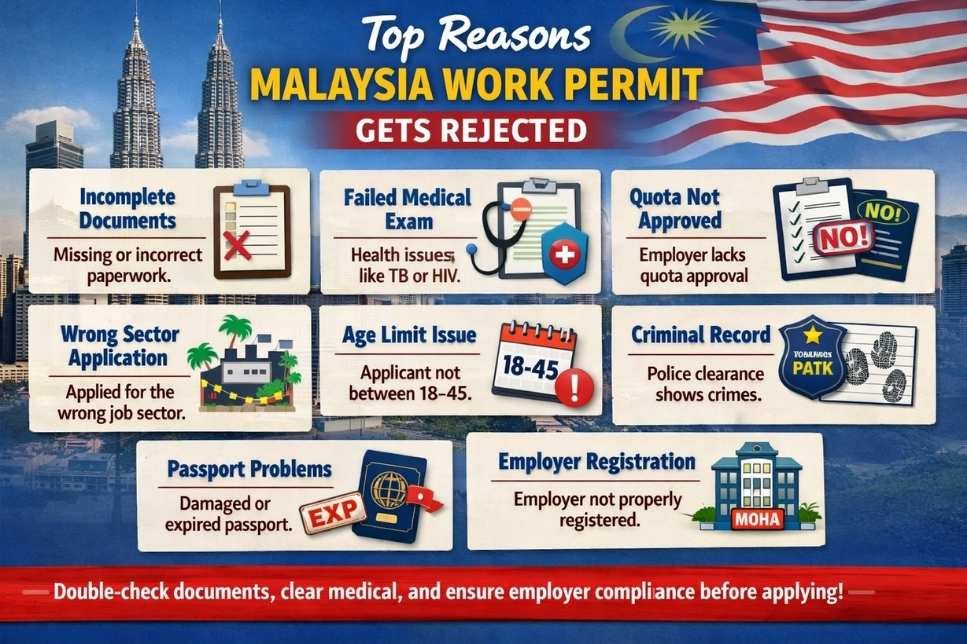
Top Reasons Malaysia Work Permit Gets Rejected
1. Incomplete or Incorrect Documents
This is the single most common reason. A missing document, a document that’s expired, a name that doesn’t match between passport and NID — any of these can cause a rejection.
What to do: Before your employer submits the FWCMS application, double-check every single document against the official requirements list. Make sure names are spelled exactly the same across all documents.
2. Failed FOMEMA Medical Examination
If your FOMEMA medical comes back with a condition that doesn’t meet Malaysia’s immigration health requirements — tuberculosis, HIV, certain other conditions — the application is rejected.
What to do: Before starting the whole process, get a basic health check in Bangladesh. If you have a treatable condition, treat it first. If you have a chronic condition, speak to a FOMEMA-approved doctor about whether you’re likely to pass.
3. Employer Quota Not Approved
Your Malaysian employer needs an approved foreign worker quota before they can apply for your permit. If they applied without this, or their quota is under review, your application gets stuck or rejected.
What to do: Ask your employer to confirm they have active quota approval before they start your application. Don’t let them rush through this step.
4. Wrong Sector Application
Bangladesh workers have restrictions on certain permit types in certain sectors. For example, TEP for Bangladeshi workers is mainly available for plantation sector. If the employer applied for a TEP in manufacturing without proper quota approval, it can be rejected.
What to do: Your employer must apply for the correct permit type for your specific sector. This is their responsibility, but you should understand the system too.
5. Age Outside the Allowed Range
For TEP, you must be between 18 and 45 years old. Applications outside this range are automatically rejected.
What to do: Not much you can do about age. If you’re over 45, discuss with your employer whether an Employment Pass is a possibility based on your qualifications.
6. Criminal Record / Police Clearance Issues
A criminal history that shows up in your police clearance certificate — even minor offences — can lead to rejection.
What to do: Get your police clearance before starting the process and review it carefully. If there are any issues, consult a legal professional about whether they can be addressed.
7. Passport Issues
Passport with less than 18 months validity, passport damage, or mismatched information between old and new passport.
What to do: Renew your passport before applying. Make sure the new passport number is correctly reflected in all documents.
8. Employer Registration Issues
If the Malaysian employer is not properly registered with MOHA, or if there are compliance issues with their business registration, applications from that employer may be rejected.
What to do: Ask your employer for their company registration number and MOHA registration status before committing to the process.
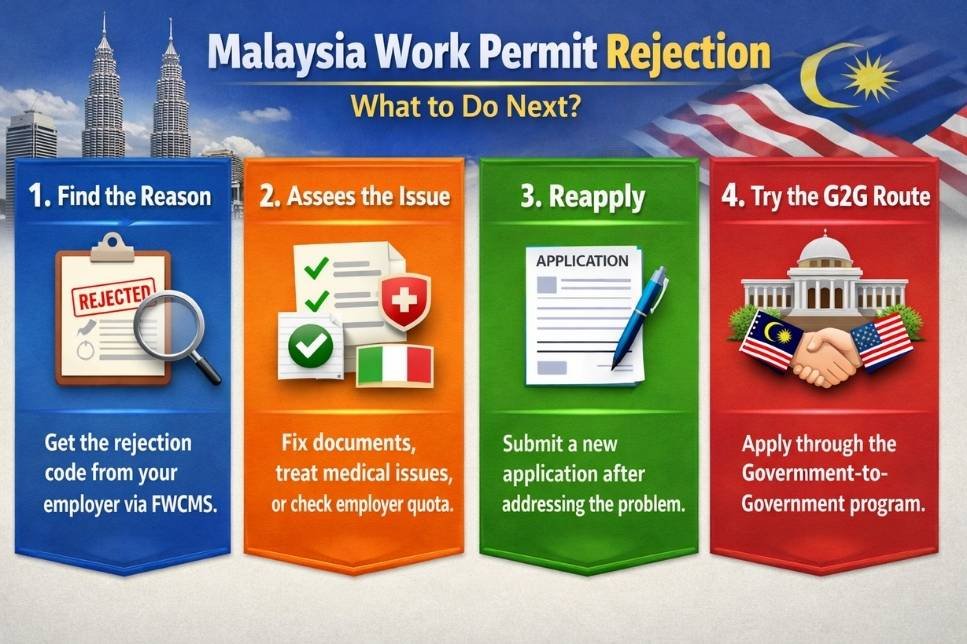
What to Do After a Malaysia Work Permit Rejection?
Step 1: Find out the specific rejection reason. Your employer should receive a rejection reason code through FWCMS. Ask for this — it’s essential for your next step.
Step 2: Assess whether it’s fixable. Document issues? Fix them. Medical failure? Treat the condition if possible. Employer quota? The employer needs to sort this.
Step 3: Reapply. Most rejection reasons can be addressed and a fresh application submitted. There’s no permanent ban on reapplying in most cases — unless you have a serious criminal record or a medical condition that cannot be treated.
Step 4: Consider the G2G route. If you’ve had issues through private agencies, consider applying through the Government-to-Government channel. This is more structured and often has fewer complications.
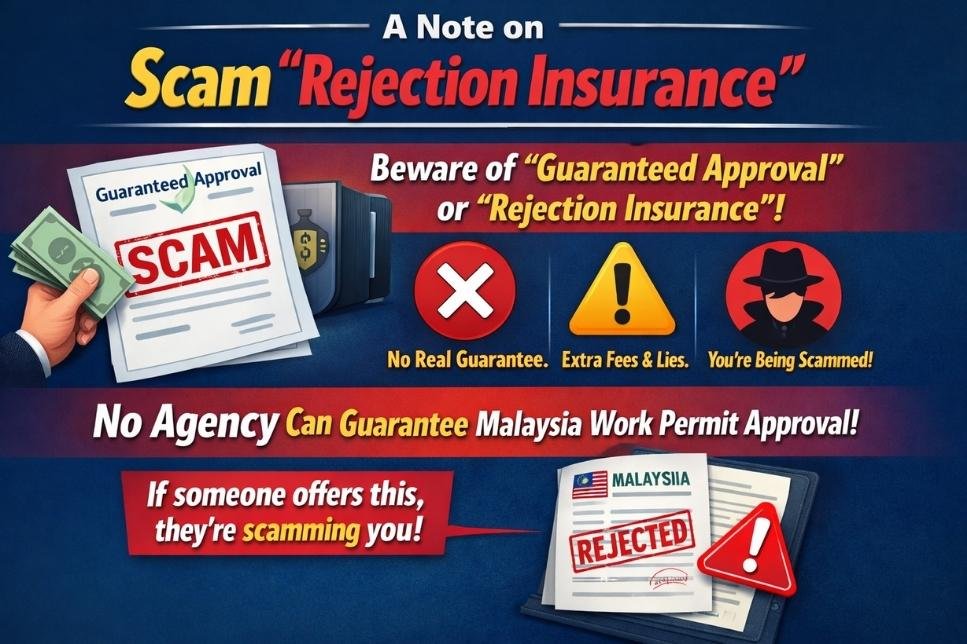
A Note on Scam “Rejection Insurance”
Some dishonest agencies offer “rejection insurance” or “guaranteed approval” for extra fees. This is not a real thing. No agency can guarantee Malaysia work permit approval. If someone is selling this to you, they’re scamming you.
What If My Visa Gets Rejected for a Different Reason?
The reasons above are specific to Malaysia work permit applications. If you’re dealing with a visa rejection for a different country or visa type, check out our general guide on why visas get rejected and what to do next for broader guidance on appeals, reapplication, and common mistakes to avoid.
Also read: Malaysia Work Permit Complete Guide 2026 | [How to Avoid Work Visa Scams] [how to appeal a Schengen visa refusal]
Last Updated: June 2026
Comments are closed.