

Every year, thousands of Bangladeshi workers lose their savings — sometimes their family’s entire life savings — to fake recruiting agents promising jobs in Malaysia, Saudi Arabia, the UAE, and other countries. The visa never arrives, the “employer” never existed, and the agent disappears with the money.
Thank you for reading this post, don't forget to subscribe!Work visa scams are one of the most common and most damaging frauds targeting migrant workers today. This guide walks you through exactly how these scams work, the warning signs to watch for, and the steps you can take to protect yourself before you hand over a single taka.
Why Work Visa Scams Are So Common
Legitimate overseas job opportunities are real and valuable — remittances from workers abroad are a major part of Bangladesh’s economy. But that same demand creates an opening for fraud. Scammers exploit:
- Urgency and desperation. Job seekers under financial pressure are less likely to slow down and verify details.
- Complex, unfamiliar processes. Most first-time applicants don’t know what a legitimate BMET clearance, work permit, or embassy attestation actually looks like — so a fake one is hard to spot.
- Trust in local networks. Many scams spread through word-of-mouth referrals from a “cousin’s friend” or a local broker who seems trustworthy simply because he’s known in the village.
- Cash-based, informal payments. Fees paid in cash, with no receipt or contract, are nearly impossible to trace or recover.
Common Types of Work Visa Scams
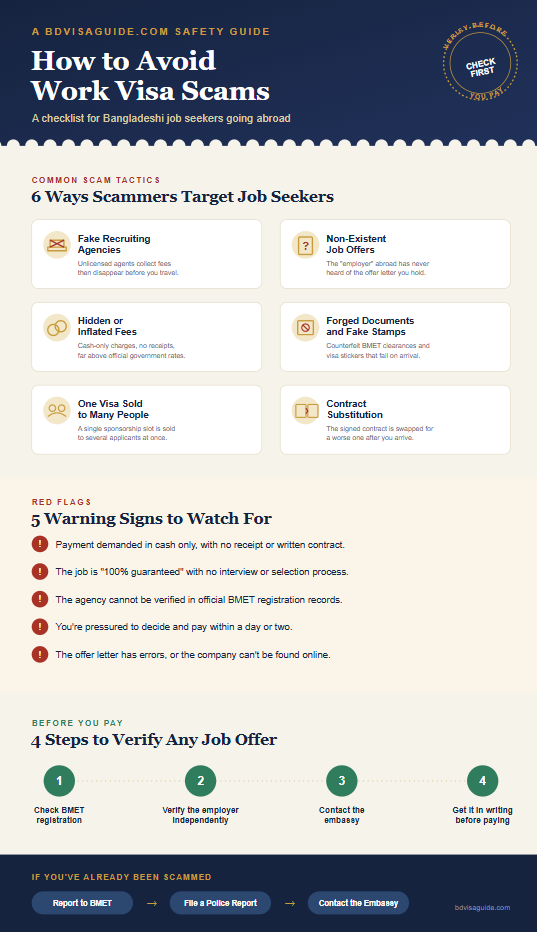
1. Fake Recruiting Agencies
Unlicensed agents set up temporary offices, collect “processing fees,” and vanish once enough people have paid. Some even use names similar to real, licensed agencies to appear legitimate.
2. Non-Existent Job Offers
You’re shown a glossy offer letter and told a company abroad is waiting for you. In reality, the company doesn’t exist, or it exists but has never heard of the offer.
3. Visa Fee Fraud
You’re asked to pay for “visa processing,” “medical tests,” “embassy fees,” or “flight booking” far above the actual government-set cost — with no itemized receipt, and often before any real application has been submitted.
4. Forged Documents and Fake Stamps
Some scammers provide forged BMET clearance certificates, fake visa stickers, or counterfeit work permits that look convincing but will fail the moment you try to travel or the moment authorities check them abroad.
5. Visa Trading / “Selling” a Sponsorship
An agent claims to have a spare work visa slot from a real company abroad and sells it to multiple people at once, knowing only one (or none) of them will actually get to use it.
6. Contract Substitution
You sign one contract in Bangladesh with a clear salary and job role, then are made to sign a completely different contract — often with lower pay or different conditions — after you arrive.
Red Flags to Watch For
Be cautious if you notice any of the following:
- You’re asked to pay entirely in cash, with no receipt or written agreement.
- The agent guarantees the job “100%” with no interview and no formal selection process.
- The agency isn’t listed or can’t be verified in BMET’s official registration records.
- You’re pressured to decide and pay within a day or two, “before the slots run out.”
- The offer letter has spelling errors, inconsistent company details, or a company name you can’t find online.
- The salary or benefits sound significantly better than similar real job postings for the same role and country.
- The agent avoids giving you a physical office address, or the office has no signage, license certificate on display, or other verifiable presence.
- You’re told not to discuss the details with anyone, including family or other applicants.
If two or more of these apply to your situation, stop and verify before proceeding.
How to Verify a Job Offer or Agency Before You Pay
- Check BMET registration. Every legal recruiting agency in Bangladesh must be registered with the Bureau of Manpower, Employment and Training (BMET). Ask for the agency’s license number and verify it directly through BMET rather than trusting a photocopy of a certificate. For the full registration and clearance process, see our step-by-step BMET clearance guide.
- Verify the employer independently. Search for the company’s official website, look it up on LinkedIn, and if possible, call the company directly using a number you find yourself — not one given to you by the agent — to confirm the job offer is real.
- Contact the relevant embassy or high commission. Bangladesh’s embassies and high commissions abroad, as well as destination-country embassies in Dhaka, can often confirm whether a sponsoring company is legitimate and registered to hire foreign workers.
- Cross-check the destination country’s official work permit process. For example, if you’re heading to Malaysia, compare what you’re being told against our guide on Malaysia work permits for Bangladeshi workers, including realistic costs and processing times. If what you’re being charged or promised doesn’t match, ask why.
- Insist on a written contract before paying anything. A legitimate agency will provide a written agreement outlining the job role, salary, working hours, contract duration, and all fees — before you’re asked for money.
- Never pay in cash without a receipt. Use bank transfers or other traceable payment methods whenever possible, and keep every receipt, message, and document related to the transaction.
- Talk to workers who have actually used the same agency. A real agency will have a track record you can verify with people outside the agent’s own circle of contacts.
Safe Steps Before You Pay Any Money
- Get everything in writing — job role, salary, contract length, and every fee — before any payment.
- Ask for an official receipt for every payment, with the agency’s registered name and license number on it.
- Compare the total fees being asked against the government-published fee structure for that country and job category.
- Never hand over your original passport or NID as “collateral” without a legally documented reason and a copy for your own records.
- If in doubt, bring a trusted family member or community leader with relevant experience to any meeting with the agent.
What to Do If You’ve Already Been Scammed
If you believe you’ve been the victim of a work visa scam:
- Report to BMET immediately. BMET has a dedicated complaint process for fraudulent recruiting agencies and can take formal action against licensed agencies that violate the law, as well as flag unlicensed operators.
- File a complaint with the local police, providing any receipts, contracts, messages, or recordings you have as evidence.
- Contact the Bureau’s vigilance or anti-fraud unit, which specifically handles migration-related fraud cases.
- Warn others in your community so the same agent cannot target more victims using the same scheme.
- If you already traveled and discovered the job or contract was fraudulent abroad, contact the nearest Bangladesh embassy or high commission immediately for emergency assistance.
For a broader look at what to do if a visa application itself is rejected or something goes wrong in the process, see our guide on why visas get rejected and what to do next.
Final Takeaway
The single most effective protection against a work visa scam is simple: slow down and verify independently before you pay. Legitimate agencies and employers will never punish you for asking questions, requesting documentation, or taking time to confirm details. Pressure to rush, secrecy, and cash-only payments are the clearest signs that something is wrong.
Migrating for work can be a life-changing, positive step — but only when it’s done through a verified, legal process. When in doubt, verify twice before you pay once.