
Planning your move to Australia and figuring out how to apply for a working visa can feel like decoding a secret language. It’s a smart move to get clear on the process, especially when your future career and life are on the line. We've broken down what you need to know to make this journey smoother.
Thank you for reading this post, don't forget to subscribe!Getting a visa isn't just about filling out forms; it's about meeting specific criteria. For instance, many skilled worker visas require a competent level of English, often demonstrated by an IELTS score of at least 6.0 in each band, as per standards set by the Department of Home Affairs. Let's dive into the different aspects of applying for your Australian working visa.
Understanding Australian Working Visas: Your First Step

It's easy to feel overwhelmed by the sheer number of visa options available when you look at immigrating to Australia. The Australian government offers various pathways, each designed for different circumstances, skilled occupations, and lengths of stay. Think of it less as a single application and more like choosing the right key for a specific lock.
Your Nationality and Eligibility
Your home country plays a significant role in determining which visa subclasses you might be eligible for and what specific requirements you'll need to meet. Some nationalities may have reciprocal agreements or specific arrangements that simplify certain aspects of the application, while others might face more stringent checks. It's also about how your qualifications and work experience are recognized within Australia's framework.
Your Skills and Occupation
Australia actively seeks skilled workers to fill positions in high-demand industries. The first critical step is often identifying if your occupation is on one of Australia's official skilled occupation lists. These lists are regularly updated based on the nation's labor market needs. If your job is listed, it generally means there's a recognized need for your skills and you can move forward with assessing your eligibility for a points-tested visa.
Your Intended Stay (Temporary vs. Permanent)
Are you looking to work in Australia for a few years, or is your goal to settle there permanently? This is a crucial distinction that dictates the type of visa you should pursue. Temporary work visas, like the Temporary Skill Shortage (TSS) visa (subclass 482), allow you to live and work for a set period and can sometimes lead to permanent residency. Permanent residency visas, such as the Skilled Independent visa (subclass 189) or Skilled Nominated visa (subclass 190), offer a direct path to long-term settlement.
The Core Requirements for Most Working Visas
While specific visa subclasses have unique criteria, several core requirements are common across most Australian working visas. Meeting these fundamental needs is essential before you even consider submitting an application. This includes demonstrating your ability to contribute economically and fit into Australian society.
Skills Assessment and Occupation Lists
Before you can truly assess your eligibility for many skilled migration programs, you'll need to have your skills officially assessed. This means a designated assessing authority in Australia will evaluate your qualifications, work experience, and any relevant licenses against Australian standards for your nominated occupation. This assessment is crucial because it determines if your skills are comparable to an Australian-qualified worker in that field. The outcomes of these assessments directly influence your ability to be invited to apply for a visa.
You'll typically need your nominated occupation to feature on relevant skilled occupation lists for the visa you're targeting, such as the Skilled Occupation List.
Navigating the Application Process: A Step-by-Step Flow
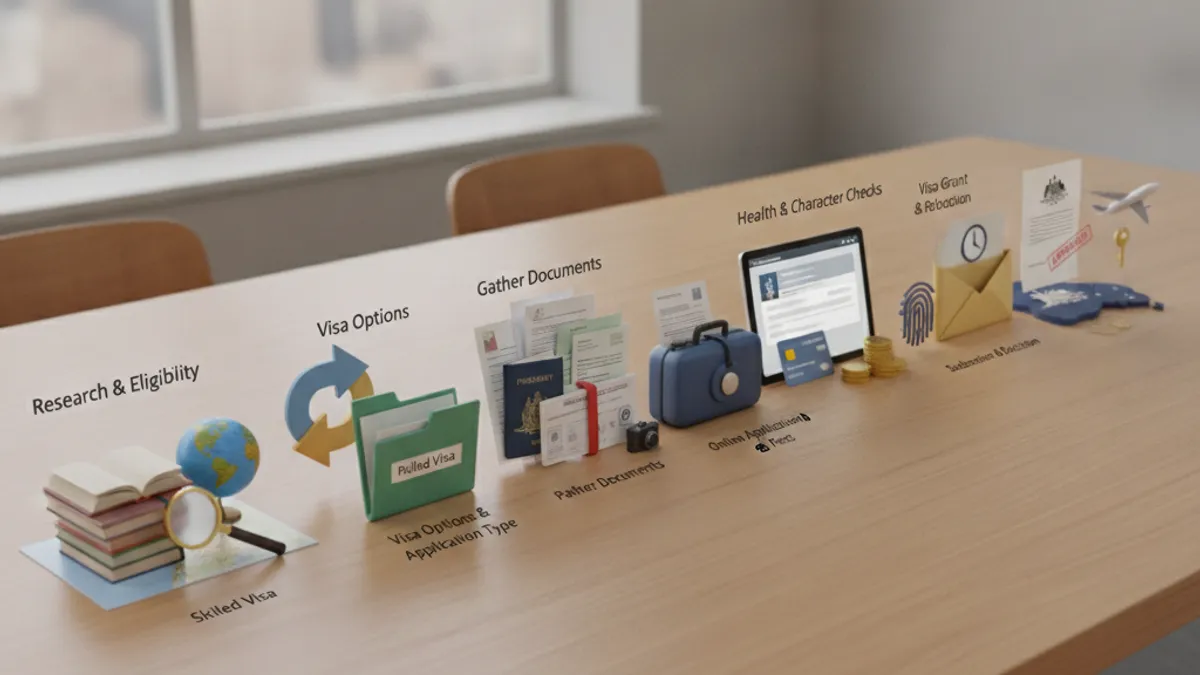
Applying for a working visa in Australia generally follows a structured process managed by the Department of Home Affairs. While the exact steps can vary slightly depending on the visa subclass, understanding this general workflow will help you prepare and stay organized. It’s designed to ensure that applicants meet the necessary criteria for skilled migration and temporary work arrangements.
Step 1: Determine Your Visa Pathway
This is arguably the most important step. You need to figure out which visa subclass best suits your situation. It depends on factors like your age, your skills and qualifications, your work experience, your English language ability, and whether you have a job offer or a nomination from an Australian state or territory. The Department of Home Affairs website, for example, provides tools and information to help you explore options based on your circumstances.
For those aiming for long-term settlement, exploring permanent residency pathways like the Skilled Independent visa (subclass 189) or Employer Nomination Scheme (subclass 186) is key. If your goal is temporary work, the Temporary Skill Shortage (TSS) visa (subclass 482) is a common choice.
Step 2: Gather Your Documents
Once you've identified your likely visa pathway, you'll need to start collecting all the supporting documents. This is often the most time-consuming part of the process. You'll need to provide evidence of your identity, such as your passport and birth certificate. Proof of English language proficiency, typically through an approved test like IELTS or PTE Academic with specific score requirements in each band, is almost always required.
Documentation for your skills assessment, employment history with reference letters detailing your roles and responsibilities, and possibly evidence of funds to support yourself are also standard. As of 2026, the types of documentation required are expected to remain consistent, though specific thresholds might shift.
Step 3: Submit an Expression of Interest (EOI)
For many skilled migration visas, you don't apply directly. Instead, you first submit an Expression of Interest (EOI) through the SkillSelect system. This is not a visa application; it's an online statement of your interest in migrating to Australia under a specific skilled visa program. You'll provide details about your skills, qualifications, work experience, and other factors that contribute to the points-based system used to rank applicants.
The higher your points score, the more competitive you are.
Step 4: Receive an Invitation to Apply (ITA)
If your EOI meets the selection criteria and you score high enough on the points test, the Department of Home Affairs may invite you to lodge a formal visa application. Invitations are issued regularly, but the number of invitations and the minimum points score required can fluctuate based on government quotas and demand. Receiving an invitation means you are now eligible to apply for the specific visa subclass you expressed interest in. You'll typically have a limited time, often 60 days, to submit your full application after receiving an ITA.
Step 5: Lodge Your Visa Application
This is the main application stage. Once you have your Invitation to Apply (ITA), you’ll proceed to formally lodge your visa application online. You'll need to complete detailed application forms and upload certified copies of all supporting documents that were referenced in your EOI, plus any additional documentation requested by the Department of Home Affairs. This stage also involves paying the relevant visa application charge.
It’s essential to be thorough and accurate, so any errors or omissions don't lead to delays or even refusal of your application.
Common Pitfalls and Mistakes to Avoid
When applying for a working visa in Australia, even small mistakes can cause significant headaches, leading to delays or outright rejection. Being aware of these common pitfalls can save you a lot of stress and help ensure your application is as strong as possible when it’s submitted. Preparation and attention to detail are key here, so let’s look at what trips people up most often.
Incomplete or Incorrect Information
This is perhaps the most frequent reason for application delays or refusals. Applicants sometimes miss questions, provide answers that don't fully address what's being asked, or make typos that change the meaning of critical data. For example, incorrectly entering your date of birth or passport number can create immediate problems. Always double-check every field before submitting.
If a question asks for all countries of residence for the past 10 years, ensure you’ve listed every single one, no matter how short the stay.
Missing Documentation
Every visa subclass has a prescribed list of documents required for a valid application. Some applicants mistakenly think that if they submitted a document for their skills assessment, they don't need to include it again for the visa application. This isn't true; each application requires its specific supporting evidence. Failing to provide a certified copy of a birth certificate, a required employment reference letter, or evidence of English proficiency means your application will be considered incomplete.
The Department of Home Affairs will usually issue a request for further information, which adds time, but sometimes applications are refused outright if essential documents are missing initially.
Not Meeting Specific Visa Criteria
It sounds obvious, but many people underestimate the exact criteria for their chosen visa. For instance, a temporary work visa might have specific requirements about the nature of the job being full-time and requiring skills not readily available in the Australian workforce. Or, a points-tested visa might require you to achieve a minimum score on the English language test, say, a score of 7 in each band of the IELTS, which is a higher bar than some other visa types. It's vital to thoroughly read the eligibility criteria for the specific visa subclass before you begin the application.
Don't assume you qualify; verify it with official government sources.
Misunderstanding Visa Conditions
Once a visa is granted, it comes with a set of conditions that you must adhere to throughout your stay in Australia. These conditions can range from work restrictions (e.g., you can only work for your sponsoring employer on certain visas) to location restrictions or limitations on study. For example, under a Temporary Skill Shortage (TSS) visa (subclass 482) linked to a specific employer, changing employers without approval can breach your visa conditions and lead to cancellation. Understanding these conditions upfront is crucial to maintaining your lawful status in Australia.
Key Information: Costs, Timelines, and Processing
The financial and time investments for an Australian working visa can vary significantly, so it’s wise to have a realistic picture. These aren't usually quick, inexpensive processes, and understanding the potential costs and how long things might take helps in planning. It’s important to remember that figures can change, so always check the official Department of Home Affairs website for the most current information.
Visa Application Fees
Visa application charges are a primary cost. For instance, the base application charge for the Temporary Skill Shortage (TSS) visa (subclass 482) can be substantial, often starting in the thousands of Australian dollars, and this figure can increase based on factors like the duration of the visa and whether it’s applied for onshore or offshore. Beyond the main fee, there are often additional costs. These can include charges for skills assessments, English language tests (which can be $300-$400 AUD each), health examinations, and police certificates.
Some applicants may also incur costs for migration agents or legal advice, which are entirely optional but can add significant expense.
Estimated Processing Times
Processing times for Australian working visas are highly variable and depend heavily on the specific visa subclass, the applicant's country of origin, and whether all required documentation is provided upfront. For skilled migration visas, processing can sometimes take between 12 to 24 months, or even longer in complex cases. Temporary visas might be processed faster, potentially in a few months, but again, this isn't guaranteed. For example, as of early 2024, processing times for Employer-Sponsored visas can range from 3 to 8 weeks for some streams, but others might see waits extending to 6 months or more.
It's crucial to check the Department of Home Affairs website’s published processing times for the specific visa subclass you're interested in applying for.
Points Thresholds for Invitations
For points-tested skilled migration visas, such as the Skilled Independent visa (subclass 189) or Skilled Nominated visa (subclass 190), your application is ranked based on a points system. This system awards points for factors like age, English language ability, skilled employment experience, educational qualifications, and whether you have a nominating state or territory. The Department of Home Affairs then invites the highest-scoring applicants to apply for a visa. The minimum points threshold required to receive an invitation can change with each invitation round and is influenced by the number of available places.
For instance, in recent invitation rounds, the required points for subclass 189 have often been in the range of 65 to 85 points. However, competition can drive this number higher, so aiming for as many points as possible is always advisable.
When to Seek Professional Help
While the Australian Department of Home Affairs provides extensive information online, the immigration system can be complex and unforgiving of errors. Deciding whether to engage a registered migration agent or an immigration lawyer is a personal choice, but it’s often a sensible route for many applicants. Professional assistance can clarify confusing aspects of the process, help identify the most suitable visa pathway, ensure all documentation is correctly prepared, and potentially expedite the application.
A registered migration agent, licensed by the Office of the Migration Agents Registration Authority (OMARA), can offer tailored advice based on your unique circumstances. They're trained to understand the nuances of immigration law and policy, which can be particularly valuable for complex cases involving skills assessments, health waivers, or character issues. For example, if you have a past criminal conviction or a significant medical condition, a professional can help you understand the likelihood of success and how best to present your case to meet the requirements. Engaging help is not mandatory, but it can provide peace of mind and a higher chance of a successful outcome, especially if you are unfamiliar with immigration procedures.
Your Decision Guide for Australian Working Visas
Ultimately, choosing and applying for an Australian working visa hinges on your personal circumstances, career goals, and future aspirations. This guide has laid out the general process, requirements, and potential challenges. Your next step is to carefully consider which visa subclass aligns best with your situation.
- For immediate work opportunities with employer backing: Look into the Temporary Skill Shortage (TSS) visa (subclass 482).
- If you have in-demand skills and want to live permanently without a specific job offer: Explore the Skilled Independent visa (subclass 189).
- If your skills are in demand by a particular state or territory: Consider the Skilled Nominated visa (subclass 190), which requires nomination.
- For established professionals sponsored by an Australian employer for permanent residency: The Employer Nomination Scheme (ENS) visa (subclass 186) is a strong option.
Always refer to the official Department of Home Affairs website for the most up-to-date information on eligibility criteria, visa subclasses, fees, and processing times, as these can change. A well-prepared application is key to a successful outcome.