
Planning a trip to Canada from the UK can raise a few questions, and one of the biggest is often about visas. So, do British citizens need a visa for Canada? For most travelers, the answer is simpler than you might think, revolving around a quick online authorization.
Thank you for reading this post, don't forget to subscribe!However, the specifics do matter, depending on your reason for visiting and how long you intend to stay. Canada's immigration system has different entry requirements, and understanding the basic rules, like the typical stay limit of six months for visitors, is key to a smooth journey.
The Quick Answer: Usually Not a Full Visa, But You Might Need an eTA

For the vast majority of British citizens planning a vacation or a short business trip to Canada, you won't need to go through the lengthy process of applying for a traditional visitor visa. Instead, you'll likely complete a straightforward online application for an Electronic Travel Authorization, or eTA. This system is designed to streamline entry for citizens of visa-exempt countries.
Think of the eTA as a digital permission slip linked to your passport, allowing you to board your flight or other transport to Canada. It’s a requirement for air travel only. If you arrive by land or sea, you typically don't need an eTA, but you must still arrive with a valid passport and meet Canada's admissibility requirements. Aggregate user feedback reports that the eTA application is generally quick and easy, often taking only minutes to complete.
What's an eTA and Why You Might Need It
An eTA is fundamentally an electronic authorization that allows foreign nationals from visa-exempt countries to enter Canada for temporary stays, such as tourism, business, or transit. Since January 2024, Canadian immigration policy has solidified the eTA as the primary entry method for many visitors. It's crucial to understand that an eTA is not a visa; it's a more advanced form of entry screening that predates your arrival.
The eTA is assessed when you apply, and if approved, it’s electronically linked to your passport. This authorization is typically valid for five years from the date it's issued or when your passport expires, whichever comes first. It allows for multiple entries into Canada, with each stay not exceeding six months. This flexibility is a significant advantage for frequent travelers.
For Who? The eTA User Group: Tourists, Business Visitors, Friends & Family
The eTA is primarily intended for individuals traveling to Canada for short-term purposes, and British citizens fall squarely into this category for most visits. If you’re heading to Canada for a holiday, to explore its stunning national parks or vibrant cities, the eTA is your ticket. Similarly, if you're attending business meetings, conferences, or exploring potential business opportunities, an eTA generally covers these activities.
This also extends to those visiting relatives or friends already residing in Canada. For students undertaking a short-term program of study, often defined as less than six months, an eTA may also be sufficient, though specific program details can influence this. Even if you are simply transiting through Canada on your way to another destination, an eTA is typically required if you are arriving by air. The Canadian government designs the eTA to facilitate legitimate short-term travel efficiently.
How Long? The Six-Month Rule
A key determinant of whether you need an eTA or a full visitor visa, or indeed no specific authorization beyond your passport, is the duration of your intended stay in Canada. For those traveling on an eTA, the maximum duration of stay for a single visit is generally set at six months. This timeframe is standard for most visitor visa entries as well, unless a longer period is explicitly granted by a border services officer upon arrival.
It’s important to understand that the six-month period is not an automatic right to stay for that exact duration. When you arrive in Canada, a border services officer will determine if you can enter and for how long. They assess your admissibility and your intentions, and they have the final say on the length of your authorized stay, which could be less than six months. If you wish to stay longer than initially permitted, you generally need to apply to extend your stay from within Canada before your authorized period expires.
Beyond the eTA: When You Do Need a Visitor Visa

While the eTA is the common route for most British visitors, there are specific circumstances when a full visitor visa is required instead. These situations often involve more complex travel intentions or a history that might require closer scrutiny by Canadian immigration authorities. The key is to honestly assess your situation against Canada’s entry requirements before booking flights.
It’s not just about what you plan to do in Canada; it's also about your personal history and any past interactions with immigration systems. Canada is thorough in its vetting process to ensure all individuals entering the country meet their admissibility standards. If your circumstances fall outside the eTA's scope, proactively applying for the correct visa is essential to avoid any issues at the border.
Staying Longer Than Six Months
If your plans involve a stay in Canada that will extend beyond the typical six-month limit associated with an eTA, you will need to apply for a visitor visa. This is a common reason for needing more than just an eTA. Visitor visas allow for stays that can sometimes be longer, but this needs to be pre-approved.
When you apply for a visitor visa, you'll need to clearly state your intended length of stay and provide justification. This might include detailed itineraries, proof of accommodation, and evidence of financial support. The visa application process is more involved than an eTA, requiring more documentation and a longer processing time, so it's best to start this well in advance of your planned travel date.
Past Immigration or Criminal Record Issues
Canada has strict admissibility rules, and past immigration issues or criminal records can significantly impact your ability to enter the country, even with an eTA. If you have ever been denied entry into Canada, overstayed a previous visa, or have any kind of criminal conviction in any country, you will likely need to apply for a visitor visa rather than an eTA.
You may also need to apply for rehabilitation or a Temporary Resident Permit (TRP) to overcome these issues. The Canadian government requires full disclosure of any such history. Failure to declare relevant information can lead to denied entry and future travel complications. Each case is assessed individually, and the visa application process allows for a more detailed review of these circumstances.
Specific Travel Purposes (Work/Study)
The eTA is strictly for temporary visits such as tourism, business meetings, or short-term study. If your primary purpose in coming to Canada is to work, even temporarily, or to enroll in a longer academic program, you will need a specific work permit or study permit, not an eTA or a standard visitor visa. These permits have entirely different application processes and requirements.
A work permit, for instance, often requires a job offer from a Canadian employer and potentially a Labour Market Impact Assessment (LMIA) to demonstrate that no Canadian worker is available for the position. Study permits require an acceptance letter from a designated learning institution. These are not activities that an eTA covers; they are distinct categories of entry with their own sets of rules and documentation.
How to Know for Sure: The Official Canadian Decision Guide

Navigating the different entry requirements can feel a bit like a puzzle, but thankfully, the Canadian government provides a fantastic tool to clarify your personal situation. It's called the "Come to Canada tool," and it's your best friend when trying to determine whether you need an eTA, a visitor visa, or another type of authorization. This online questionnaire is designed to simplify the process by asking targeted questions.
By using this official tool, you can get a personalized assessment of your travel needs. It takes into account your nationality, the reason for your visit, and the duration you intend to stay. This is the most reliable way to get accurate information directly from the source, rather than relying on general advice that might not perfectly match your circumstances.
Using the "Come to Canada tool"
The "Come to Canada tool" acts as your personal guide through Canada's immigration regulations. It's a series of questions that you answer about yourself and your travel plans. You'll be asked about your citizenship, your main purpose for visiting Canada (like tourism, business, or study), and the length of your intended stay. Based on your responses, the tool will generate a customized list of requirements specific to your situation.
This guided process helps avoid confusion and ensures you're looking at the correct pathway for entry. It's designed to be user-friendly and intuitive, making it accessible for anyone planning a trip. The output provides a clear understanding of whether to proceed with an eTA application or a more extensive visitor visa application.
What Information You'll Need
To make the most of the "Come to Canada tool" and subsequent applications, have some key information ready. Primarily, you’ll need your valid UK passport. Ensure it's not set to expire within six months of your planned arrival, as many travel authorizations are linked to passport validity. Beyond that, be prepared to answer questions about your financial situation to prove you can support yourself during your stay.
You may also be asked about your employment status, your travel history, and any family members who might be accompanying you or residing in Canada. If you've had any past immigration issues or legal troubles, be ready to provide details, as this information is critical for accurate assessment. Having this readily available will make the process much smoother.
The eTA Application: Simple Steps for Most
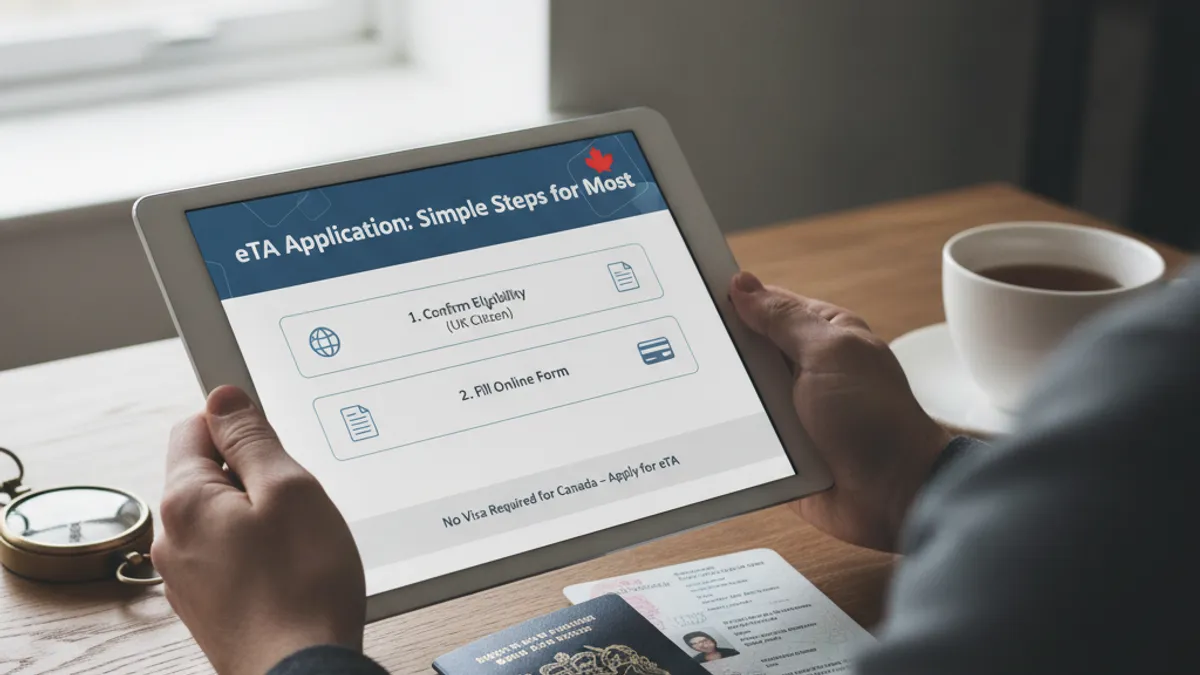
Applying for your eTA is designed to be a quick and efficient process, typically completed online in just a few minutes. The Canadian government aims for this to be the least burdensome step for most visitors. You don't need to visit an embassy or submit physical documents. Everything is handled through their secure online portal.
This streamlined approach means most British citizens can secure their travel authorization well before their departure date, often within minutes of submission. However, it's always wise to apply as far in advance as possible to allow for any unforeseen delays or additional checks. The application fee, as of 2026, is CAD $7 and is payable by credit or debit card.
What You Need: Passport and Payment
To successfully submit an eTA application, you'll need a few key items readily available. First and foremost is your valid UK passport. Ensure it's an e-passport, which has a microchip inside; this is indicated by a symbol on the cover. Your eTA will be electronically linked to this specific passport, so make sure you use the same passport to travel that you used to apply.
You'll also need a valid credit or debit card for the application fee, which is currently CAD $7. The payment is processed securely online. Have your personal details, such as your name, date of birth, and passport information, handy. Sometimes you might be asked about your employment details, so having that information accessible can speed things up.
Applying Online: What to Expect
The official Government of Canada website is the only place to apply for an eTA. Be wary of third-party sites that might charge higher fees or provide faulty service. Once you navigate to the correct portal, you'll be guided through a series of questions. These range from basic personal identification to more detailed queries about your travel history, health, and criminal background.
Honesty is paramount here; any discrepancies or false information can lead to your eTA being denied or revoked. In most cases, approval is almost instantaneous, and you'll receive confirmation via email. However, some applications may be flagged for further review, which can take longer, sometimes up to 72 hours, though this is less common for straightforward applications from UK citizens.
When to Apply for a Full Visitor Visa

If your situation doesn't fit the eTA criteria, or if you plan to stay in Canada for longer than six months, you'll need to apply for a visitor visa, also known as a Temporary Resident Visa (TRV). This process is more thorough and requires more documentation than an eTA. It’s essential to understand the differences and requirements to ensure you don't face issues at the border.
A visitor visa allows you to enter Canada for tourism, visiting family, or business purposes for a specific period, which is generally up to six months, but can be longer if approved by immigration officials. The application involves more detailed scrutiny of your background, finances, and intentions in Canada. It's a more formal process to ensure you meet all of Canada's immigration and admissibility criteria.
The Application Process for Visitor Visas
Applying for a visitor visa involves a more in-depth process than the eTA. You'll typically start by gathering necessary documents, which include your passport, proof of financial support (like bank statements), travel itinerary, and potentially a letter of invitation if you are visiting family or friends. You'll also need to complete an application form, which is more comprehensive than the eTA form.
The application is usually submitted online through the Immigration, Refugees and Citizenship Canada (IRCC) portal. Biometrics (fingerprints and photos) may be required, depending on your situation and where you are applying from. Processing times can vary significantly, from a few weeks to several months, so it's crucial to apply well in advance of your planned travel dates.
Key Differences from an eTA
The most significant difference lies in the depth of the application and the level of scrutiny. An eTA is an automated risk assessment, whereas a visitor visa application involves a manual review by an immigration officer. This means that while an eTA is often approved within minutes, a visitor visa can take weeks or even months.
Furthermore, an eTA is linked to your passport for air travel eligibility, allowing flexible re-entry for up to five years. A visitor visa is a physical stamp or document in your passport, typically valid for a specific period, often up to 10 years (but allowing stays of up to six months per entry, unless otherwise stated). If you have a criminal record or past immigration irregularities, you will almost certainly need a visitor visa and potentially other forms of admissibility assessment, which an eTA cannot accommodate.
Common Pitfalls: Mistakes to Avoid

When planning your trip to Canada, it's easy to overlook small details that could cause significant problems at immigration. These mistakes often stem from misunderstandings about the requirements or assuming that certain situations are covered when they aren't. Being aware of these common pitfalls can save you a lot of stress and potential rejection at the border.
Many travelers assume that if they are from the UK, entry is always guaranteed. However, Canada's immigration system is thorough, and even minor oversights can lead to delays or outright refusal. Proactive checking and honest disclosure are your best tools for a smooth experience.
Forgetting to Declare Issues
One of the most critical mistakes people make is failing to declare past immigration issues or any criminal record. If you have ever been denied entry to Canada, overstayed a visa in any country, or have been convicted of a crime, you must declare it. This applies even if the offense seems minor or occurred many years ago.
Canadian border services officers have access to various databases. If they discover undeclared issues, it can result in an immediate refusal of entry, a ban from Canada for several years, and significant difficulties with future travel applications. It's always better to be upfront; declaring an issue and applying for the appropriate visa (like a visitor visa or a Temporary Resident Permit) allows you to present your case properly. Trying to hide it will almost always backfire.
Assuming an eTA is Enough for Work
This is a widespread misconception. An eTA is only for temporary visits such as tourism, business meetings, or short-term study programs, generally anything under six months and not involving employment. If you plan to work in Canada, even for a short period, you absolutely need a work permit. An eTA will not suffice, and attempting to work on an eTA is a serious violation of immigration law.
Similarly, if you intend to study for a program longer than six months, you'll need a study permit. The eTA is designed for visitors, not for individuals intending to engage in economic activities or long-term academic pursuits. Always verify the specific permit required for your intended activity before you travel to avoid being turned away at the border or facing problems with your immigration status.
Incorrect Passport Information
Your eTA or visitor visa is electronically linked to the passport number you provide during your application. If you travel with a different passport than the one used for your application, you will likely be denied boarding or entry. This is because the travel authorization cannot be found and linked to your current passport.
This can happen if your passport expires and you get a new one before your trip, or if you have dual nationality and use the "wrong" passport. Always carry the specific passport you used for your eTA or visa application. If you do receive a new passport after obtaining an eTA, you generally need to apply for a new eTA with your new passport details. Always double-check passport numbers on all applications and travel documents for accuracy.