Thank you for reading this post, don't forget to subscribe!
About 13.1 million people living in the United Kingdom were born outside the country in 2024. That was approximately 19% of the UK population. This is the best available recent estimate of the foreign-born population, not a count of foreign citizens or people who arrived during a single year.
For readers in the United States, understanding Britain’s immigrant population starts with one key distinction: people born abroad are not the same as people who hold foreign citizenship. The United Kingdom includes England, Scotland, Wales, and Northern Ireland. Britain, in a strict geographic sense, refers to Great Britain, which includes England, Scotland, and Wales. Many reports use Britain and the UK interchangeably, but their exact geographic scope can differ.
The latest estimate published by the University of Oxford’s Migration Observatory puts the UK’s foreign-born population at about 13.1 million in 2024. This means roughly one in five residents was born in another country. The estimate includes people who may have lived in the UK for decades, people who became British citizens, and people who arrived more recently.
Annual migration figures answer a different question. The Office for National Statistics estimated that net long-term migration was 171,000 in the year ending December 2025, based on provisional estimates released in May 2026. Net migration is the difference between people arriving to live in the country and people leaving to live elsewhere. It does not measure the entire immigrant population.
This guide explains the size of Britain’s immigrant population, where immigrants come from, where they live, why they move, and how immigration numbers are measured. It also explains why population estimates, visa figures, asylum statistics, and annual migration totals should not be treated as interchangeable.
The best recent estimate indicates that approximately 13.1 million foreign-born people lived in the United Kingdom in 2024. The Migration Observatory at the University of Oxford reports that this represented around 19% of the country’s population. In simple terms, about one in every five people living in the UK was born in another country.
This figure is a population estimate, not a count of everyone who entered the country during 2024. It includes people who arrived many years ago and stayed, as well as people who moved to the UK more recently. It also includes people who have since become British citizens.
The latest census-based benchmark was smaller. Census figures collected in 2021 in England, Wales, and Northern Ireland and in 2022 in Scotland indicated that about 10.7 million UK residents were born overseas. The increase to approximately 13.1 million by 2024 reflects population change between the census period and the newer estimate.
The figures are estimates rather than a live count. Population surveys, administrative records, and census data have different strengths and limits. Readers should therefore use the date and method attached to each number when making comparisons.
Source: economist.com
Estimated foreign-born population
Approximately 13.1 million people in 2024.
Share of the UK population
About 19% in 2024.
Census-era benchmark
Approximately 10.7 million foreign-born residents across the UK using the 2021 and 2022 census data.
Annual net migration
A separate measure that records the balance between long-term arrivals and departures over a stated period.
What Does Foreign-Born Population Mean?
A foreign-born person is someone whose country of birth is outside the country where they currently live. For this article, the term refers to someone born outside the UK who now lives in the UK. Their current nationality does not change their country of birth.
For example, a person born in India who moved to Britain as a child and later became a British citizen still belongs to the foreign-born population. A person born in Britain to parents who moved from another country is not foreign-born, although that person may have a different nationality at birth or another immigration-related family background.
Foreign-born resident
A person who lives in the UK but was born in another country.
Foreign national
A person who does not hold British citizenship. Some foreign nationals were born in the UK.
Immigrant
A person who moves to a country to live there. Statistical definitions may set a minimum period of residence.
Does Britain Mean the Same Thing as the United Kingdom?
Not always. Great Britain consists of England, Scotland, and Wales. The United Kingdom includes those three nations and Northern Ireland. Many popular articles use Britain as a short name for the UK, but official statistics may cover the entire UK or only selected nations.
When reading a population figure, check the geographic label. A figure for England and Wales cannot automatically be presented as a UK total because it excludes Scotland and Northern Ireland. This distinction matters when comparing census results, regional estimates, and national migration statistics.
How Has the Number of Immigrants in Britain Changed?
The foreign-born population has grown substantially over the past two decades. The Migration Observatory estimates that the UK had approximately 5.3 million foreign-born residents in 2004, compared with about 13.1 million in 2024. The increase reflects long-term migration, changing labor and education patterns, family movement, humanitarian arrivals, and the fact that many people who arrive remain in the country.
The growth has not been steady in every year. Economic conditions, international conflicts, travel restrictions, visa rules, and changes in demand for workers and students can all affect migration. The effects may appear in population estimates only after people have arrived and stayed long enough to be counted as residents.
The early 2020s saw unusually high levels of migration. The post-Brexit immigration system, the recovery of international travel after the COVID-19 pandemic, student migration, work-related arrivals, and humanitarian routes all played a part in changing the numbers. These factors did not affect every nationality or migration category in the same way.
More recent figures show that annual net migration has fallen sharply from its recent peak. The Office for National Statistics estimated net long-term migration at 171,000 in the year ending December 2025, down from an updated estimate of 331,000 for the year ending December 2024. This fall does not mean the foreign-born population has fallen by the same amount. A smaller positive net migration figure means the population is still receiving a net addition from international migration, all else being equal.
Source: cdn.statcdn.com
2004
The estimated foreign-born population was around 5.3 million.
Census period, 2021 and 2022
Census-based figures indicated around 10.7 million foreign-born residents across the UK.
2024
The estimated foreign-born population reached about 13.1 million.
Year ending December 2025
Provisional long-term net migration was estimated at 171,000.
Why Has Net Migration Fallen?
The latest decline has largely been driven by lower net migration among people who are not British citizens, especially non-EU nationals. Changes in work and study migration have contributed to the reduction, while more people have also left the UK over time.
Visa policy can affect future arrivals, but the relationship is not immediate. A new rule may change applications, approvals, travel plans, or the length of time people stay. The effect on the resident population depends on all these factors, along with emigration and changes in the wider economy.
Fewer work-related arrivals
Changes in work routes and eligibility can affect how many people move to the UK for employment.
Changes in study migration
International student numbers and the rules for family members can influence migration totals.
More departures
Net migration falls when more people leave, even if immigration continues.
Where Do Most Immigrants in Britain Come From?
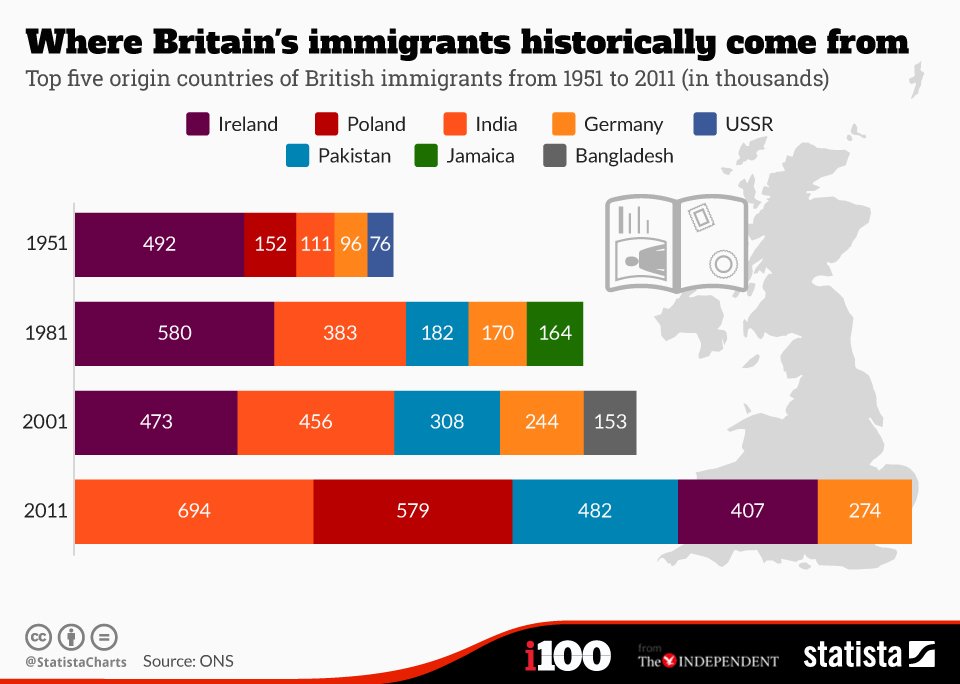
Immigrants living in Britain come from countries across Europe, Asia, Africa, the Americas, and other parts of the world. Census-era data identifies India, Poland, Pakistan, Romania, and Ireland among the leading countries of birth for UK residents born abroad. The exact order and population totals depend on the reference year and the measure used.
Country of birth is not the same as nationality. Someone born in Poland may now hold British citizenship, while someone born in Britain may hold Polish citizenship. For this reason, a ranking of foreign-born residents will not necessarily match a ranking of foreign nationals living in the country.
The mix of countries has changed over time. European migration increased during the years when citizens of EU countries could move to the UK under free-movement rules. Following Brexit, the immigration system changed, and migration from outside the EU became a larger driver of recent population growth.
Family connections, jobs, universities, historical ties, and humanitarian circumstances help explain why people move from particular countries. No single reason applies to every immigrant from a given country, and national origin alone does not reveal a person’s immigration status, occupation, or length of residence.
Source: iasservices.org.uk
India
Indian-born residents form one of the largest foreign-born communities in the UK. Work, study, and family migration are among the routes through which people may arrive.
Poland
Polish-born residents are a major part of the UK’s European-born population, reflecting substantial migration during and after the period of EU free movement.
Pakistan
Pakistani-born residents are part of a long-established community shaped by family ties, work, and other forms of migration.
Romania
Romanian-born residents include people who moved for employment, family reasons, and other purposes.
Ireland
Irish-born residents have longstanding links with Britain. Special arrangements between the UK and Ireland also distinguish their movement rights from those of many other foreign nationals.
Why Are Country Rankings Difficult to Compare?
A country-of-birth table may include British citizens born abroad, while a nationality table may exclude those same people if they have become British citizens. The two tables answer different questions and can produce different rankings.
The date also matters. A ranking from the 2021 and 2022 censuses should not be described as an exact ranking for 2026. Recent migration has changed the size and composition of the population since the census period, and newer estimates may use different methods.
Which Parts of Britain Have the Most Immigrants?
London has the highest concentration of foreign-born residents among UK regions. More than 40% of London’s residents were born abroad, according to the Migration Observatory’s analysis. The capital attracts people through its large labor market, universities, international business links, transport connections, and established family and community networks.
The South East also has a substantial foreign-born population. Census-era data shows that almost half of all foreign-born UK residents lived in London and the South East combined. These areas offer a wide range of jobs and education options, and their transport links connect residents with other parts of the country.
Immigration is not limited to large cities. Migrants also live in towns, rural communities, coastal areas, and regions across England, Scotland, Wales, and Northern Ireland. Their distribution varies by occupation, housing costs, university locations, family connections, and local employment needs.
A high share of foreign-born residents does not automatically mean that every neighborhood has the same experience of immigration. Local population size, housing supply, public services, labor demand, and the age profile of residents all affect how migration influences a particular place.
Source: iasservices.org.uk
London
Has the highest regional concentration of foreign-born residents, at more than 40% of its population.
South East England
Contains a large foreign-born population and is closely linked to London’s economy and transport network.
Other cities and towns
Migrants also live in university cities, industrial areas, rural communities, and smaller towns throughout the UK.
Why Do Many Immigrants Settle in London?
London offers a broad mix of jobs in finance, technology, health care, hospitality, education, transport, and other sectors. It is also home to many universities and international organizations, which can attract students and skilled workers.
Existing family and community networks can influence settlement choices. People may move to an area where relatives live, where they speak a familiar language, or where they can find support while adjusting to a new country. However, high housing costs and living expenses can also encourage some residents to move elsewhere.
What Is the Difference Between Immigration and Net Migration?
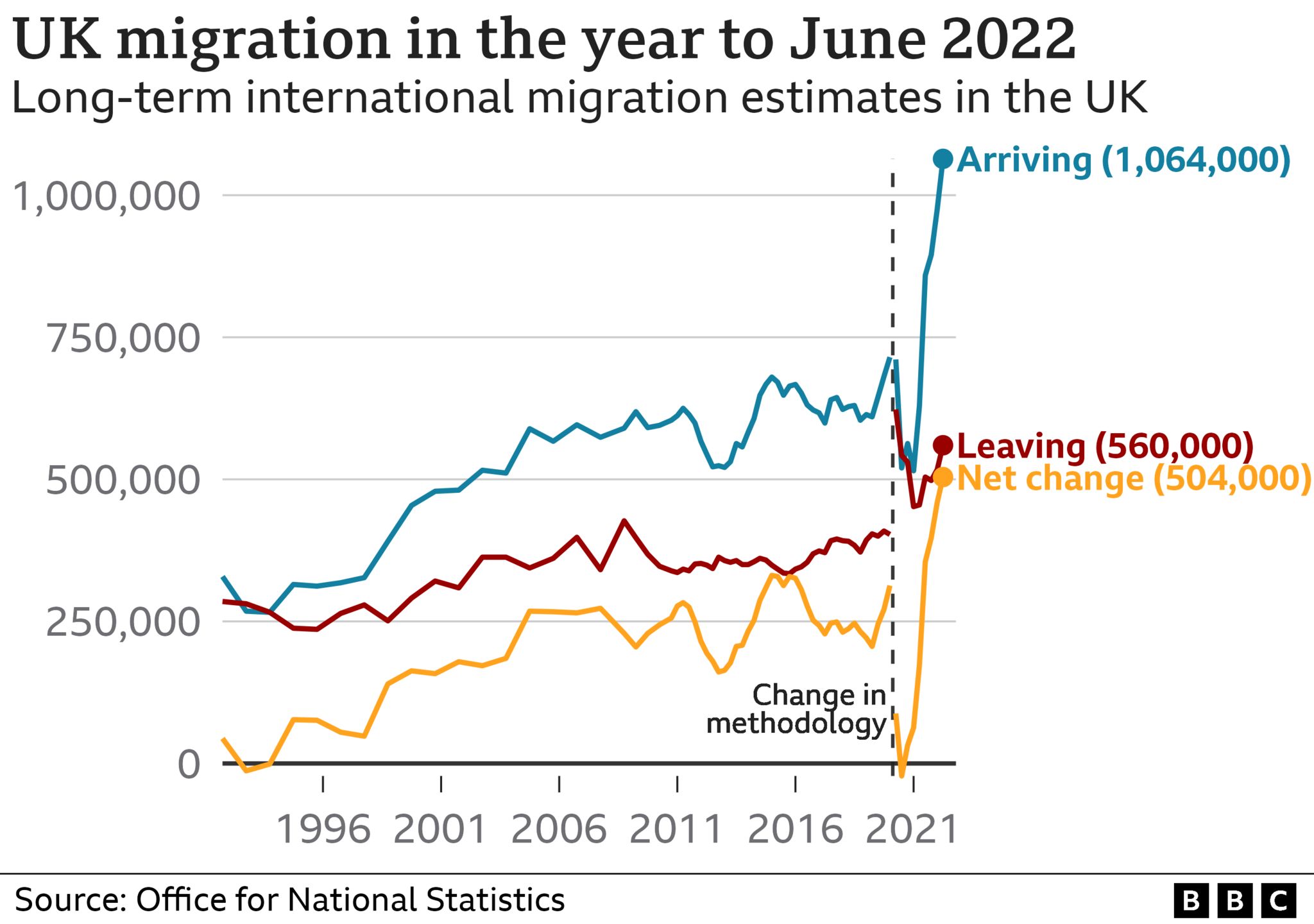
Immigration counts people who move into a country to live there, while emigration counts people who leave to live elsewhere. Net migration is the difference between the two figures. It is one of the most useful measures for understanding how international movement contributes to population change.
For example, if 800,000 people move into a country and 600,000 leave during the same period, net migration is positive 200,000. This is a hypothetical example, not an official UK statistic. The calculation shows why the number of arrivals alone cannot tell the full story.
The Office for National Statistics estimated that 813,000 people immigrated to the UK for the long term in the year ending December 2025. It estimated 642,000 long-term emigrants during that period, producing provisional net migration of 171,000. These figures refer to movements during a 12-month period, not the total number of immigrants already living in the country.
Long-term migration statistics generally focus on people who change their country of usual residence for at least 12 months. Short visits, holidays, and many temporary trips are not counted as long-term immigration. This definition helps separate people moving to live in the UK from visitors who arrive for a brief stay.
Source: i.ytimg.com
Immigration
The number of people who move into the country during a stated period under the statistical definition being used.
Emigration
The number of people who leave the country to live elsewhere during the same period.
Net migration
Immigration minus emigration. A positive result means more people moved in than moved out.
Foreign-born population
The stock of people currently living in the country who were born abroad, regardless of when they arrived.
Why Can Immigration Fall While the Immigrant Population Grows?
A population total reflects years of arrivals, departures, births, deaths, and changes in citizenship. Even when annual immigration declines, the number of foreign-born residents can continue to rise if more people remain in the country than leave and other population changes support growth.
The reverse can also happen. Immigration may rise during one year while the foreign-born population grows more slowly than expected if many residents leave or if estimates use different dates and methods. Annual flows and the resident population must therefore be read separately.
Why Do People Immigrate to Britain?
People move to Britain for several reasons, including work, education, family life, and protection from danger. Some arrive with a clear plan to stay for many years, while others move for a limited period and later return home or settle in another country.
Work migration can help employers recruit people with the skills they need. Study migration brings people to British universities and colleges, while family migration allows eligible relatives to join or remain with family members. Humanitarian routes provide protection or relocation opportunities for people who meet specific conditions.
These categories are not interchangeable. A person arriving on a student visa is not necessarily seeking permanent residence, and a person seeking asylum has not automatically received refugee status. The legal route, the person’s circumstances, and the outcome of an application determine what rights and options are available.
Source: ichef.bbci.co.uk
Employment
Some migrants arrive to take eligible jobs, fill skill gaps, or work under a visa route that permits employment.
Education
International students move to attend eligible educational institutions. Their stay may depend on course requirements and immigration rules.
Family
Eligible partners, children, and other qualifying relatives may apply to join family members in the UK under the relevant rules.
Humanitarian protection
People fleeing persecution, conflict, or serious danger may seek asylum or qualify for specific humanitarian programs.
Does Every Immigrant Plan to Stay Permanently?
No. Some people move to the UK for a short or fixed period, such as to study or take a temporary job. Others hope to settle permanently, and some change their plans after arriving.
Long-term migration statistics measure a person’s change of usual residence under the relevant definition. They do not prove that every person will remain forever. Immigration status, visa duration, settlement eligibility, and future personal choices are separate matters.
Are All Immigrants in Britain Foreign Citizens?
No. A person can be an immigrant by birthplace and later become a British citizen. Once citizenship is granted, that person remains part of the foreign-born population but is no longer counted as a foreign national under a nationality-based measure.
Foreign nationals can also include people who were born in Britain but do not hold British citizenship. Children born in the UK do not automatically become British citizens in every case. Their citizenship depends on the law and the circumstances of their birth, including the status of their parents.
This difference is important when evaluating claims about the number of immigrants living in Britain. A foreign-born population estimate answers where people were born. A foreign-national estimate answers which citizenship they hold. Neither figure, on its own, provides a complete count of people with an immigration history or a particular legal status.
Source: cdn.statcdn.com
British citizen born abroad
Included in foreign-born population statistics but generally excluded from foreign-national totals.
Foreign citizen born in Britain
May be included in foreign-national statistics but excluded from foreign-born population totals.
Permanent resident
May have permission to live in the UK indefinitely without holding British citizenship.
Does Permanent Residence Mean British Citizenship?
No. In the UK, indefinite leave to remain generally allows an eligible person to live and work in the country without a time limit on their immigration permission. It does not automatically make that person a British citizen.
Citizenship normally requires a separate application or a qualifying legal basis. The rules depend on the applicant’s circumstances, residence history, and other legal requirements. Anyone considering an application should check current official guidance before acting.
How Do UK Immigration Statistics Count Asylum Seekers and Small-Boat Arrivals?
Asylum seekers are people who have asked for international protection and whose claims have not yet been finally decided. Refugees are people who meet the applicable legal definition or have received recognition under a relevant protection process. These terms describe different legal situations.
Some people who claim asylum arrive through regular travel routes, while others enter irregularly. Small-boat arrivals across the English Channel are one part of the wider migration picture, but they are not a measure of all immigrants in Britain. They also do not represent every person who claims asylum.
The Home Office publishes data on asylum applications, decisions, immigration enforcement, and small-boat arrivals. The Office for National Statistics produces long-term migration estimates using its own statistical definitions and methods. The figures may overlap because some asylum seekers are included in long-term migration estimates, but they should not be added together without checking for duplication.
For example, the number of people arriving by small boat during a year is a count of a specific arrival method. It does not include people who arrive by air or other routes, and it does not count the entire asylum-seeking population already living in the UK. Likewise, an asylum application count may refer to applications or applicants rather than everyone who crossed a border during that year.
Source: ichef.bbci.co.uk
Asylum applications
Measure requests for protection under the relevant reporting method, not the entire immigrant population.
Refugees
People recognized as needing protection under an applicable legal process or status.
Small-boat arrivals
A specific category of irregular arrival, not a total count of immigration to Britain.
Long-term migration estimates
Measure changes in usual residence under the statistical definition, including eligible people arriving for different reasons.
Can Small-Boat Arrivals Be Used to Estimate All Immigration?
No. Small-boat arrivals are only one route into the UK. Many people move through work, study, family, and other routes, while others arrive as visitors and later leave. A figure for small boats cannot establish the size of the foreign-born population or the total number of people who entered the country.
A sound comparison must use the same period, population definition, and data source. It should also distinguish people from applications, arrivals from residents, and irregular entry from lawful migration.
How Reliable Are Britain’s Immigration Figures?
Official migration figures are estimates built from several data sources and statistical methods. The Office for National Statistics publishes migration estimates and explains the methods used to produce them. Census data offers a detailed population snapshot, while newer estimates help track changes between censuses.
No single statistic answers every immigration question. Census figures may be several years old by the time they are used in an article, while recent annual migration estimates can be revised as better information becomes available. Some population breakdowns are less current or less precise than national totals.
The best way to interpret a number is to check its date, geography, definition, and publication status. Provisional estimates should be described as provisional. A figure for England and Wales should not be presented as a UK total, and a net migration figure should not be described as the number of immigrants living in Britain.
When figures from different sources appear to conflict, they may measure different populations or use different reference dates. For example, the foreign-born population includes naturalized British citizens, while a foreign-national count does not. A census count and a yearly migration flow also answer different questions.
Source: iasservices.org.uk
Check the reference date
A population estimate for 2024 is not the same as a migration total for the year ending December 2025.
Check the geographic scope
Confirm whether the figure covers the UK, Great Britain, England and Wales, or a single region.
Check the definition
Look for terms such as foreign-born, foreign national, immigration, net migration, asylum applicant, and refugee.
Check whether the estimate is provisional
Recent migration data may be revised when more complete information becomes available.
Which Sources Should Readers Trust?
The Office for National Statistics is the main source for UK population and international migration estimates. The Home Office publishes official statistics on visas, asylum, enforcement, and other parts of the immigration system. Census agencies provide information on country of birth and nationality, while the Migration Observatory at the University of Oxford offers analysis that explains the meaning and limits of the figures.
These sources serve different purposes. Use the ONS for population and long-term migration estimates, the Home Office for immigration system activity, and census or Migration Observatory material for demographic context. Cross-checking definitions is more useful than selecting whichever figure appears largest or most recent.
What Does Britain’s Immigrant Population Mean for the Country?
Immigration affects the UK’s economy, workforce, public services, communities, and population structure. Its effects vary by location, time period, occupation, age, legal status, and the ability of local services to respond to changing needs. A national population figure alone cannot show every benefit or cost.
Migrants work across many sectors, including health care, research, education, hospitality, transport, agriculture, technology, and finance. International students also contribute to universities and local economies. The scale of these contributions depends on employment, earnings, spending, public finances, and other factors that must be assessed using suitable evidence.
Immigration can also add pressure to housing, transport, schools, health services, and local infrastructure when demand grows faster than capacity. These pressures are not caused by migration alone. Housing supply, public investment, workforce shortages, regional planning, and the wider economy can also shape the outcome.
A balanced assessment therefore separates the number of immigrants from the effects of immigration. A large foreign-born population does not by itself prove that immigration is either wholly beneficial or wholly harmful. The strongest analysis looks at specific outcomes, compares relevant groups and time periods, and considers both national trends and local conditions.
Source: i.ytimg.com
Workforce
Migrants can fill jobs and bring skills, but effects vary by sector, wages, and labor-market conditions.
Public services
Population growth can increase demand for services, making funding and planning important.
Local communities
Migration can change the languages, cultures, and needs of neighborhoods, with outcomes shaped by local conditions.
Population change
Migration influences the size and age structure of the population alongside births, deaths, and emigration.
Does a Larger Immigrant Population Mean Higher Annual Immigration?
Not necessarily. The number of foreign-born residents is a cumulative population measure, while annual immigration counts people moving into the country during a period. The resident total can remain high even after yearly arrivals decline.
For a fair comparison, use foreign-born population estimates to discuss how many immigrants live in the country. Use annual immigration and net migration figures to discuss how international movement has changed over time.
Frequently Asked Questions
Q
How many immigrants are in Britain in 2026?
The most recent foreign-born population estimate cited here is approximately 13.1 million people living in the UK in 2024, equal to about 19% of the population. This should not be described as an exact 2026 count because a newer comprehensive foreign-born population estimate is not established by the data cited here. The latest annual migration estimates cover a different measure and period.
Q
What percentage of Britain’s population is made up of immigrants?
Approximately 19% of the UK’s population was foreign-born in 2024. This means roughly one in five residents was born outside the UK. The percentage refers to country of birth, not the share of people who hold foreign citizenship.
Q
Which country sends the most immigrants to Britain?
India is among the leading countries of birth for immigrants living in the UK, alongside Poland, Pakistan, Romania, and Ireland. The exact ranking depends on the reference year and whether the statistic measures country of birth, nationality, or recent arrivals. These measures should not be treated as interchangeable.
Q
Which British city has the most immigrants?
London has the largest concentration of foreign-born residents among UK regions, with more than 40% of its population born abroad. It attracts migrants through employment, education, international connections, and established family networks. The highest percentage and the highest total number are different measures, so comparisons should state which one is being used.
Q
How many people immigrate to the UK each year?
The answer changes each year. The Office for National Statistics provisionally estimated 813,000 long-term immigrants in the year ending December 2025. This counts people who moved to the UK for the long term under the statistical definition, not everyone who visited the country or the total number of immigrants already living there.
Q
Are immigrants in Britain mostly illegal immigrants?
No such conclusion can be drawn from the foreign-born population figure. That figure includes British citizens born abroad, people with valid immigration permission, and other residents with different legal circumstances. The number of foreign-born residents does not reveal how many people lack immigration permission. Estimates of irregular migration require separate evidence and careful definitions.
Q
Are foreign-born residents the same as foreign nationals?
No. Foreign-born residents were born outside the UK, even if they later became British citizens. Foreign nationals do not hold British citizenship and may include people born in Britain. The two groups overlap, but they are not identical.
Q
Does net migration show how many immigrants live in Britain?
No. Net migration is the difference between long-term immigration and long-term emigration during a stated period. The foreign-born population counts residents who were born outside the UK, including people who arrived many years ago. Net migration can help explain changes in the population, but it is not a substitute for a resident population estimate.
✦ Wrapping Up
Conclusion
The clearest answer to how many immigrants are in Britain is that approximately 13.1 million people living in the United Kingdom were born abroad in 2024. This was about 19% of the total population, or roughly one in five residents. It is a recent estimate, not an exact count for October 2026.
Annual migration statistics tell a different story. Provisional figures from the Office for National Statistics put long-term net migration at 171,000 in the year ending December 2025. This represents the balance of people moving into and out of the UK, not the full number of immigrants living there.
To understand Britain’s immigration picture accurately, compare figures with the same date, geographic scope, and definition. Foreign-born residents, foreign nationals, visa holders, asylum seekers, refugees, and annual migrants are different groups or measures. Keeping those distinctions clear helps readers understand the evidence without overstating what any single statistic can prove.
💡 Key Takeaway
For the most accurate picture, start with the Office for National Statistics for population and long-term migration figures, use Home Office statistics for visas and asylum, and consult the Migration Observatory at the University of Oxford for demographic analysis. Always check the publication date, geographic coverage, and definition before quoting an immigration number.