Thank you for reading this post, don't forget to subscribe!
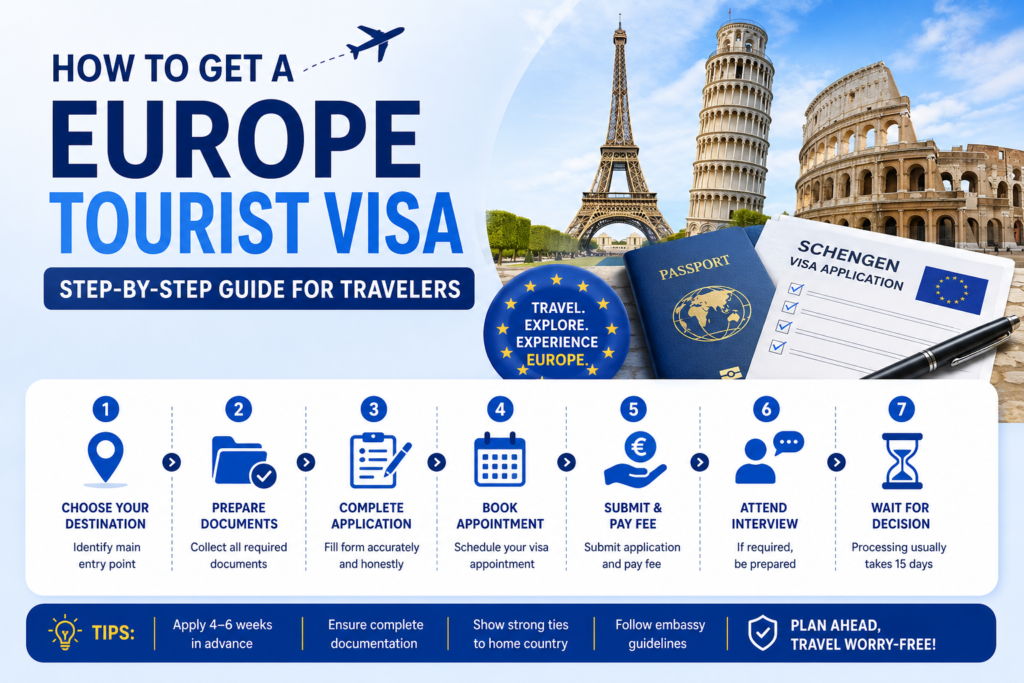
To get a visa for Europe, first choose your destination and visa type, check the official requirements, prepare your documents, book an appointment if required, submit your application, and wait for a decision. The right process depends on your nationality, purpose of travel, and length of stay.
For travelers in the United States, planning a trip to Europe starts with checking the entry rules for your passport and destination. A U.S. citizen can generally visit the Schengen Area for tourism for up to 90 days within any 180-day period without a short-stay visa. However, a person living in the United States who holds a different passport may need a visa before departure. Living in America does not automatically give someone visa-free access to Europe.
Europe does not have one visa that covers every country and every purpose. The Schengen visa allows eligible travelers to make short visits across participating countries, while national visas cover many long stays for work, study, or family reasons. The United Kingdom and some other European destinations have separate entry systems. This guide explains how to choose the right route, gather the right evidence, pay the required fees, and avoid common application errors. Rules and fees in this guide reflect official information checked on October 26, 2026, and should be confirmed with the relevant government authority before applying.
The first step is to identify the visa that matches your trip. The term Europe visa is a general phrase, not the name of one universal permit. Your nationality, destination, travel purpose, and length of stay determine which rules apply.
The Schengen Area has 29 participating countries under its common short-stay visa policy. A valid Schengen visa generally allows travel among participating countries, subject to the conditions on the visa and border-entry rules. However, not every European country belongs to the Schengen Area, and a Schengen visa does not replace every national visa.
Source: www.youtube.com
Schengen tourist visa
For eligible travelers visiting for holidays, sightseeing, or leisure for a short stay.
Business visitor visa
For permitted business activities, such as meetings or conferences. It does not automatically authorize employment.
Family or private visit
For visiting relatives, friends, or other hosts. The applicant may need an invitation and proof of accommodation.
Student visa
For studies. Short courses may fall under short-stay rules, while longer programs usually require a national student visa or residence permit.
Work visa
For employment in a specific country. Work authorization and national immigration rules apply, and a tourist visa is not a substitute.
Long-stay or national visa
For stays exceeding 90 days when the destination country’s rules require a national visa or residence permit.
Does a Schengen Visa Cover All of Europe?
No. The Schengen Area includes many European destinations, but it is not the same as the whole continent or the European Union. The United Kingdom and Ireland have separate immigration systems. Cyprus also has its own visa rules, so check its current requirements before travel.
For example, a traveler planning a holiday in France, Germany, and Italy may be able to use one suitable Schengen visa for the trip. A traveler adding London must check the separate UK entry requirements. Never assume that permission to enter one European country gives you permission to enter every other country.
Short visit
Check whether you need a Schengen visa, another national visa, or no visa for your passport.
Long-term stay
Contact the immigration authority of the country where you plan to live, study, or work.
How Can I Get Europe Visa Step by Step?
You can make the application process easier by following a clear order. Begin with the official requirements, then collect documents that match your purpose of travel. Do not book an appointment with an unrelated embassy just because it appears to have an earlier opening.
Source: www.youtube.com
Step 1: Choose your destination
List every country you intend to visit, your travel dates, and the number of days planned in each country.
Step 2: Check your visa requirement
Use the official immigration or embassy website for the country you plan to visit. Check the rules for your passport and legal country of residence.
Step 3: Select the correct application authority
For a multi-country Schengen trip, apply through the country where you will spend the longest time. If the stays are equal, apply through the country you will visit first.
Step 4: Read the document checklist
Get the current checklist for your visa category and place of residence. Requirements can vary by country, consulate, and applicant.
Step 5: Complete the application form
Enter your personal details, passport information, trip purpose, accommodation, and travel dates accurately. Make sure your answers match your supporting documents.
Step 6: Book an appointment
Use the embassy or its officially authorized visa application center. Follow the stated process for your country of residence.
Step 7: Submit your documents and biometrics
Attend the appointment if required, submit the application, provide fingerprints and a photograph when requested, and pay the applicable fees.
Step 8: Track the application
Keep your receipt and reference number. Respond promptly if the authorities request more information.
Step 9: Check the decision
If approved, check the visa dates, number of entries, and permitted duration before leaving. If refused, read the decision notice and follow the available review or appeal procedure.
When Should You Apply for a Europe Visa?
For a standard Schengen short-stay visa, the application can generally be submitted up to six months before the planned trip and must normally be lodged at least 15 days before departure. Some appointments are difficult to obtain, so waiting until the final weeks can create a serious problem.
A normal Schengen application usually takes 15 days to process. The period may extend to 45 days when further examination or extra documents are needed. These are processing rules, not a promise that an appointment will be available or that a decision will arrive by a particular date. Long-stay visas follow national procedures and can take longer.
Plan ahead
Check appointment availability before making nonrefundable travel bookings.
Allow extra time
Build in time for document translation, missing records, public holidays, and possible requests for further evidence.
Europe Visa Requirements and Documents
A successful application should tell a clear and consistent story about who you are, why you are traveling, how you will pay for the trip, where you will stay, and what you plan to do afterward. The exact documents depend on the country and visa category, so use the official checklist as your final guide.
A large stack of paperwork does not guarantee approval. The documents need to be genuine, relevant, current, and consistent with your application. If a document is unavailable, ask the consulate whether an alternative is accepted rather than creating or altering evidence.
Source: vazirgroup.com
Valid passport
For a Schengen short-stay application, the passport generally must have been issued within the previous 10 years and remain valid for at least three months after your planned departure from the Schengen Area. Check the exact rules and required blank pages.
Completed application form
Provide accurate personal details, the purpose of travel, intended dates, and other requested information. Sign the form wherever required.
Passport photograph
Supply a recent photo that meets the required size, background, and biometric standards.
Travel medical insurance
Schengen applicants generally need insurance covering emergency medical care, hospitalization, and repatriation, including in the event of death. Follow the official minimum coverage and territorial rules.
Proof of financial means
Provide suitable bank statements, income evidence, pay slips, sponsorship documents, or other accepted proof showing how you will cover the trip.
Accommodation evidence
Use genuine hotel reservations, a host invitation, or other accepted proof of where you will stay.
Travel itinerary
Show your intended route, dates, transport plans, and the countries you expect to visit. Submit the bookings or reservations required by the relevant authority.
Evidence of your situation at home
Depending on your circumstances, this may include employment letters, business records, study enrollment, family responsibilities, or evidence of ongoing commitments.
Purpose-specific documents
A business traveler may need an invitation from a company. A visitor may need a host letter, and a student may need an admission letter and evidence of funds.
How Much Money Do You Need for a Europe Visa?
There is no single bank balance that guarantees a Europe visa. The required financial evidence depends on the destination, length of stay, accommodation costs, itinerary, and whether another person will pay for the trip. Some countries publish reference amounts, but these are not universal rules for every European destination.
Your statements should help explain the source and availability of your funds. Regular income, savings, and reasonable spending plans can support a coherent application. A sudden large deposit with no clear source may raise questions, so keep evidence that explains unusual transactions.
Estimate the full trip cost
Include transport, accommodation, food, local travel, insurance, activities, and a reasonable emergency reserve.
Show funds you can access
Use documents accepted by the relevant authority and make sure the account holder and transaction history are clear.
Explain sponsorship
If someone else pays, provide the required sponsorship letter and financial records, plus evidence of the relationship when requested.
What If You Are Self-Employed or Unemployed?
You can still apply, but you need documents that accurately explain your situation. A self-employed applicant may provide business registration, tax records, invoices, and bank statements. An unemployed applicant may use personal savings, a genuine sponsor, family support evidence, or other documents accepted by the consulate.
Do not invent a job, income, business, or sponsor to make an application appear stronger. Explain your circumstances honestly and provide the best available supporting evidence.
Self-employed applicants
Gather relevant business and income records, proof of business activity, and evidence of available funds.
Students
Provide enrollment evidence and the required proof of personal or sponsored financial support.
Sponsored travelers
Check whether the destination requires a specific sponsorship form, proof of relationship, or a formal declaration.
How Much Does a Europe Visa Cost?
The cost depends on the visa category, applicant’s age, destination, and application service. For a standard Schengen short-stay visa, the general fee is 90 euros for adults and 45 euros for children aged 6 to 11. Children under six are generally exempt from the Schengen visa fee, although other charges or requirements may still apply.
Visa service centers may charge an additional service fee. You may also need to budget for travel to the appointment, photographs, document translation, insurance, and other required records. National long-stay visas have separate fees, so do not use the short-stay fee as the cost of a work or student visa.
Source: economadtravel.com
Schengen visa fee
Generally 90 euros for adults and 45 euros for children aged 6 to 11, subject to applicable exemptions and special arrangements.
Service center fee
An additional fee may apply when an authorized external provider accepts the application.
Supporting costs
Budget for insurance, transport, photographs, translations, and any required civil or financial documents.
Refund policy
Visa fees are generally not refunded when an application is refused or withdrawn. Confirm the rules before paying.
Example of a Europe Visa Budget
Consider a hypothetical adult applying for a short-stay Schengen visa. The standard application fee is 90 euros. If an authorized service center charges an additional fee, the applicant must add that amount to the total, along with insurance and any document preparation costs.
For example, if the service fee were 25 euros and insurance cost 35 euros, those three items would total 150 euros. These service and insurance figures are examples, not quoted prices or a universal fee schedule. The actual cost depends on the provider, coverage, and country where the application is lodged.
Before paying
Check the embassy website for the current visa fee, payment method, service fee, and accepted payment currency.
Avoid unnecessary expenses
Do not pay a broker who claims to have special influence over the decision or access to guaranteed appointments.
How to Apply for a Europe Visa From the United States
If you live in the United States, the first question is whether you need a visa at all. U.S. citizens generally do not need a Schengen short-stay visa for tourism or other permitted short visits of up to 90 days within a 180-day period. They still need to meet passport, entry, and purpose-of-travel rules.
If you are a U.S. resident with a passport from a country that requires a Schengen visa, you may need to apply through the consulate responsible for your place of legal residence in the United States. Permanent residents and other noncitizens should check the rules for their nationality and residence status. A U.S. green card does not, by itself, replace a required European visa.
Source: touristplaces.guide
U.S. citizens
Check the destination’s passport validity, permitted activities, and stay limits. For long-term work or study, consult the relevant national immigration authority.
U.S. permanent residents
Use your actual passport nationality to determine whether a Schengen visa is required, then follow the application instructions for your U.S. residence.
Other U.S. residents
Confirm which consulate handles applications in your state and whether proof of lawful U.S. residence is required.
Travelers visiting the UK
Check the separate UK visa or electronic travel authorization rules. Schengen permission does not automatically authorize entry to the UK.
What Is ETIAS, and Do You Need It?
ETIAS is the European Travel Information and Authorisation System. It is a travel authorization planned for eligible travelers who can visit participating European destinations without a visa. It is not a visa and does not replace a visa for people whose nationality requires one.
As of October 26, 2026, the official European Union ETIAS website states that the system is not yet collecting applications and is expected to start in the last quarter of 2026. Check the official website for a confirmed launch date before traveling. Do not pay unofficial websites claiming to issue an ETIAS authorization while the system is not operating.
Visa-required passport
Apply for the relevant visa under the current rules. ETIAS is not a substitute.
Visa-exempt passport
Check the official ETIAS website for the launch announcement and any requirement that applies to your travel dates.
How Can Applicants From Bangladesh Get a Europe Visa?
Bangladeshi citizens generally need a visa for short visits to the Schengen Area. Applicants should identify their main destination, check the relevant embassy’s current instructions, and submit the application through the appropriate authorized channel. The European Union Delegation in Bangladesh provides information on the embassies and visa arrangements available to Bangladeshi travelers.
If you live in Bangladesh, start with the official website of the embassy responsible for your destination. Some European countries use an external visa application center to collect documents and biometrics. The responsible embassy or immigration authority makes the decision, not a travel agent or the service center.
Source: aipassportphotos.com
Identify your main destination
Apply through the Schengen country where you will spend the most time. If the stays are equal, use the country you will visit first.
Check local application instructions
Confirm the current checklist, appointment process, application center, payment method, and document translation requirements.
Prepare financial evidence
Gather genuine bank statements, income records, employment or business documents, and sponsor records where relevant.
Confirm appointment availability
Book through the official embassy or authorized provider. Avoid people who claim to sell guaranteed appointments.
Keep all records
Retain copies of the application, payment receipt, appointment confirmation, and tracking details.
Can You Apply Through Any European Embassy?
No. You should not choose an embassy solely because its appointment calendar looks convenient. The authority handling your application must be responsible for the destination and your place of residence under the applicable rules.
Some countries represent other Schengen countries for certain visa applications, while others handle only specific categories. Representation arrangements can change, so check the official embassy or European Union information page before booking.
Wrong embassy
Confirm jurisdiction and destination responsibility before paying fees or traveling to an appointment.
No appointments available
Check the authorized provider regularly, contact the relevant mission through its official channels, and consider changing travel dates if needed.
How to Improve Your Chances of Getting a Europe Visa
No document, bank balance, invitation letter, or travel history guarantees approval. The best approach is to provide truthful information and evidence that supports the stated purpose of the visit. Make it easy for the reviewing officer to understand your plans without having to resolve avoidable contradictions.
The authorities may assess the purpose of the trip, available funds, accommodation, insurance, credibility of the evidence, and the applicant’s circumstances. The exact assessment depends on the law and facts of the individual case.
Source: www.youtube.com
Make the itinerary realistic
Use travel dates and bookings that fit your budget, available vacation time, and intended activities.
Keep documents consistent
Check that the dates, names, employment details, financial figures, and accommodation information match across all records.
Explain unusual transactions
Provide a truthful explanation and supporting evidence for large deposits or changes in your financial situation.
Show the purpose clearly
Use relevant invitations, bookings, enrollment letters, or other documents that support the reason for travel.
Follow photo and document rules
Use the required photo format and provide translations or certified copies when the authority requests them.
Apply for the correct category
Do not use a tourist visa to conceal a plan to work or live in a country when a different permit is required.
Common Reasons Europe Visa Applications Fail
Applications may be refused for reasons such as an unclear purpose, insufficient evidence of financial means, unreliable documents, inadequate insurance, or doubts about whether the applicant meets the entry conditions. Missing paperwork can also delay a decision or lead to refusal.
If you receive a refusal, read the decision carefully. It should explain the reasons and information about the available appeal process. Depending on the case, you may be able to appeal or submit a new application with stronger evidence. A new application does not erase the earlier decision, and paying again does not guarantee approval.
If your funds appear insufficient
Review the destination’s requirements and provide accurate, documented evidence of your available funds or legitimate sponsorship.
If your travel purpose is unclear
Provide relevant supporting records and a consistent itinerary that reflects the actual purpose of the visit.
If a document is missing
Follow the consulate’s instructions on supplying the missing document. Do not send unsolicited records if the authority says not to.
If you suspect fraud
Keep your records, avoid further payments to the suspected scammer, and contact the relevant authority or qualified legal adviser.
What Happens After Your Europe Visa Is Approved?
Visa approval is a major step, but it does not remove every entry requirement. Check the visa sticker or electronic decision for its validity dates, number of entries, and authorized length of stay. These details determine how and when you can travel.
A visa with multiple entries does not automatically allow unlimited stays. For a standard short-stay Schengen visa, the general limit remains 90 days within any 180-day period, subject to the visa’s conditions. Border officials may also ask about your purpose of travel, accommodation, funds, and return plans.
Source: kritinglobal.com
Check your visa details
Make sure your name and passport details are correct and confirm the validity dates and entry conditions.
Carry key supporting records
Keep relevant bookings, insurance information, invitation details, and evidence of funds available during your journey.
Respect your permitted stay
Track the days spent in the Schengen Area, including visits to different participating countries.
Follow local laws
A visitor visa does not automatically permit employment or long-term residence.
Can You Extend a Europe Visa?
A short-stay Schengen visa can be extended only in limited circumstances under the applicable rules. You should not assume that wanting to remain longer, missing a flight, or changing holiday plans will qualify you for an extension.
If a serious and unexpected event affects your departure, contact the competent immigration authority before your authorized stay expires. For a planned longer stay, apply for the appropriate national visa or residence permit rather than relying on a short-stay extension.
Unexpected emergency
Seek advice from the local immigration authority and provide supporting evidence of the circumstances.
Planned long-term move
Check the destination country’s work, study, family, or residence procedure before your current permission ends.
Frequently Asked Questions
Q
Can I get a Europe visa online?
You can complete some application forms online and may be able to book appointments or track applications through official websites. However, a standard Schengen visa application generally requires submission of supporting documents and may require an in-person appointment for biometrics. Do not assume that a website offering an instant European e-visa is official.
Q
How long does it take to get a Europe visa?
A standard Schengen short-stay visa normally takes about 15 days to process after the application is lodged. Some cases can take up to 45 days when additional checks or documents are needed. Appointment waiting times, national visa procedures, and local conditions can add further delays.
Q
Can I visit several European countries with one visa?
A valid Schengen visa generally allows travel among the participating Schengen countries during its validity, subject to the conditions issued. You must apply through the country responsible for your main destination. Countries outside the Schengen Area may require separate permission.
Q
Does a U.S. green card allow me to enter Europe without a visa?
No, not automatically. Visa requirements generally depend on the passport you travel with, not simply your U.S. immigration status. A U.S. permanent resident may still need a Schengen visa based on nationality. Check the official entry rules for your destination before booking.
Q
What is the minimum bank balance for a Europe visa?
There is no single minimum bank balance for all European countries. Financial requirements depend on the destination, duration of the trip, accommodation, and personal circumstances. Check the official country’s rules and provide genuine evidence that you can cover the expected costs.
Q
Can I work in Europe with a tourist visa?
A tourist visa generally does not authorize ordinary employment. Some countries permit specific business visitor activities, but these rules do not provide a general right to work. If you intend to take a job, check the national work permit and visa process for the country concerned.
Q
Can I apply again after a Europe visa refusal?
Yes, you may be able to submit a new application, depending on the circumstances and applicable rules. First read the refusal reasons, determine what evidence was missing or unclear, and decide whether to appeal or reapply. A new application should address the actual concerns rather than simply repeat the same documents.
Q
Is ETIAS the same as a Schengen visa?
No. ETIAS is a planned travel authorization for eligible travelers who are exempt from the Schengen visa requirement. It does not replace a visa for travelers who must obtain one. Check the official European Union ETIAS website for its current launch status and application instructions.
✦ Wrapping Up
Conclusion
Getting a Europe visa starts with choosing the right destination and confirming the rules for your passport. For a short visit to the Schengen Area, you may need a Schengen visa, while work, study, and long stays often require a national visa or residence permit. Some travelers can visit without a short-stay visa, but they must still meet the entry rules.
Prepare your documents carefully, show a clear purpose of travel, provide genuine financial evidence, arrange the required insurance, and submit the application through the correct official channel. Apply well ahead of your planned departure and check current fees, appointment procedures, and processing times. No agent can guarantee approval, and a visa decision remains with the competent authority.
💡 Key Takeaway
Before making travel bookings, visit the official European Commission visa policy website and the embassy website for your main destination. Confirm whether your passport requires a visa, download the correct checklist, calculate your planned stay, and begin collecting documents that accurately support your trip.