
So, you're asking: can I apply for a U.S. visa from another country? This is a question that pops up a lot, especially if your travel plans or living situation take you outside your home country. The short answer is usually yes, you can, but it's not a simple one-size-fits-all situation. Think of it like needing to get special permission to enter a club; the bouncer at the door has a set of rules, and they might be different depending on where you're standing when you ask.
Thank you for reading this post, don't forget to subscribe!Applying for a U.S. visa requires following specific procedures laid out by the U.S. Department of State, and where you submit your application is a critical piece of that puzzle. Generally, the U.S. Department of State requires you to apply for a non-immigrant visa at a U.S. embassy or consulate in the country where you have your residence.
This is a standard practice outlined in their Foreign Affairs Manual, and deviating from it often requires specific justifications.
The Quick Answer: It Depends on Your Situation

Let's get straight to it: If you're asking "can I apply for a U.S. visa from another country," the most accurate, no-nonsense answer is: yes, but only if you are a legal resident of that other country. The U.S. Department of State's guidelines for consular processing emphasize that you must apply in the country where you have your permanent residence. This provides a baseline for most applicants and is a critical point to understand your eligibility and plan your next steps effectively.
If you're a tourist in a third country, or just passing through, applying there is usually not an option. You'll typically need to go back to your home country or your country of legal residence to begin the application process. This is a critical point to understand your eligibility and plan your next steps effectively.
Understanding Where You're Supposed to Apply for Visas

Your Country of Legal Residence is Usually Key
The guiding principle for U.S. visa applications is submission at a U.S. embassy or consulate located in your country of legal residence. This means the place where you are officially recognized as living, typically holding a residency permit or a long-term visa. This isn't just a suggestion; it's a core requirement that helps consular officers assess your application within a familiar context.
When you apply from your country of residence, you'll typically need to provide evidence of this status. This could include things like:
- A valid residency permit or green card.
- A long-term work or student visa.
- Proof of address, such as utility bills or rental agreements, showing you've lived there for a significant period.
Without this proof of legal residence, most embassies will refuse to process your application and will instruct you to apply from your country of citizenship or permanent residence.
What if You're Just Visiting a Third Country?
This is where many people run into trouble. If you're a tourist in, say, France, and you decide you want to apply for a U.S. visa while you're there, chances are you'll be turned away by the U.S. embassy in Paris. Why? Because you're not a legal resident of France.
Consular officers are trained to process applications from individuals who have a strong connection to the country where the embassy is located.
Applying from a country where you are only a temporary visitor, like a tourist, is generally not allowed. The U.S. Department of State's policy is designed to prevent individuals from circumventing the usual application process in their home country and to ensure consistent application of visa regulations. So, if you're on vacation in a third country and realize you need a U.S. visa, your best bet is usually to plan your trip back home first.
Scenarios Where Applying from Abroad Might Work
While the general rule points to your country of residence, there are specific situations where applying from another country is not only possible but often necessary. Understanding these scenarios is crucial for navigating the U.S. visa application process correctly, especially if your life circumstances fall outside the typical domestic application path.
Applying as a Resident of a Third Country
This is the most common and accepted reason for applying for a U.S. visa from abroad. If you have legally relocated to another country and established residence there, you are expected to apply for your U.S. visa from the U.S. embassy or consulate serving that country. For example, if you are a citizen of India but have been living and working in Germany for the past three years with a valid German residency permit, you would apply for your U.S. visa at the U.S. embassy in Berlin, not in India.
To successfully do this, you'll need to provide solid documentation proving your legal residency status in that third country. This typically includes your residency card, a long-term visa, and sometimes even proof of employment or study in that country. The embassy needs to be convinced that you genuinely reside there and aren't just visiting temporarily to expedite your visa application for the U.S.
The Tricky Case: Applying While in Transit
This is where things get particularly complex and often unenjoyable. If you are in a third country purely for transit, meaning you're just passing through to get somewhere else, perhaps waiting for a connecting flight or a brief layover, applying for a U.S. visa there is highly unlikely to be permitted. U.S. embassies and consulates abroad generally do not process visa applications from individuals who are only temporarily present in the country as tourists or transit passengers. They consider these individuals to be outside their normal jurisdiction for visa processing.
The rationale is that your presence in that third country is fleeting and not indicative of any established ties or residency. In such a situation, the standard advice is that you must return to your country of citizenship or your country of legal, permanent residence to initiate the visa application process. Any attempt to apply while only in transit might lead to immediate refusal and a directive to apply from your usual place of abode.
When Emergencies or Exceptional Circumstances Arise
Life doesn't always go according to plan, and sometimes people find themselves in a third country due to unforeseen circumstances, perhaps a family emergency, a sudden job relocation that hasn't been fully formalized with new residency permits yet, or even political instability in their home country. In these rare and exceptional situations, you might be able to petition a U.S. embassy or consulate in the country where you are temporarily located to accept your visa application.
However, this is not guaranteed. You will need to present a compelling case explaining why you cannot travel to your country of citizenship or legal residence to apply. The embassy will require substantial evidence to support your claims of an emergency or exceptional circumstance. This could include medical documentation, official letters of relocation, or evidence of political turmoil.
Even with strong proof, the decision to accept your application rests entirely with the consular officer. It’s a long shot and should not be relied upon without a truly unavoidable reason.
What You'll Need to Show When Applying from Another Country
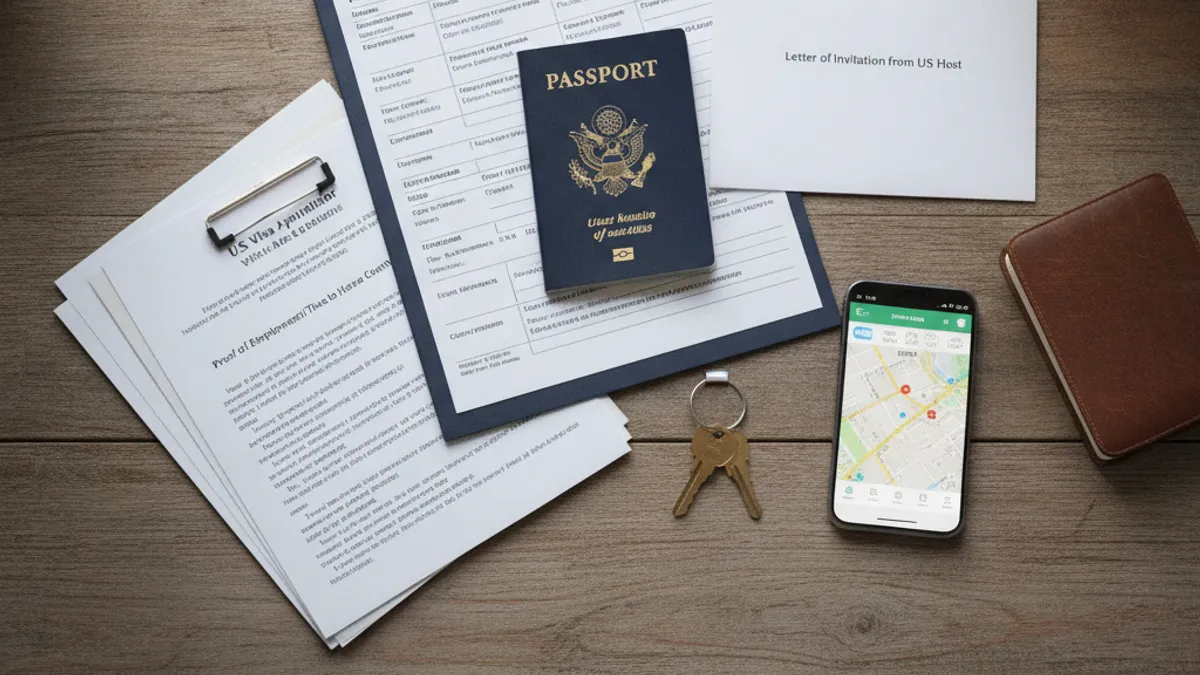
When you're looking to apply for a U.S. visa from abroad, the stakes can feel a bit higher. That's because you're stepping outside the standard procedure. To successfully navigate this, you need to be prepared to provide very clear and convincing evidence across a few key areas. It's not just about filling out forms; it's about proving your intentions and your situation to the consular staff.
Proving Your Ties Back Home
This is arguably the most critical aspect. When you apply for a non-immigrant visa, the U.S. government operates under the assumption that you intend to return to your home country after your visit to the U.S. is complete. Therefore, you must demonstrate strong ties to your country of citizenship or, if applying from abroad, your country of legal residence. These ties act as your anchor, showing you have compelling reasons to return.
Examples of strong ties include:
- Family: Spouse, children, elderly parents who depend on you.
- Employment: A stable job with ongoing responsibilities and a clear intention to return to it.
- Property: Owning a home or significant assets.
- Financial Commitments: Business ownership, ongoing investments, or financial obligations in your home country.
- Social Ties: Membership in community organizations or strong social networks.
If you're applying from a third country, showcasing these ties to that country becomes even more important, alongside any remaining ties to your home country. The more concrete your ties, the more confident the consular officer will be that you will depart the U.S. as required.
Verifying Your Legitimate Reason to Travel
Beyond proving you'll come back, you absolutely must convince the consular officer of your genuine purpose for visiting the United States. This means clearly articulating why you need to go to the U.S. and what you plan to do there. The justification needs to align perfectly with the type of visa you're applying for.
For instance, if you're applying for a tourist visa (B-2), you need to explain your travel plans, sightseeing, visiting family, attending a wedding, medical treatment, and provide any supporting documentation. If it's a student visa (F-1), you'll need your I-20 form from your U.S. educational institution. For a work visa (H-1B), you'll need your approved petition and a job offer. Vagueness or a seemingly weak reason for travel can lead to visa denial.
The more specific and well-supported your reason, the better your chances.
Meeting Specific Visa Requirements
Each type of U.S. visa has its own unique set of eligibility criteria. These aren't optional; they are non-negotiable hurdles you must clear. When applying from another country, these requirements often take center stage. For example, a student visa applicant won't just need proof of residency; they'll also need to prove they have sufficient funds to cover their tuition and living expenses in the U.S. without working.
Similarly, a business visitor on a B-1 visa needs to show they are coming to the U.S. for legitimate business activities, like attending conferences or negotiating contracts, and not to be employed. Failure to meet even one of these specific requirements, no matter how strong your ties or how clear your reason for travel, can result in your visa application being denied. Always consult the official U.S. Department of State website or the specific embassy's site for the exact requirements of the visa category you're pursuing.
Navigating Embassy and Consulate Policies

U.S. embassies and consulates around the world operate under the direction of the U.S. Department of State, but each location has its own specific policies and procedures. This is especially true when it comes to processing visa applications from individuals who are not citizens of the country where the embassy is located. Understanding these specific policies is crucial to avoid common pitfalls.
How to Find the Right Embassy Website
The most accurate information regarding visa application procedures, including rules for third-country nationals, will always be found on the official website of the specific U.S. embassy or consulate where you intend to apply. Simply searching for "U.S. Embassy [Country Name]" is your best bet.
Once on the embassy's website, look for sections like "Visa Services," "U.S. Citizens Services" (though this is for U.S. citizens, it sometimes contains relevant links or contact information), or specifically "Applying for a Visa from a Third Country." These sections will detail any special requirements, restrictions, or procedures that apply to non-residents. It's critical to read these carefully, as policies can vary significantly from one embassy to another. For instance, as of 2026, some embassies might be more accommodating to certain nationalities applying from their jurisdiction than others.
Understanding Local Processing Rules
Embassy websites will often spell out their jurisdiction. This means they'll clearly state which nationalities or residency types they are equipped and willing to process applications for. Some embassies may have agreements to accept applications from nationals of neighboring countries, while others strictly adhere to processing only for citizens and legal residents of the country where they are located.
For example, a U.S. embassy in a popular tourist destination might have more experience processing applications from tourists on short stays compared to an embassy in a country with a very small foreign population. It’s also important to understand that even if an embassy can process your application, the wait times for appointments and processing can differ greatly. Checking the embassy's specific visa wait time information is also a vital part of planning. This local context is key to a smooth application process.
Common Mistakes to Avoid When Applying Abroad
Applying for a U.S. visa from another country introduces a layer of complexity, and it's easy to stumble if you're not careful. Several common errors can lead to significant delays or even outright denial. The biggest mistake is often assuming a process that works in one embassy will work the same way in another. Always verify the specific rules for your application location.
Assuming You Can Apply Anywhere
A frequent misconception is that you can simply walk into any U.S. embassy or consulate worldwide and initiate a visa application. This is rarely the case. As we've discussed, the primary rule centers on your legal residency. If you're not a legal resident of the country where the embassy is located, they will very likely refuse to accept your application.
This rule isn't arbitrary; it's a policy designed to manage caseloads and ensure applicants are within the jurisdiction they are most connected to.
Not Checking Official Embassy Guidelines
Another significant error is relying on outdated information or general advice found on unofficial forums or through word-of-mouth. Embassy policies can change, and each consulate operates with a degree of autonomy within the State Department framework. What might have been true a year ago, or for an embassy in a different country, may not be true for your specific situation today. Always, always, always refer to the official website of the U.S. embassy or consulate where you plan to apply.
This is your most reliable source for current requirements, appointment availability, and any specific instructions for third-country national applicants.
Can You Apply from a Third Country if You're Just Visiting?

No, you generally cannot apply for a U.S. visa from a third country if you are merely visiting as a tourist or for a short-term trip. The U.S. Department of State requires visa applications to be submitted at a U.S. embassy or consulate in the country of your legal residence. If you are in a country temporarily for tourism or transit, you are not considered a resident.
In such instances, you will almost certainly be directed to return to your home country or your country of permanent residency to initiate the application process.
Why Tourists Can't Usually Apply Abroad
The reasoning behind this policy is straightforward. Consular officers are tasked with processing applications from individuals who have established a clear connection to the country of the embassy. When you are just passing through as a tourist, you lack those established ties. The embassy's jurisdiction is generally for residents of that country, not for transient visitors.
This is why airlines and travel agencies often stress the importance of starting your visa application process in your home country or country of long-term residence well in advance of any planned international travel.
What Happens If You Try Anyway?
If you attempt to apply for a U.S. visa at an embassy in a country where you are only a temporary visitor, your application will most likely be refused. You might be given a standard refusal letter stating that you must apply from your country of residence. In some cases, you may be instructed to reschedule your appointment once you have returned to your home country. This can cause significant disruption to your travel plans and might even lead to visa interview scheduling delays, impacting your ability to travel to the U.S. as planned.
What if You're Working Abroad and Need a Visa?

If you are currently employed and living in a country other than your home nation, that country's U.S. embassy or consulate is typically where you will apply for your U.S. visa. Your employment and residency status in that foreign country generally designate it as your current place of legal residence for consular processing purposes. This is a very common scenario, especially for professionals on expat assignments or those who have relocated for work.
To be successful, you will need to provide proof of your employment and legal residency in that country. This could include your work contract, recent pay stubs, health insurance documentation, and a valid residency permit or long-term visa for that country. The consular officers will want to see that you have established a stable living and working situation abroad. This demonstrates your intent to continue residing in that country, reinforcing your ties there.
Proof of Employment and Residency
When applying from your country of employment abroad, standard documentation includes:
- Residency Permit/Long-Term Visa: Your official document allowing you to live and work in that country.
- Employment Contract: A copy of your current signed contract.
- Recent Pay Stubs: Typically, the last 3-6 months of payslips.
- Tax Documents: Proof of tax contributions in that country.
- Utility Bills/Lease Agreements: Bills or rental contracts showing your current address.
These documents collectively build a picture for the consular officers that you have a legitimate reason to be residing in that country and that it is a stable base for your life.
Can You Apply from Your Home Country Instead?
While you can often choose to apply from your country of citizenship, it might complicate matters or not be the preferred route if you have significant ties and residency established in your country of employment abroad. The U.S. embassy in your home country might question your assertion of residency abroad if you are not actively living there. Generally, it's advised to apply from where you are currently living and working, as that is considered your primary place of residence. If you have specific reasons to apply from your home country despite living abroad, be prepared to explain them thoroughly.
What About Student Visa Applications from Abroad?

International students pursuing education in the U.S. also face the question of where to apply for their F-1 or M-1 student visas. Similar to other visa types, you will typically apply at the U.S. embassy or consulate in the country where you have legal residence. If you are a student living in your home country, you apply from there. If you are already studying abroad in a third country and applying for a different program in the U.S., you would usually apply from that current country of residence, provided you have legal status there.
The Role of the I-20 Form
Your application for a U.S. student visa begins with receiving a Form I-20, "Certificate of Eligibility for Nonimmigrant Student Status," from the U.S. educational institution where you've been accepted. This document is crucial because it confirms your acceptance and provides essential details about your program, costs, and how you will be funded. The information on your I-20 will dictate your visa application process.
Crucially, when you attend your visa interview, you'll need to present your I-20, along with other required documents. The consular officer will use this form to verify your eligibility. If you are applying from a third country, the I-20’s start date and your residency status in that third country will be examined together to ensure consistency.
Proof of Financial Support
A major part of the student visa application, regardless of where you apply from, is demonstrating that you have sufficient funds to cover your tuition, living expenses, and other costs associated with studying in the U.S. This often requires providing bank statements, scholarship letters, or affidavits of financial support from sponsors. The amount needed will be detailed on your I-20 form. If you are applying from a third country, you may also need to show how these funds are accessible or manageable from your current location.
Making the Right Decision for Your Visa Application
So, you’ve explored the ins and outs of applying for a U.S. visa from another country. The core takeaway is clear: your legal residency status is the most significant factor determining where you should apply. If you are a legal resident of a country other than your home nation, that country's U.S. embassy or consulate is generally your designated application point.
When to Apply from Your Home Country
If you are currently living in your home country, that's where you should apply. You'll need to show proof of citizenship, such as a passport, and demonstrate strong ties to your home country that indicate your intention to return after your U.S. visit. This is the most straightforward scenario and often involves fewer complications than applying from a third country.
When to Apply from Your Country of Residence Abroad
If you've relocated and established legal residency abroad, you will apply from the U.S. embassy or consulate in that country. Be prepared to present robust evidence of your residency status, such as a valid permit or long-term visa, alongside employment verification and proof of property or family ties in that location. This demonstrates your commitment to residing there and fulfills the consular processing requirements.
What If You're Just Visiting a Third Country?
If you find yourself in a third country as a tourist, traveler, or in transit, do not plan to apply for your U.S. visa there. This is a common mistake that can lead to immediate refusal and significant delays. Instead, make arrangements to return to your home country or your country of legal residence to submit your application. Always verify the explicit policies on the embassy's website for the most accurate guidance relevant to your specific situation.