
Considering what is J-1 visa in USA often means you’re looking for a way to experience America through an exchange program. This visa isn’t just a travel document; it’s a vehicle for cultural immersion, skill development, and international connection, specifically designed for approved exchange visitor categories. It allows individuals to come to the United States for practical training, education, or cultural exchange.
Thank you for reading this post, don't forget to subscribe!The U.S. Department of State oversees these programs, working with designated sponsorship organizations to facilitate everything from securing the crucial Form DS-2019 to ensuring participants meet all requirements. The program’s goal is to foster mutual understanding between the U.S. and other countries, offering participants a unique glimpse into American life and society. Let’s break down who qualifies, what the process involves, and the key aspects you need to understand.
J-1 Visa Quick Guide: Key Things to Know First
Before diving into the specifics, it’s helpful to have a quick overview of what makes the J-1 visa distinct. This visa category is specifically for participants in approved exchange visitor programs. It’s not a tourist visa (like the B-2) or an immigrant visa; it’s a temporary, non-immigrant status designed for a cultural exchange experience that benefits both the visitor and the host country. As of 2026, the program continues to facilitate these exchanges, but its rules and requirements are strictly enforced.
- Purpose: Cultural exchange, education, training, and skill development.
- Eligibility: Depends on participation in a specific, State Department-approved exchange program.
- Key Document: Form DS-2019, Certificate of Eligibility for Exchange Visitor Status, issued by a designated sponsor.
- Duration: Varies by program category, from a few weeks to several years.
- Requirement: Often includes a two-year home-country physical presence requirement after program completion.
- Sponsorship: You must be sponsored by a designated organization authorized by the U.S. Department of State.
Understanding these core points is the first step to successfully navigating the J-1 visa process. It sets the stage for understanding the requirements and steps involved in your application.
Who Qualifies for a J-1 Visa? Your Eligibility Checklist

So, who can actually get a J-1 visa? The answer really hinges on whether you fit into one of the many categories the Exchange Visitor Program supports and if you can find a suitable program. It’s not a matter of simply wanting to visit for leisure; you need a specific purpose aligned with an approved exchange. Our research shows that eligibility is typically determined by your age, education level, professional background, and the specific exchange program you aim to join.
Student Exchange Programs
These are some of the most common J-1 categories, allowing students to study at U.S. colleges and universities, or even attend high school. The specific requirements vary greatly depending on the program. For instance, college students might need to demonstrate a certain GPA and a plan for academic training related to their studies. High school exchange students often need parental consent and a solid understanding of program rules regarding living with a host family.
- Full-time Students: Pursuing a degree at a U.S. post-secondary institution.
- High School Students: Participating in secondary school exchange programs.
- Academic Training: Internships or practical training directly related to a student’s field of study.
- Medical Students: Specific programs exist for physicians to complete rotations or clerkships.
Trainee and Internship Programs
These categories are designed for individuals who have already graduated from a college or university (or are currently studying and meet certain criteria) and wish to gain practical experience in their field within the U.S. The key here is that the experience must be hands-on and directly related to the participant’s academic pursuits. It’s not just about working a job; it’s about structured learning and skill development.
- Interns: Typically students or recent graduates seeking hands-on experience in their field.
- Trainees: Individuals with a degree and at least one year of professional experience outside the U.S., or those with five years of experience, seeking to enhance their skills.
- Purpose: To gain practical experience, not to fill a labor shortage.
- Program Length: Trainee programs can last up to 18 months, while internship programs usually last up to 12 months.
Scholar and Research Programs
For academics, researchers, professors, and specialists, these J-1 categories offer a fantastic opportunity to collaborate with U.S. institutions, conduct research, or share expertise. This is often about contributing to academic discourse or advancing knowledge in a specific field. Participants in these programs are typically well-established in their home countries and are coming to the U.S. to enrich their own professional experience and contribute to American academia.
- Professors: Coming to teach or conduct research.
- Research Scholars: Engaging in research, lecturing, consulting, or observing.
- Specialists: Individuals with exceptional knowledge in a specialized field, coming to consult, observe, or advise.
- Duration: Can range from a few weeks to a maximum of five years for Research Scholars and Professors.
Au Pair and Camp Counselor Programs
These are unique, family-oriented, and recreational categories within the J-1 visa umbrella. The Au Pair program allows foreign nationals to live with an American family, provide childcare, and in return, receive room, board, and a small stipend, while also experiencing American culture and potentially taking some coursework. The Camp Counselor program brings international staff to U.S. summer camps, helping to run activities. Both require specific sponsorship and adherence to program regulations.
- Au Pairs: Provide childcare for a host family in exchange for room, board, and a stipend; typically involves some educational component.
- Camp Counselors: Work at U.S. summer camps, leading activities and assisting with camp operations.
- Duration: Au pair programs typically last 12 months, extendable up to 24 months. Camp counselor programs are seasonal, usually lasting up to four months.
The Exchange Visitor Program Explained: What It’s All About

At its heart, the Exchange Visitor Program isn’t just about getting a visa; it’s about fostering cultural understanding and educational enrichment. The U.S. Department of State administers this program, which operates through a network of designated sponsor organizations. These sponsors are crucial because they are the entities authorized to issue the Form DS-2019, which is your ticket to applying for the J-1 visa itself.
Without a DS-2019 from an approved sponsor, you cannot proceed. The program’s core mission is to promote mutual understanding between the United States and other countries by bringing individuals to the U.S. to teach, study, conduct research, or demonstrate special skills.
The program encompasses a wide array of categories, each with its own specific objectives and requirements. These aren’t just academic pursuits; they range from high school students experiencing American education to professionals undergoing specialized training, researchers collaborating in labs, and even nannies or camp counselors. The underlying principle is that participants will return to their home countries with new perspectives, skills, and an enhanced understanding of American culture, which they can then share. This reciprocity is a key component and often leads to the mandatory “two-year home-country physical presence requirement,” known as the 212(e) rule.
Key Pillars of the Exchange Visitor Program:
- Cultural Exchange: Encouraging interaction and understanding between people from different backgrounds.
- Educational Opportunities: Providing access to U.S. academic institutions and specialized learning.
- Skill Development: Offering practical training and experience in various professional fields.
- Mutual Benefit: Aiming to enrich both the participants and the communities they engage with in the U.S., fostering goodwill.
This program underscores a commitment to international cooperation and personal growth. It’s vital to recognize that your participation is not merely personal; it’s part of a larger framework designed to build stronger global connections.
How to Apply for a J-1 Visa: Step-by-Step
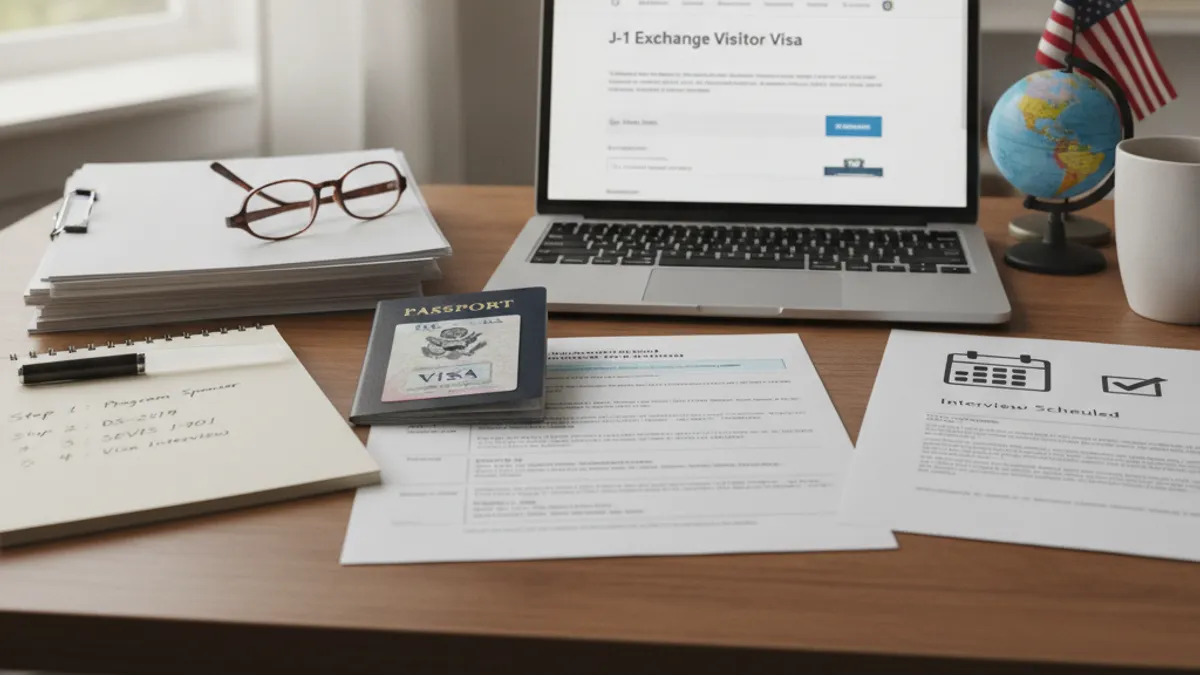
Embarking on the J-1 visa application process can seem like a lot, but breaking it down into manageable steps makes it much clearer. The entire journey hinges on finding the right exchange program and getting sponsored. This is where the designated sponsor organizations play their critical role, acting as your gateway to the U.S. exchange visitor system. You can’t apply for a J-1 visa directly through an embassy or consulate without first being accepted into an eligible program and receiving the necessary documentation from your sponsor.
Choosing and Working with a Sponsor Organization
The absolute first step in the J-1 visa process is to identify and be accepted into an exchange program administered by a designated sponsor organization. These organizations are authorized by the U.S. Department of State to manage specific J-1 categories. They vet applicants, ensure program compliance, and issue the essential Form DS-2019.
You’ll need to research programs that align with your educational background, career goals, and interests. Once you find a program and are accepted, the sponsor will guide you through their internal procedures.
- Research: Identify sponsors for your desired J-1 category (e.g., Intern, Trainee, Scholar, Student).
- Apply: Complete the sponsor’s application, which often includes essays, resumes, and proof of qualifications.
- Acceptance: If accepted, the sponsor will provide detailed instructions on program particulars and visa requirements.
- Communication: Maintain open communication with your sponsor; they are your primary point of contact for all J-1 related matters.
Getting Your Form DS-2019
Once you’ve been accepted into a program and your sponsor has confirmed your eligibility, they will issue you a Form DS-2019, Certificate of Eligibility for Exchange Visitor Status. This document is fundamental. It contains vital information about your program, including its start and end dates, your sponsor’s details, and your designated J-1 category. You must have this form in hand to proceed with your visa application and for entry into the United States.
- Crucial Document: The DS-2019 is proof you are participating in an official exchange program.
- Information Verification: Carefully check all details on the DS-2019 for accuracy. Any errors must be corrected by the sponsor immediately.
- Program Details: It outlines your program dates, sponsor, J-1 category, and financial support.
Paying the SEVIS Fee
Before you attend your visa interview, you must pay the I-901 Student and Exchange Visitor Information System (SEVIS) Fee. This fee supports the SEVIS program, which tracks international students and exchange visitors in the U.S. You’ll need your SEVIS ID number, which is located on your Form DS-2019, to pay this fee. Keep the receipt as proof of payment, as you’ll need it for your visa interview.
As of the latest guidance, the fee for J-1 visa applicants is $220.
- Mandatory Fee: Required for most J-1 visa applicants.
- SEVIS ID: Found on your Form DS-2019.
- Online Payment: Typically paid through the official SEVP government website.
- Receipt: Keep this official receipt for your interview.
The Visa Application and Interview
With your DS-2019 and SEVIS fee receipt, you can now complete the Online Nonimmigrant Visa Application, Form DS-160. After submitting the DS-160, you’ll need to schedule a visa interview at the U.S. embassy or consulate in your home country. During the interview, a consular officer will review your application, ask questions about your program plans, and assess your eligibility for the J-1 visa. Be prepared to clearly articulate your reasons for participating in the exchange program and your intentions to return to your home country afterward.
- DS-160 Form: Complete this online application thoroughly and accurately.
- Interview Scheduling: Book your appointment well in advance, as wait times can vary significantly.
- Required Documents: You’ll typically need your passport, DS-2019, SEVIS fee receipt, DS-160 confirmation page, and potentially financial documentation.
- Interview Questions: Expect questions about your program, your academic/professional background, and your ties to your home country.
Arriving in the U.S.
Upon successful completion of your visa interview, you’ll be issued your J-1 visa, which will be placed in your passport. You can typically enter the United States up to 30 days before the start date listed on your DS-2019. When you arrive at a U.S. port of entry, a Customs and Border Protection (CBP) officer will inspect your documents and determine your admissibility. They will stamp your passport, indicating your admission status and the date you are permitted to stay until.
It’s crucial to report to your sponsor shortly after arrival, as they manage your ongoing program status.
- Entry Window: Usually allowed up to 30 days prior to your program start date.
- Port of Entry Inspection: CBP officers make the final decision on your admissibility.
- Documentation: Have your passport with visa, DS-2019, and SEVIS fee receipt ready.
- Reporting to Sponsor: Essential for registration and program commencement.
J-1 Visa Benefits: What You Gain

The J-1 visa offers a unique set of advantages for participants looking to immerse themselves in American culture and gain invaluable international experience. Beyond just the opportunity to live and work or study in the U.S., the program is structured to provide significant personal and professional growth. Aggregated feedback from participants indicates that the primary draw is the chance for deep cultural immersion, going beyond what a typical tourist experience can offer. You get to live like a local, understand daily life, and build genuine connections.
This cultural exchange is often paralleled by substantial skill development. Whether you’re a student gaining practical experience through an internship, a researcher collaborating on cutting-edge projects, or a trainee learning new professional techniques, the J-1 visa facilitates direct, hands-on learning. This can significantly boost your resume and career prospects upon your return home. Furthermore, the networking opportunities are immense.
You’ll be interacting with Americans and other international participants from diverse backgrounds, potentially building a global network of contacts that can last a lifetime.
- Cultural Immersion: Live, work, and interact within American communities.
- Skill Enhancement: Gain practical experience and professional training directly relevant to your field.
- Global Networking: Build relationships with Americans and fellow exchange visitors from around the world.
- Personal Growth: Develop independence, adaptability, and a broader worldview.
- Career Advancement: Enhance your resume and marketability upon returning to your home country.
The benefits extend beyond tangible skills; the experience often fosters greater self-confidence and a more nuanced understanding of global affairs. It’s an investment in yourself and your future that can yield lifelong dividends.
Potential J-1 Visa Pitfalls and How to Avoid Them
While the J-1 visa is a fantastic opportunity, navigating its requirements can sometimes lead to missteps. Our analysis of common issues found that many participants face challenges due to misunderstandings about program rules, documentation errors, or not fully grasping the long-term implications of their visa status. Being aware of these potential pitfalls from the outset is key to a smooth and successful exchange experience. The most common problems stem from insufficient preparation and a lack of attention to detail.
Common Application Mistakes
One of the most frequent errors involves incomplete or inaccurate documentation. This can range from missing signatures on forms to providing outdated financial statements or failing to properly explain the purpose of your stay in the DS-160 application. Another significant issue is not thoroughly understanding the specific requirements of the J-1 category you’ve applied for. For example, an intern must ensure their placement genuinely involves training and not just basic employment, and this needs to be clearly documented through the DS-7002 form if applicable.
- Incomplete Forms: Missing information or signatures on DS-160, DS-2019, or other required documents.
- Incorrect Documentation: Submitting the wrong type of financial proof, expired passports, or poorly translated academic transcripts.
- Misinterpreting Program Rules: Not understanding the specific job duties for Interns/Trainees vs. casual employment, or the academic requirements for students.
- Insufficient Ties to Home Country: Failing to convince the consular officer that you intend to return home after your program.
Maintaining Your Visa Status
Once in the U.S., maintaining your J-1 status is paramount. This means adhering to all program rules, not working without authorization, and ensuring you remain enrolled or engaged in your designated program activities. Deviating from your program’s terms or your approved dates without proper authorization can lead to a loss of status, meaning you’ll no longer be legally present in the U.S. and may face difficulties in the future. Regularly communicating with your sponsor organization is vital for staying compliant.
Your sponsor is responsible for updating your record in the SEVIS system.
- Program Adherence: Stick to the activities and timeline outlined in your DS-2019.
- Authorized Employment: You can only work as permitted by your specific J-1 category and sponsor.
- Reporting Changes: Inform your sponsor immediately of any changes to your address, academic standing, or program participation.
- Timely Departure: You must leave the U.S. by the end date specified on your DS-2019, or within any authorized grace period.
Understanding the Two-Year Home-Country Physical Presence Requirement (212(e))
A critical, and often misunderstood, aspect of the J-1 visa is the “two-year home-country physical presence requirement,” also known as section 212(e) of the Immigration and Nationality Act. Many J-1 visa holders are subject to this rule, which mandates that they must return to their country of nationality or last legal permanent residence for at least two years after completing their J-1 program before they can apply for certain other U.S. visas, such as an H-1B temporary worker visa or an immigrant visa (green card). It’s crucial to check your DS-2019 and passport for a stamp indicating if this requirement applies to you. While waivers are possible in certain circumstances, they are complex and should not be relied upon without thorough investigation.
- What it Means: You must physically reside in your home country for two consecutive years after your J-1 program ends.
- Visa Restrictions: This prevents you from immediately changing to certain other non-immigrant or immigrant visa statuses while in the U.S.
- Checking Applicability: The DS-2019 and visa stamp will indicate if 212(e) applies.
- Waiver Process: Waivers exist but are difficult to obtain and require specific qualifying circumstances (e.g., no objection statement from your home country, exceptional hardship to a U.S. citizen spouse/child).
J-1 Visa Costs and Fees to Budget For
Understanding the financial commitment is a crucial part of planning for a J-1 visa. While the J-1 visa itself doesn’t typically have a direct visa application fee like some other categories, there are several mandatory costs associated with the process. These fees are essential for your application to be processed and for you to legally participate in the exchange program. It’s wise to budget for these expenses early on to avoid any surprises.
Mandatory Fees You’ll Encounter:
- SEVIS I-901 Fee: This is a non-negotiable fee required for all J-1 participants. As of 2026, the standard rate stands at $220. This fee funds the Student and Exchange Visitor Information System (SEVIS), which tracks international visitors in the U.S. You must pay this before your visa interview.
- Visa Application Fee (MRV Fee): While sometimes referred to as a visa application fee, the primary fee paid to the Department of State at the embassy or consulate is officially termed the Machine Readable Visa (MRV) fee. For most J-1 applicants, this is $185. This fee covers the processing of your visa application, regardless of whether it’s approved or denied.
- Program Fees: These vary wildly depending on the sponsor organization and the specific exchange program. Some programs may have substantial fees covering placement, insurance, and administrative costs, while others might be minimal or even free if you secure independent funding or a position with a stipend. Always ask your sponsor for a breakdown of all program-related costs.
- Travel and Living Expenses: This is the most variable cost. You’ll need to account for flights to and from the U.S., initial accommodation upon arrival, daily living expenses (food, transportation, personal items), and any travel or recreational activities you plan. Sponsors often require proof that you have sufficient funds to support yourself for the duration of the program.
Program-Specific Costs to Consider:
- Insurance: J-1 visa regulations mandate that participants and their dependents must maintain health insurance that meets specific requirements. Sponsors often provide this, or they may require you to obtain it through a specific provider, with costs ranging from $50 to over $100 per month depending on coverage and location.
- Program Administration/Placement Fees: Some sponsors charge a fee for their services in placing you in a program, providing support, and issuing the DS-2019. This can range from a few hundred to over a thousand dollars.
- Coursework or Training Materials: If your program involves any required coursework, textbooks, or specific training materials, factor those into your budget.
It’s essential to get a clear, itemized list of all expected costs from your sponsor organization as early as possible. This proactive approach helps in financial planning and ensures you’re fully prepared.
J-1 Visa vs. Other U.S. Visas: What’s the Difference?
Understanding how the J-1 visa stacks up against other common U.S. visa categories is key to identifying if it’s the right fit for your goals. While several visas allow individuals to spend time in the United States, they serve very different purposes and have distinct eligibility criteria and restrictions. This is particularly important if you’re comparing options for study, work, or cultural exchange.
| Visa Category | Primary Purpose | Key Characteristic | Typical Duration | Common Restrictions |
|---|---|---|---|---|
| J-1 Visa | Cultural Exchange, Education, Training | Participation in a State Department-approved exchange program, requires a sponsor. | Varies by program | Often includes requirement to return home for 2 years (212(e)), employment tied to program. |
| F-1 Visa | Academic Study | Enrolling in a U.S. SEVP-certified academic institution. | Duration of studies | Limited work opportunities (often on-campus or Optional Practical Training after studies). |
| B-1/B-2 Visa | Temporary Business/Tourism | Short-term visits for business meetings, conferences, or pleasure travel. | Up to 6 months typically | No employment permitted, cannot enroll in a course of study that leads to a degree. |
| H-1B Visa | Specialty Occupations (Skilled Workers) | For individuals in occupations requiring theoretical or technical expertise. | Up to 3 years (renewable) | Requires a U.S. employer sponsor, has annual caps (lottery system), and path to permanent residency. |
| J-1 vs. F-1: The J-1 is more versatile for hands-on training and cultural immersion, even for those not pursuing a full degree, whereas the F-1 is strictly for academic study. An F-1 visa participant can’t typically engage in the kind of structured internships or trainee programs common for J-1 holders without additional authorization. | ||||
| J-1 vs. B-1/B-2: A B-1/B-2 visa is for short, non-work-related visits. You cannot legally work, intern, or train in the U.S. on a B-1/B-2 visa. The J-1 visa requires participation in an approved structured program that often includes work or training components. | ||||
| J-1 vs. H-1B: The H-1B is an employment-based visa secured by a specific U.S. employer for a particular job. The J-1 is program-based, focused on exchange and training, not filling ongoing labor needs. If your goal is long-term skilled employment in the U.S., an H-1B is more direct, assuming you can find a sponsoring employer. |
If your primary objective is cultural exchange, obtaining practical training related to your field of study outside a traditional degree program, or participating in a specific exchange like a camp counselor or au pair, the J-1 visa is likely your designated pathway. For purely academic pursuits at a U.S. university, the F-1 visa is typically more appropriate.
Using Your J-1 Visa: What Can You Actually Do?

The J-1 visa isn’t just a passive entry document; it allows you to actively participate in specific activities within the U.S., all tied to your approved exchange program. The type of activities you can engage in depends entirely on the J-1 category you were approved for and the specific details of your program as outlined by your sponsor. It’s crucial to remember that your ability to work, study, or train is strictly governed by the terms of your visa and program. Unauthorized activities can lead to serious immigration consequences.
Key Activity Streams for J-1 Visa Holders:
- Study: J-1 students can attend U.S. colleges and universities, pursue research, or participate in academic training related to their field of study. This is similar to the F-1 visa but often integrated within a broader exchange framework.
- Training and Internships: For categories like “Intern” and “Trainee,” the focus is on hands-on practical experience in your chosen field. This involves learning specific skills and gaining industry knowledge under supervision. The training must be directly related to your academic major or professional background.
- Teaching and Research: Scholars, professors, and researchers come to the U.S. to impart knowledge, collaborate on academic projects, or conduct scientific research at U.S. institutions.
- Childcare and Recreation: Programs like the Au Pair and Camp Counselor categories allow participants to work in specific roles within American families or at summer camps, respectively.
Employment Regulations for J-1 Holders:
Employment for J-1 visa holders is always program-specific. For instance, students might have on-campus work opportunities or off-campus Academic Training, while trainees engage in work directly related to their training plans. Unauthorized employment is a serious violation. Your ability to work is contingent on the specific J-1 category and your sponsor’s approval.
Always confirm any work opportunities with your designated sponsor before accepting any position.
- Interns/Trainees: Work must be directly related to the training plan (DS-7002).
- Students: May work on-campus and, in some cases, off-campus through Academic Training.
- Scholars/Professors: Employment is typically tied to their academic or research appointment.
- Au Pairs/Camp Counselors: Work is defined by the terms of their specific programs.
If you are unsure whether a particular activity is permitted under your J-1 status, the best course of action is always to consult your sponsoring organization. They are your primary resource for ensuring you remain in compliance with U.S. immigration regulations.
J-1 Visa Waivers: When You Need to Get Out of the Two-Year Rule

As we touched upon earlier, many J-1 visa holders are subject to the two-year home-country physical presence requirement (212(e)). This rule mandates that you return to your home country for two consecutive years after your J-1 program concludes before you can apply for certain other U.S. visas, like an H-1B or an immigrant visa. However, there are specific circumstances under which you can apply for a waiver of this requirement, allowing you to pursue those pathways sooner if eligible. Obtaining a waiver is a complex process and not guaranteed.
Who Might Qualify for a Waiver?
The U.S. government offers waivers based on several grounds, each requiring substantial proof:
- No Objection Statement: Your home country’s government issues a statement indicating they do not object to you not returning for the two-year period. This is the most common basis for a waiver but can be difficult to obtain from certain governments.
- Request by a U.S. Federal Government Agency: If a U.S. federal agency determines that your departure would be detrimental to their interest, they can request a waiver on your behalf. This is typically for individuals whose J-1 program involved work beneficial to a U.S. agency.
- Persecution: You can demonstrate that you fear persecution in your home country based on race, religion, or political opinion. This often involves extensive documentation and evidence.
- Exceptional Hardship to a U.S. Citizen or Lawful Permanent Resident Spouse or Child: You must prove that your departure would cause exceptional hardship to your U.S. citizen or lawful permanent resident spouse or child. This is a high bar to meet and requires significant evidence of hardship.
- Interested Government Agency (IGA) Waiver: Certain U.S. government agencies that have an interest in your continued stay for specific projects or reasons can sponsor a waiver. This often applies to individuals in fields like healthcare or research where there’s a demonstrated need.
The Waiver Application Process:
The process for applying for a J-1 waiver is administered by the Department of State, but it often involves multiple government agencies.
- J-1 Waiver Recommendation Application: You’ll start by submitting an online application to the Department of State’s J-1 Waiver Online system.
- Contact Relevant Agencies: Depending on your waiver basis, you might need to interact with your home country’s consulate, a U.S. federal agency, or demonstrate hardship.
- USCIS Review: Once the Department of State has processed your initial application and, if applicable, received recommendations, your case may be forwarded to U.S. Citizenship and Immigration Services (USCIS) for a final determination.
- Notification: USCIS will notify you and the Department of State of their decision. If the waiver is granted, you can then typically proceed with applying for a change of status or a new visa.
Given the complexity and the stringent evidence requirements, seeking advice from an experienced immigration attorney is highly recommended if you believe you qualify for a J-1 waiver. They can help you assess your eligibility, gather the necessary documentation, and navigate the intricate application procedures.
J-1 Visa FAQs: Clearing Up Common Questions
You’ve got questions about the J-1 visa, and that’s completely normal. This visa category has many moving parts, and it’s easy to get confused. We’ve gathered some of the most frequent inquiries to help clarify any lingering doubts you might have. Let’s tackle some of these head-on to ensure you have the clearest understanding possible as you consider or proceed with your J-1 exchange program.
How long can I stay in the U.S. on a J-1 visa?
Your allowed stay on a J-1 visa depends entirely on the specific exchange program you are participating in. Some programs, like Summer Work Travel, might last only a few months. Others, like scholar or certain trainee programs, can extend up to 18 months or even five years. The exact duration will be clearly stated on your Form DS-2019.
It’s crucial to adhere to these dates and to depart the U.S. by the program’s end date unless you have received an authorized extension or change of status.
Can I work a second job on a J-1 visa?
Generally, no. Your work authorization on a J-1 visa is strictly tied to the specific exchange program you were approved for. For example, if you are a J-1 Intern, you can only work for the company listed on your DS-2019 and DS-7002 training plan. Students might have limited on-campus work privileges or be eligible for Academic Training related to their studies.
Taking on unauthorized employment is a serious violation of your visa status and can have severe consequences, including deportation and future inadmissibility to the U.S. Always confirm with your sponsor before accepting any work.
What happens if my J-1 program ends early?
If your J-1 program concludes before the date stated on your DS-2019, you typically have a grace period of 30 days to depart the United States. This grace period is meant for you to make travel arrangements and leave the country. You cannot continue to work or engage in any program activities during this grace period. If your program ends due to a serious issue, such as dismissal, you should contact your sponsor organization immediately.
They will advise you on the next steps, which may involve departing the U.S. sooner than planned.
Do I need health insurance as a J-1 visa holder?
Yes, absolutely. All J-1 visa participants are required by federal regulation to maintain health insurance that meets specific minimum coverage requirements for the entire duration of their program. Your sponsor organization is responsible for ensuring you comply with this. Many sponsors offer a designated insurance plan, or they may approve an outside plan that meets the criteria.
Failure to maintain adequate health insurance is a violation of your J-1 status and can jeopardize your visa.
Can I extend my J-1 stay?
In some cases, it’s possible to extend your J-1 program, but this is determined by the specific program category and the rules set by your sponsor and the U.S. Department of State. For example, a research scholar might be able to extend their stay if their research is ongoing and supported by their sponsor. However, extensions often require a new DS-2019 reflecting the updated program dates.
You must apply for an extension before your current program end date and ensure you receive approval from your sponsor and potentially undergo further visa processing if needed.
Expert Tips for a Smooth J-1 Exchange Experience
Securing a J-1 visa and successfully completing your exchange program involves more than just following the procedural steps. It’s about proactive engagement, clear communication, and a thorough understanding of the regulations. Based on editorial analysis of successful exchange participant feedback and program administrator insights, here are some expert tips to ensure your experience is as rewarding and problem-free as possible. These go beyond the basic application requirements.
- Choose Your Sponsor Wisely: Not all sponsors are created equal. Research their reputation, the types of programs they offer, and their level of support for participants. Read reviews if available, and don’t hesitate to ask potential sponsors detailed questions about their services and how they assist participants. A good sponsor is invaluable.
- Understand Your Program Inside and Out: Before you even arrive, thoroughly review all details of your exchange program. Know what your responsibilities are, what you are expected to achieve, and any specific rules you must follow. If you’re a trainee or intern, become intimately familiar with your training plan (DS-7002) and ensure your duties align.
- Maintain Constant Communication with Your Sponsor: Your sponsor is your lifeline in the U.S. immigration system. Keep them informed of any changes in your circumstances, address, or program participation. If you have any questions or concerns, no matter how small they seem, reach out to them. Proactive communication can prevent many common issues from escalating.
- Document Everything: Keep copies of all official documents: your passport, visa, DS-2019, SEVIS fee receipt, DS-160 confirmation page, flight itineraries, and any communication from your sponsor or U.S. government agencies. This organized record-keeping can be a lifesaver if any issues arise.
- Be Culturally Aware and Respectful: Remember that the J-1 visa is about cultural exchange. Be open-minded, respectful of U.S. customs and laws, and willing to engage with people from different backgrounds. Small efforts to understand and adapt can make your experience much richer and more positive.
- Plan Your Finances Meticulously: Beyond the mandatory fees, budgeting for living expenses is critical. Research the cost of living in your host city or region. Understand how your stipend or financial support works, and ensure you have a buffer for unexpected costs.
- Know Your Departure Obligations: Pay close attention to your program end date and the subsequent departure requirements, especially if the 212(e) rule applies to you. Planning your departure and any potential visa waiver applications well in advance is crucial to avoid overstaying your visa.
Comments are closed.