Thank you for reading this post, don't forget to subscribe!
Immigration means moving to another country to live there, either temporarily under an authorized status or permanently, depending on the purpose and rules that apply.
In the United States, immigration refers to the process through which people from other countries enter the country to live, work, join family, or build a new life. Some people come to the U.S. as permanent residents, while others receive permission to stay for a limited time. The rules depend on the person’s purpose, eligibility, and immigration status.
For example, someone who moves from India to the United States to live with a spouse may qualify for a family-based immigrant visa. A person who travels from Brazil to attend a short business meeting may instead need a temporary visitor visa, depending on their citizenship and circumstances. These journeys involve different legal rules, even though both people cross an international border.
Understanding immigration starts with a simple idea: people move into a country, and the government sets rules for entry and residence. In the United States, these rules affect visas, employment, family reunification, permanent residence, and citizenship. Knowing the basic terms can help readers understand news reports, public debates, and the steps involved in a possible move to America.
Immigration means entering a country from another country with the intention of living there for some period. In everyday speech, the term often refers to people who move to a new country to settle, work, study, or join family. In law, however, immigration has a more specific meaning that depends on the country and the person’s status.
In the United States, immigration is governed mainly by federal law. Federal agencies determine which people may qualify for visas, enter the country, remain for certain periods, obtain permanent residence, or pursue citizenship. The rules differ based on a person’s circumstances and the immigration category involved.
Imagine that a family moves from Bangladesh to the United States after receiving approval for an immigrant visa. The family is immigrating to the United States because it is moving into a new country to establish residence. The same family is emigrating from Bangladesh because it is leaving its country of origin.
The word immigration can describe both the movement of people and the legal system that manages that movement. News stories may discuss immigration policy, immigration enforcement, immigration applications, or immigration reform. Each phrase refers to a different part of the broader subject.
Source: canadaimmigration.today
Everyday meaning
Moving from one country to another to live, work, join family, or establish a new home.
Legal meaning
The rules and procedures that govern entry, admission, residence, and certain changes in immigration status.
Practical meaning
The process a person may follow to qualify for a visa, enter the country, maintain lawful status, or become a permanent resident.
Who Is an Immigrant?
An immigrant is generally a person who moves to a country other than the country from which they came, often to establish residence. In U.S. immigration discussions, the term frequently refers to a person who has moved to the country from abroad. The exact legal meaning depends on the context, so it helps to distinguish everyday language from formal immigration categories.
A lawful permanent resident, often called a green card holder, is a person who has permission to live permanently in the United States, subject to applicable laws. Other foreign-born residents may have temporary visas, humanitarian protections, or different immigration statuses. These categories should not be treated as interchangeable.
Immigrant
A general term for someone who moves to another country, commonly to establish residence.
Permanent resident
A person authorized to live permanently in the United States while meeting the conditions of that status.
Nonimmigrant
A person admitted or authorized under a category intended for a specific temporary purpose, such as tourism, study, or certain types of work.
What Is the Difference Between Immigration, Emigration, and Migration?
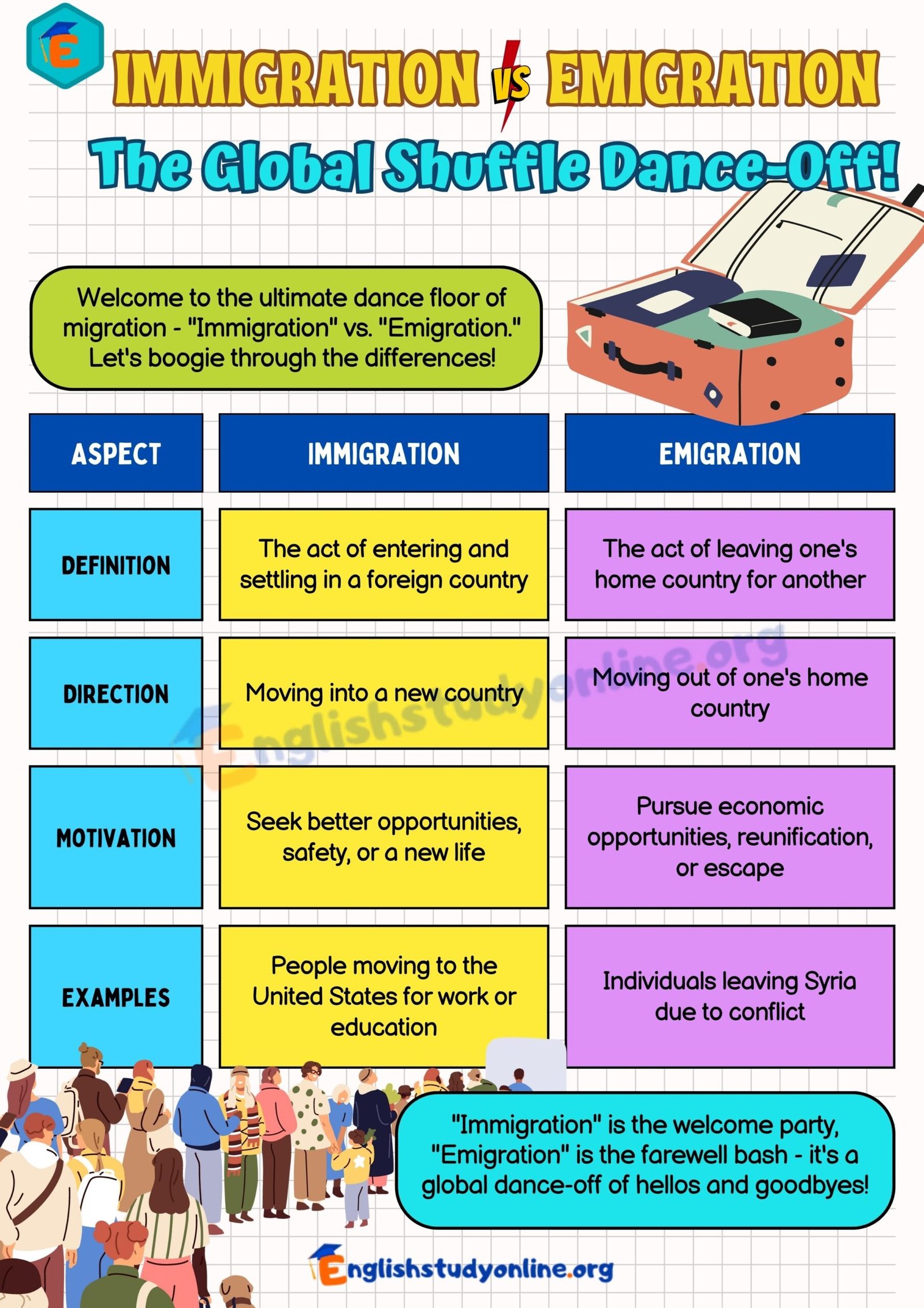
Immigration and emigration describe opposite sides of an international move. Immigration focuses on entering a destination country, while emigration focuses on leaving the country a person is departing from. Migration is the broader term for moving from one place to another, either within a country or across national borders.
The easiest way to remember the difference is to think about the direction of travel. If a person moves from Mexico to the United States, that person is immigrating to the United States and emigrating from Mexico. Both descriptions can be correct at the same time.
Migration does not always involve crossing an international border. A person who moves from Texas to California has migrated within the United States, but has not immigrated to another country. International migration, by contrast, involves movement across a national border.
These terms also appear in government statistics. Researchers may count immigration into a country, emigration out of it, or net international migration, which measures the balance between incoming and outgoing migration under the relevant statistical method. These measures describe population movement rather than deciding whether any individual has legal permission to enter or remain.
Source: www.youtube.com
Immigration
A person moves into another country. Example: A family moves from Bangladesh to the United States.
Emigration
A person leaves their country of origin or former residence. Example: The same family leaves Bangladesh.
Migration
A broad term for movement between places, including moves within one country and moves between countries.
A Simple Example of the Three Terms
Suppose Maria lives in Argentina and receives permission to move to the United States permanently. From Argentina’s point of view, Maria is emigrating. From the U.S. point of view, she is immigrating. The overall journey is a form of international migration.
Now suppose Maria moves from New York to Florida several years later. That move is domestic migration because she remains within the United States. It is not international immigration or emigration.
Entering a destination
Use immigration when describing movement into the destination country.
Leaving a country
Use emigration when describing movement out of the country being left.
Movement in general
Use migration when discussing movement without limiting the meaning to entering or leaving.
What Are the Main Types of Immigration to the United States?
The United States offers several immigration pathways, and each one has different eligibility rules. Some pathways are based on family relationships, others on employment or special circumstances. A person’s nationality, family connections, qualifications, immigration history, and intended activities may affect which options are available.
Not every person who comes to the United States is an immigrant in the formal visa sense. Tourists, many international students, exchange visitors, and temporary workers generally use nonimmigrant categories. Some people who first enter under a temporary category may later qualify for a different status, but a change is not automatic and must follow the applicable rules.
The main categories below provide a general overview. They are not a guarantee of eligibility, and each category can contain additional rules, exceptions, limits, or documentation requirements.
Source: care.perfect-petals.co.uk
Family-based immigration
Eligible relatives of U.S. citizens and lawful permanent residents may be able to sponsor certain family members. The permitted relationships and waiting periods depend on the sponsor’s status and the relationship.
Employment-based immigration
Some people qualify through employment, professional qualifications, extraordinary ability, certain labor needs, or eligible investment-related categories. Requirements vary substantially by category.
Humanitarian pathways
Refugee, asylum, and other humanitarian protections address specific circumstances. Each has its own legal definition, eligibility standards, and application process.
Diversity Visa program
This program makes a limited number of immigrant visas available to eligible applicants from qualifying countries who meet the program’s requirements. Selection does not guarantee a visa.
Special immigrant categories
Certain people may qualify through specific provisions established by U.S. law. These categories apply only when the person meets the relevant criteria.
Adoption-related immigration
Eligible international adoptions may involve immigration procedures that depend on the child’s circumstances, the adoption process, and the applicable law.
Family-Based Immigration
Family-based immigration allows eligible U.S. citizens and lawful permanent residents to petition for certain relatives. U.S. citizens may petition for qualifying spouses, children, parents, and siblings under the applicable rules. Permanent residents generally have a narrower set of family sponsorship options.
Immediate-relative categories for qualifying relatives of U.S. citizens are not subject to the same annual numerical limits that apply to family-preference categories. Other family categories may involve waiting periods because the number of visas available each year is limited.
A family relationship alone does not guarantee approval. Applicants may need evidence of the relationship, civil documents, financial sponsorship documents, medical examinations, and other records required for their case.
First step
Check whether the family relationship is eligible under current U.S. immigration rules.
Evidence
Collect accurate records that support the relationship and satisfy the requirements of the specific category.
Employment-Based Immigration
Employment-based immigration can provide a route to permanent residence for some workers and professionals. Depending on the category, a case may require an employer petition, labor certification, proof of professional qualifications, or evidence of exceptional achievements. Other categories have distinct requirements and may permit a person to petition without a traditional employer sponsor.
A job offer in the United States does not automatically grant immigration status. Applicants should confirm the correct category, determine who must file each petition, and review any applicable visa availability rules before making major plans.
Check the category
Determine which employment-based classification, if any, matches the person’s qualifications and circumstances.
Confirm sponsorship
Find out whether an employer or another qualifying petitioner must file a petition.
Humanitarian Immigration and Protection
Humanitarian immigration provisions may protect people who meet specific legal requirements related to persecution, displacement, or other circumstances recognized by law. Refugee processing and asylum are distinct legal processes, and neither should be treated as a general immigration shortcut.
Eligibility depends on individual facts and the applicable legal standards. People facing urgent danger or complex protection questions should consult official government guidance or a qualified immigration attorney or accredited representative when appropriate.
Individual assessment
The facts of the person’s situation determine whether a humanitarian pathway may apply.
Reliable guidance
Use official U.S. government resources and qualified legal assistance for case-specific questions.
How Does the U.S. Immigration Process Work?
The U.S. immigration process depends on the category, the applicant’s location, and the reason for moving. Someone applying for an immigrant visa from abroad generally follows a different procedure from someone already in the United States who may qualify to apply for adjustment of status. The correct process must be identified before forms are submitted.
Many immigrant visa cases begin with a petition filed by an eligible family member, employer, or other qualifying petitioner. U.S. Citizenship and Immigration Services, known as USCIS, reviews many petitions. Depending on the category and the applicant’s circumstances, a case may then move to the National Visa Center and a U.S. embassy or consulate for further processing.
Some people may qualify to apply for lawful permanent residence from within the United States through adjustment of status. This option is not available to everyone, and eligibility can depend on the original entry, current status, visa availability, and other legal conditions. Applicants should not assume that being physically present in the country gives them a right to adjust status.
The process may include application forms, fees, supporting evidence, background checks, fingerprints, a medical examination, and an interview. Some cases require additional documents or administrative review. Processing times vary, so applicants should check the current information for their specific form, category, and location.
Source: ar.inspiredpencil.com
Step 1: Identify the correct pathway
Determine whether the case is family-based, employment-based, humanitarian, diversity-based, or another eligible category.
Step 2: Confirm eligibility
Review the official requirements and identify any sponsor, petition, visa availability, or status conditions.
Step 3: File the required petition or application
Use the correct forms and follow the current filing instructions. Keep copies of submitted documents and receipts.
Step 4: Complete further processing
Depending on the case, complete document review, fees, biometrics, a medical examination, and an interview.
Step 5: Wait for a decision
Monitor official case updates and respond to requests for evidence or additional documents by the stated deadline.
Step 6: Follow the decision and entry instructions
If approved, follow the relevant visa, admission, or residence instructions. Approval at one stage does not always guarantee approval at every later stage.
What Documents May Be Required?
Required documents vary by immigration category. A family-based immigrant visa case may require birth certificates, marriage certificates, proof of the qualifying relationship, a passport, financial sponsorship documents, police certificates where required, and a medical examination. Employment-based cases may require different evidence, such as educational records, employment documents, or proof of professional achievements.
Applicants should use the checklist issued for their exact category and consular post or USCIS application. Documents should be accurate, complete, and consistent. If a record is unavailable, the official instructions may explain what alternative evidence is accepted.
Identity records
A valid passport and other identity documents required for the particular application.
Civil records
Birth, marriage, divorce, adoption, or other certificates relevant to the case.
Financial or employment evidence
Records required to establish financial sponsorship, a qualifying job, or another category-specific condition.
Medical and background requirements
Examinations, police certificates, fingerprints, or other checks when required by the relevant rules.
What If an Application Is Delayed or Refused?
A delay does not necessarily mean an application has been denied. Authorities may need more documents, additional security checks, or time to process a case. Applicants should use the official case-status system and the instructions associated with their application rather than relying on unverified claims about processing times.
If an application is refused, read the written decision carefully. The available next step may depend on the legal reason for refusal and the type of case. A request for evidence, a visa refusal, a denial of a petition, and a finding of inadmissibility are different situations and may require different responses.
Before submitting a new application or making a major decision, consider consulting a qualified immigration attorney or a Department of Justice-accredited representative if the matter is complex. Avoid anyone who guarantees approval or encourages false statements.
Check the notice
Identify what the authority requested or what legal reason was given for the decision.
Respect deadlines
Follow the response date and submission method stated in the official notice.
Get qualified help
Seek legal guidance when the case involves a prior removal, fraud concern, criminal history, complicated status issue, or unclear appeal rights.
What Is the Difference Between an Immigrant Visa and a Nonimmigrant Visa?
The main difference is the purpose of the trip and the type of stay the visa is intended to support. An immigrant visa is generally for a person seeking to move to the United States permanently. A nonimmigrant visa generally covers a defined temporary purpose, such as tourism, certain business activities, study, or temporary employment.
For example, a person who qualifies to join a spouse permanently may pursue a family-based immigrant visa. A visitor who wants to spend a short vacation in the United States may need a visitor visa, depending on nationality and other applicable rules. An international student may need a student visa for an approved course of study.
A visa is a travel document issued under the relevant rules. It does not, by itself, guarantee admission at a U.S. port of entry or authorize every activity a traveler may wish to undertake. Admission and the permitted period or conditions of stay are determined under the applicable procedures.
People should choose a visa category based on their genuine purpose and circumstances. Applying for a category that does not match the intended activity can lead to problems, including refusal or other immigration consequences.
Source: immikare.com
Immigrant visa
Generally used by eligible people seeking to move to the United States permanently and obtain lawful permanent resident status after the required steps.
Visitor visa
May allow eligible travelers to visit temporarily for tourism or certain business activities, subject to the category’s restrictions.
Student visa
May be required for eligible international students attending an approved educational institution under the relevant program.
Temporary work visa
May permit qualifying employment under specific conditions, which can include an approved petition or employer sponsorship.
Does a Visa Guarantee Entry to the United States?
No. A visa generally permits a traveler to seek admission at a U.S. port of entry, but it does not guarantee that admission will be granted. U.S. Customs and Border Protection officers make admission decisions under the applicable law and circumstances.
Travelers should verify their documents, confirm that their planned activities match their visa category, and follow any entry conditions. They should not rely on a visa alone as proof that they can remain in the country indefinitely.
Check the purpose
Make sure the planned visit or move matches the visa category.
Check the documents
Review passport validity, visa validity, and any instructions for admission.
What Is a Green Card, and How Is It Related to Immigration?
A green card is the common name for a U.S. Permanent Resident Card. It is evidence that a person has lawful permanent resident status in the United States. This status generally allows the person to live and work permanently in the country, subject to immigration law and the conditions that apply to permanent residents.
A green card is not the same as a visa, and it is not the same as U.S. citizenship. Permanent residents must continue to meet their legal obligations and should understand how international travel, criminal conduct, tax responsibilities, and extended absences may affect their circumstances.
Eligible permanent residents may later apply for U.S. citizenship through naturalization. Many applicants must satisfy residence, physical-presence, good-moral-character, English-language, and civics requirements, although specific rules and exceptions may apply. Meeting the basic residence period does not automatically guarantee citizenship.
A person who receives an immigrant visa abroad generally must follow the visa’s instructions and enter the United States within the permitted validity period. Other people may become permanent residents through an eligible process inside the country. The appropriate route depends on the person’s case.
Source: insubstory.com
Permanent residence
Allows a qualifying person to live permanently in the United States, subject to applicable laws.
Employment
Generally permits permanent residents to work in the United States, subject to any applicable restrictions.
Citizenship is separate
A green card does not automatically make its holder a U.S. citizen. Naturalization requires a separate application and eligibility review.
Travel matters
Extended time outside the United States can raise questions about maintaining permanent residence. Travelers should check the rules before making long absences.
Can Every Immigrant Become a U.S. Citizen?
No. Immigration status does not automatically lead to citizenship. Naturalization is available only to people who satisfy the relevant eligibility requirements, and some people may face legal barriers or may not qualify under their current circumstances.
For many applicants, the usual route involves first obtaining lawful permanent residence and later meeting the requirements for naturalization. Certain military-related or family-related provisions may affect the applicable rules. Applicants should confirm the requirements that apply to them before filing.
Review eligibility
Check the current naturalization rules, including the required residence period and any applicable exceptions.
Prepare evidence
Gather the records needed for the citizenship application and follow the current official instructions.
Why Do People Immigrate to the United States?
People immigrate to the United States for many reasons, including family, employment, education, safety, and personal goals. The reasons differ from person to person, and the legal pathway available to each person depends on the relevant circumstances. A person’s motivation alone does not establish eligibility for a visa or immigration benefit.
Family reunification is one common reason. A person may want to live near a spouse, parent, child, or another qualifying relative. Employment is another reason, as some workers and professionals may qualify through job opportunities, specialized skills, or other employment-related provisions.
Some people seek protection because they fear persecution or face circumstances covered by humanitarian law. Others come for education or temporary work and later explore whether they qualify for another immigration category. A change from a temporary stay to permanent residence is possible only when the applicable legal requirements are met.
Immigration can bring opportunities, but moving to another country also requires preparation. People may need to find housing, understand local laws, plan finances, obtain health coverage, learn about education options, and adjust to a new community. Good preparation can reduce avoidable stress during a major life change.
Source: whatisthedifference.co.uk
Family connections
People may seek to reunite with qualifying relatives who already live in the United States.
Work and career
Some people pursue eligible opportunities that match their professional skills and immigration category.
Education
Students may come temporarily to attend approved programs, while some later consider other pathways if they qualify.
Safety and protection
Eligible people may seek refugee, asylum, or other protection under the rules that apply to their circumstances.
Personal goals
Some people move to build a new life, join a community, or pursue long-term plans within an available legal pathway.
What Challenges Can Immigrants Face?
Immigrants may face language barriers, high living costs, difficulty finding suitable work, unfamiliar systems, and separation from loved ones. Some also face long application waits or uncertainty about their immigration status. The type and severity of these challenges vary widely.
A practical plan can help. Before moving, people should estimate housing and daily costs, research employment rules, keep essential documents secure, and learn where to find reliable information. New residents can also seek appropriate local services and community support.
Financial planning
Estimate housing, transport, food, insurance, and other basic costs before making a move.
Language and community
Look for suitable language classes, community programs, and trustworthy local resources.
Legal awareness
Understand the conditions of the person’s immigration status and seek qualified help when needed.
What Are the Benefits and Challenges of Immigration?
Immigration can benefit individuals, families, businesses, and communities, but its effects depend on the circumstances. New residents may bring skills, fill jobs, start businesses, study, pay taxes, and contribute to local communities. Families may also gain the chance to live together after long periods apart.
The economic effects are not identical in every place or for every worker. Employers may gain access to needed skills, while some local communities may need more housing, schools, transportation, or public services as their populations change. The outcome depends on local conditions, public policy, labor markets, and the time period being examined.
Immigration also creates personal challenges. People may need to adapt to a new culture, learn new systems, or rebuild social networks. Families may experience separation during the application process, and applicants can face costs and delays that make planning difficult.
A balanced understanding avoids treating immigration as wholly positive or wholly negative. Its effects should be evaluated through reliable evidence and clear definitions. Personal stories can help explain individual experiences, but they do not by themselves establish the effects of immigration across an entire country.
Source: creation.domyhomeworkk.com
Potential benefits
Family reunification, new skills, entrepreneurship, employment, cultural exchange, and contributions to local communities.
Potential pressures
Demand for housing, public services, language support, and other local resources may rise in some areas.
Individual challenges
Applicants and new residents may face legal costs, processing delays, unfamiliar systems, and social adjustment.
Why context matters
Outcomes vary by location, immigration category, labor market, policy, and the needs of the people involved.
How Can Immigrants Prepare for Life in America?
Preparation begins with understanding the immigration status and its limits. People should confirm whether they may work, study, bring eligible family members, or travel internationally under their specific status. They should also keep copies of important immigration records and note any deadlines.
After arrival, practical tasks may include finding housing, understanding transportation, opening an appropriate bank account, learning about health coverage, and researching school enrollment for children. New residents should use reliable government and community resources for information rather than assuming that every state or city follows the same process.
Keep documents safe
Store passports, immigration records, birth certificates, and other important documents securely.
Understand work rules
Confirm employment authorization before starting work when authorization is required.
Plan basic needs
Research housing, transportation, education, healthcare, and expected living costs.
Common Immigration Mistakes to Avoid
Immigration applications can be complicated, and small errors may cause delays or other problems. Applicants should rely on the current instructions for their exact category instead of assuming that the same forms and evidence apply to every case. A careful review before submission can help identify missing information and inconsistent records.
One common mistake is confusing a visa with permission to live permanently in the United States. Another is assuming that a tourist visa allows employment or that a person can automatically change status after arrival. Each visa and status has specific rules that must be followed.
Applicants should also be cautious about false promises. No private consultant, recruiter, or attorney can honestly guarantee that a government agency will approve a case. People should be wary of anyone who asks them to submit false documents, hide relevant facts, or pay for a supposed guaranteed visa.
A person’s immigration history can affect the options available. Prior overstays, removal orders, certain criminal matters, or suspected misrepresentation may create serious complications. Because the consequences depend on the facts and applicable law, professional legal advice may be especially important in these situations.
Source: radvisionworld.com
Using outdated instructions
Check the current official forms, filing fees, addresses, and procedures before submitting an application.
Providing false information
Answer questions truthfully and never submit fabricated records. False statements can lead to serious immigration consequences.
Ignoring deadlines
Keep copies of notices and respond within the time allowed by the relevant authority.
Assuming approval is automatic
A family relationship, job offer, lottery selection, or petition approval does not always mean the final visa or immigration benefit will be granted.
Trusting unauthorized advisers
Verify an attorney’s qualifications or a representative’s authorization before paying for immigration advice.
Where Can You Find Reliable U.S. Immigration Information?
The U.S. Citizenship and Immigration Services website provides information about petitions, green cards, naturalization, and many other immigration benefits. The U.S. Department of State explains immigrant visas and consular processing for applicants applying from abroad. U.S. Customs and Border Protection provides information related to admission at ports of entry.
USAGov offers a starting point for finding official information about immigration and citizenship. Applicants outside the United States can also review the instructions published by the U.S. embassy or consulate responsible for their case. When a question involves personal legal risk, official web pages may not replace advice from a qualified immigration attorney or accredited representative.
USCIS
Use uscis.gov for many petitions, permanent residence applications, naturalization information, and case-status tools.
U.S. Department of State
Use travel.state.gov for immigrant visa categories, consular processing, and visa-related instructions.
USAGov
Use usa.gov/immigration-and-citizenship to find official information on immigration, residence, and citizenship.
Qualified legal assistance
Seek an authorized professional when personal circumstances, prior immigration violations, or complex eligibility questions require legal analysis.
Frequently Asked Questions
Q
What does immigration mean in one sentence?
Immigration means moving into a country from another country to live there, either temporarily or permanently, depending on the purpose of the move and the rules that apply.
Q
What is the difference between an immigrant and an emigrant?
An immigrant is someone moving into a destination country, while an emigrant is someone leaving a country. A person who moves from Bangladesh to the United States is immigrating to the United States and emigrating from Bangladesh.
Q
Is immigration the same as moving to another state?
No. Moving from one U.S. state to another is domestic migration because the move takes place within the same country. Immigration generally refers to moving into a country from abroad.
Q
Can someone immigrate to the United States without a green card?
People can enter or remain in the United States under different immigration categories, including certain temporary visas and humanitarian protections. However, temporary status is not the same as lawful permanent residence. The appropriate status depends on the person’s eligibility and circumstances.
Q
How long does U.S. immigration take?
There is no single processing time for every immigration case. Timing depends on the application category, visa availability, the applicant’s circumstances, the government office handling the case, and whether additional evidence or review is required. Applicants should check current official processing information for their specific case.
Q
Does getting a U.S. visa mean a person is an immigrant?
Not necessarily. An immigrant visa is generally intended for someone seeking permanent residence, while a nonimmigrant visa usually covers a temporary purpose such as tourism, study, or certain work. The term immigrant is also used more broadly in everyday language, so the context matters.
Q
Can an immigrant become a U.S. citizen?
Some immigrants can become U.S. citizens through naturalization if they meet the legal requirements. Many applicants must first obtain lawful permanent residence and satisfy applicable residence, physical-presence, good-moral-character, English-language, and civics requirements. Eligibility and exceptions depend on the individual’s circumstances.
Q
Where should I start if I want to immigrate to the United States?
Start by identifying a possible immigration category, such as an eligible family-based or employment-based pathway. Then review the current official requirements through USCIS or the U.S. Department of State, depending on where you are applying and the type of case. If your circumstances are complex, seek advice from a qualified immigration attorney or accredited representative.
✦ Wrapping Up
Conclusion
Immigration means moving into a country from another country to live there. In the United States, the term also relates to the laws, applications, visas, and procedures that determine whether a person can enter, remain, or obtain permanent residence. The exact rules depend on the person’s purpose, eligibility, and immigration category.
Understanding the difference between immigration, emigration, and migration makes the basic concept easier to follow. It is also useful to know how immigrant visas differ from nonimmigrant visas and how a green card differs from citizenship. These distinctions help people avoid common misunderstandings when researching a move to America.
Anyone considering immigration should begin with accurate information from official U.S. government sources. Requirements can change, and a pathway that works for one person may not work for another. Careful planning, honest applications, and qualified legal guidance when needed can help people make informed decisions.
💡 Key Takeaway
If you are considering moving to the United States, visit uscis.gov, travel.state.gov, or usa.gov/immigration-and-citizenship to identify the relevant immigration category, review its current requirements, and determine the appropriate next step before submitting an application.