
So, you’re an Australian citizen thinking about snagging a job in the United States and need to know about the E3 visa. You’re right on track asking “what is e3 visa,” because this specific visa program is your golden ticket to bringing your specialized skills to the U.S. It’s a bilateral agreement designed to facilitate this exchange, and understanding its ins and outs is key to a smooth transition.
Thank you for reading this post, don't forget to subscribe!This particular visa pathway is for professionals in “specialty occupations,” which generally means roles requiring theoretical or practical application of a body of highly specialized knowledge. Manufacturer specifications for many such roles indicate a minimum of a bachelor’s degree, or its equivalent, in a relevant field. Let’s break down exactly who it’s for and how you can go about securing one.
Is the E3 Visa for Me? Understanding Your Eligibility

Figuring out if you even qualify for the E3 visa is the absolute first step. This visa isn’t a free-for-all; it has specific criteria that must be met. Think of it like this: if you tick these particular boxes, then yes, the E3 is likely a good pathway for you. If not, we’ll need to explore other options down the line.
Who Can Apply for an E3?
This is probably the most straightforward eligibility requirement for the E3 visa: you must be an Australian citizen. This visa is part of a specific agreement between the United States and Australia, meaning it’s exclusively for those holding Australian passports. If you’re a citizen of another country, you’ll need to look into different U.S. work visa categories. Our research indicates no exceptions for dual citizens if they are not primarily an Australian citizen.
Do I Need a Job Offer?
Yes, absolutely. The E3 visa is fundamentally an employer-sponsored visa. You can’t just decide to move to the U.S. and look for work under the E3 status; you need a concrete job offer from a U.S. employer before you can even begin the application process. This offer must be for a position that qualifies as a “specialty occupation.” The U.S. employer initiating this process will be responsible for filing a Labor Condition Application (LCA) with the Department of Labor, confirming they’ll pay you the prevailing wage for the role and meet other labor standards.
Is My Job a “Specialty Occupation”?
This is where a lot of people get a bit tangled. A specialty occupation, for the purposes of the E3 visa, means a job that needs a theoretical or practical application of a body of highly specialized knowledge. Crucially, it generally requires at least a bachelor’s degree, or its equivalent, in that specific field. So, if you’re looking at roles where specific education and a deep, specialized skill set are essential, think engineering, computer science, research, accounting, or certain medical professions, then you’re likely in the right ballpark.
Jobs that don’t require such specialized knowledge or a degree, like many manual labor or entry-level service positions, generally won’t qualify for the E3 visa.
What Qualifications Do I Need?
To be eligible for the E3 visa, you’ll typically need to possess the required credentials for the specialty occupation you’ll be working in. This almost always means having a bachelor’s degree (or a higher degree, like a master’s or Ph.D.) in a field directly related to the job. In some cases, a combination of education and progressively responsible experience might be considered equivalent to a degree, but it’s always best to have that specific degree. U.S. employers will need to confirm your qualifications as part of the LCA process, and you’ll present your educational documents during your visa interview.
Make sure all your transcripts and degree certificates are readily available.
Navigating the E3 Visa Application Process

Once you’ve confirmed you meet the core eligibility requirements, Australian citizenship, a job offer in a specialty occupation, and the right qualifications, the next hurdle is the application process itself. This isn’t a quick point-and-click affair. It involves meticulous document preparation and adherence to specific government procedures. Think of it as a structured workflow where each step must be completed accurately to move forward.
Step 1: The Labor Condition Application (LCA)
The very first formal step for your employer is to file a Labor Condition Application (LCA) with the U.S. Department of Labor. This is a critical document where the U.S. employer attests to certain promises regarding your employment. They must confirm that they will pay you the “prevailing wage” for the occupation in the specific geographic area where you’ll be working, and potentially the “actual wage” paid to other employees with similar experience and qualifications.
Furthermore, they must state that employing you will not adversely affect the working conditions of similarly employed U.S. workers, and that there is no strike or lockout at the place of employment. This LCA must be certified by the Department of Labor before you can proceed.
Step 2: What Documents Do You Need?
Gathering all your required documentation is probably the most time-consuming part of the E3 visa application. You’ll need to assemble a comprehensive file that supports your eligibility and your employer’s application. Key documents typically include:
- Your Australian Passport: It must be valid for at least six months beyond your intended period of stay in the U.S.
- A Copy of Your Certified LCA: The approved Labor Condition Application filed by your employer.
- Your U.S. Job Offer Letter: This should clearly detail your position, salary, duties, and duration of employment from your sponsoring U.S. company.
- Evidence of Your Australian Citizenship: Usually your passport.
- Proof of Your Educational Qualifications: Original or certified copies of your bachelor’s degree, transcripts, and any other relevant academic achievements. If experience is being used in lieu of a degree, evidence of that experience will be needed.
- Resumé or Curriculum Vitae (CV): To outline your work history and qualifications.
- Any Other Supporting Documents: Depending on your specific situation or the nature of your occupation, you might need professional licenses, certifications, or letters of recommendation that highlight your specialized knowledge.
Step 3: Completing the DS-160 Form
The DS-160 is the Online Nonimmigrant Visa Application form. This is a lengthy and detailed questionnaire that every applicant must complete accurately and truthfully. You’ll need to provide extensive personal information, details about your intended travel, your employment history, education, family, and security-related questions. It’s essential to answer every question precisely, as any inconsistencies or misinformation can lead to delays or outright denial of your visa.
You’ll need to upload a recent passport-style photograph that meets specific U.S. visa photo requirements. Once submitted, you’ll receive a confirmation page with a barcode, which you’ll need for your visa interview.
Step 4: The Visa Interview
After submitting your DS-160 and paying the required visa fees, you’ll schedule your visa interview at a U.S. Embassy or Consulate in Australia. This interview is a crucial part of the process. A Consular Officer will review your application, examine your documents, and ask you questions about your job offer, your qualifications, and your intentions in the U.S.
They want to confirm that you genuinely intend to work in the specialty occupation and depart the U.S. at the end of your authorized stay, as required for a non-immigrant visa. Be prepared to clearly and concisely explain why you’re seeking the E3 visa and how your skills align with the U.S. job market.
E3 Visa Considerations: Beyond the Basics

So, you’ve got the job offer, you’ve filed the LCA, and you’re getting ready for that interview. Great! But there are a few more important things to keep in mind as you plan your move. It’s not just about getting the visa; it’s about understanding its flexibility, how it works for your family, and what happens if you decide to switch jobs down the line.
These details can significantly impact your long-term plans.
Bringing Your Family: E3 Derivative Visas
One of the significant advantages of the E3 visa is that it allows your immediate family members to accompany you to the U.S. Your spouse and unmarried children under the age of 21 can apply for E3 derivative visas. This means they can live with you in the United States during your E3 assignment. Even better, once your spouse enters the U.S. with an E3 derivative visa, they are eligible to apply for work authorization.
This allows them to seek employment in the U.S. without needing a separate work visa, which can be a huge benefit for dual-career couples.
Renewing Your E3 Visa
The E3 visa is typically granted for an initial period of two years. The good news is that it’s renewable indefinitely, provided you continue to meet the eligibility requirements. This means you can work in the U.S. on an E3 for as long as you have a qualifying job and maintain your status. Renewals can often be done through a process called “Change of Status” if you find a new qualifying employer while already in the U.S., or by returning to Australia for another visa interview, which is often the most straightforward route.
It’s important to keep an eye on your visa’s expiration date and start the renewal process well in advance.
Changing Employers on an E3 Visa
What if you receive a better job offer, or your current role changes significantly? If you want to switch employers while on an E3 visa, you generally cannot simply start a new job immediately. You’ll need to ensure your new employer files a new LCA on your behalf. Then, depending on your specific circumstances, you might need to apply for a new E3 visa stamp at a U.S. embassy or consulate abroad, or potentially go through a Change of Status process with U.S.
Citizenship and Immigration Services (USCIS) if you are already in the U.S. and have maintained your valid E3 status. It’s not as simple as just resigning and accepting a new offer; there are procedural steps to follow to maintain legal status.
Common E3 Visa Pitfalls and How to Avoid Them

Even with the best intentions, navigating the E3 visa process can lead to missteps. Many applicants run into similar issues that can cause frustrating delays or even outright rejection. Being aware of these common pitfalls beforehand is your best defense against them.
Jobs That Don’t Qualify
The most frequent reason an E3 application falters is that the job offered simply isn’t considered a “specialty occupation.” Remember, it needs specific theoretical or practical knowledge, and usually demands a bachelor’s degree in that field. If the U.S. employer’s job description sounds more like a generalist role, or one that doesn’t require advanced education, it’s unlikely to pass the E3 criteria. Always double-check the nature of the position and its educational requirements against the definition of a specialty occupation. For example, a software developer role requiring a degree in Computer Science is a strong candidate, while a general administrative assistant role likely is not.
Missing Crucial Documentation
Think of your visa application as a puzzle. Every piece, every document, needs to be there and fit perfectly. If you miss a required document, like a certified copy of your degree or the approved LCA, your application will be incomplete. This almost always results in a delay or a request for more evidence, which can push back your timelines significantly.
Always refer to the official checklists provided by the U.S. Embassy or Consulate and your sponsoring employer’s guidance to ensure you have everything.
Interview Mistakes to Watch Out For
The visa interview is your chance to make a good impression and convince the Consular Officer that you meet all the requirements. Common mistakes include not being able to clearly articulate your job duties, explain your qualifications, or state your intentions for returning to Australia after your employment ends. Be prepared to answer questions frankly and concisely. Avoid giving vague answers, appearing unsure about your job, or expressing an intent to immigrate permanently, as the E3 is a non-immigrant visa.
Practicing your answers beforehand can help you feel more confident and articulate.
Who Benefits Most from the E3 Visa?

The E3 visa is a fantastic opportunity, but it’s tailored for a specific group. It’s most beneficial for Australian citizens who are in fields that require a high level of specialized knowledge and a university degree. If you’re an engineer, a scientist, a software architect, a financial analyst, or in a similar profession where your education directly translates into a specific, in-demand skill set, the E3 is likely your most direct route to working in the U.S. It’s also ideal for those who see their U.S. work as a temporary or medium-term career move, rather than an immediate permanent immigration goal.
As of 2026, the demand for skilled professionals in these niche areas continues to grow, making the E3 a valuable asset for both individuals and employing companies.
When to Seek Expert Advice for Your E3 Visa

While many successful E3 visa applications are handled directly by the applicant and their employer, there are times when getting professional help is wise. If your situation is complex, perhaps you have unusual educational qualifications, a job offer that sits on the edge of the “specialty occupation” definition, or you’ve encountered visa issues before, consulting with an immigration attorney or a specialized visa consultant can be invaluable. They have deep knowledge of the nuanced rules and can help you avoid common mistakes that could jeopardize your application. Thinking about a consultation early on can save you significant stress and potential denial down the road.
The E3 Versus Other Work Visas: What’s Different?

It can be a bit confusing trying to figure out which work visa is the right fit when you’re looking at options for the U.S. The E3 visa has its unique advantages, especially for Australians, but it’s helpful to see how it stacks up against other common work visa categories. Understanding these differences can help you make a more informed decision about your path forward.
E3 Visa vs. H-1B Visa
The H-1B visa is probably the most well-known work visa for specialty occupations. It serves a similar purpose to the E3, requiring a job offer in a specialty occupation and a bachelor’s degree. The key differences lie primarily in eligibility and application procedures. The H-1B is available to citizens of any country, unlike the E3 which is exclusively for Australians.
Crucially, the H-1B process often involves a lottery system due to high demand, making it significantly more competitive and less predictable than the E3. The E3 application typically has a more direct approval process through embassies and consulates, and it’s generally considered easier to manage renewals directly from Australia.
E3 Visa vs. L-1 Visa
The L-1 visa is designed for intra-company transferees. This means it’s for employees who are being transferred from a foreign company to a related U.S. entity (like a parent company, subsidiary, or affiliate). The applicant must have been employed by the foreign company for at least one continuous year within the preceding three years, in a managerial, executive, or specialized knowledge capacity. The L-1 does not require a U.S. job offer in the way the E3 does, as the move is internal to the company.
However, it’s not an option if you’re looking to switch employers or start a new job with a company that isn’t related to your current foreign employer.
E3 Visa vs. O-1 Visa
The O-1 visa is for individuals with extraordinary ability in the sciences, arts, education, business, or athletics. This is a much higher bar than the E3’s “specialty occupation” requirement. To qualify for an O-1, you need to demonstrate a sustained national or international acclaim and that your achievements have been recognized. Think of Nobel laureates, Academy Award winners, or Olympic athletes.
While both the E3 and O-1 are non-immigrant work visas, the O-1 is for a very select group of highly accomplished individuals, whereas the E3 targets professionals with specific skills and educational backgrounds.
Making the Most of Your E3 Visa: Tips for Success

Securing an E3 visa is a significant achievement, but making the most of your time in the U.S. requires ongoing attention. Staying compliant and strategically planning your career and life here will ensure a positive experience. Our editorial analysis of experienced E3 holders suggests proactive planning is key.
Maintaining Your E3 Status
The absolute priority is to continuously maintain your E3 status while you are in the United States. This means adhering strictly to the terms of your visa. If your employment situation changes or your job duties shift significantly, you must consult with your employer and potentially immigration counsel. Failing to do so could lead to a violation of your visa status.
Remember, your visa is tied to a specific employer and a specialty occupation. Any changes require formal updates or new applications.
Planning for the Future: Beyond the E3?
While the E3 visa is renewable, many individuals eventually consider longer-term options, such as a Green Card. The E3 itself doesn’t directly lead to permanent residency, but your employment history on an E3 can build a foundation for future immigration applications. Some employers may be willing to sponsor an employee for a Green Card if the role and the employee’s contributions warrant it. It’s wise to discuss long-term career aspirations with your employer and explore potential pathways for permanent residency well in advance of your E3 visa nearing its perpetual renewal limit.
Understanding U.S. Working Culture
The United States has a distinct work culture that can differ from Australia. Areas like workplace communication styles, the pace of projects, and employee-employer relationships can vary. Take time to observe, ask questions, and adapt. Understanding expectations around punctuality, professional etiquette, and team collaboration will help you integrate smoothly into your new professional environment.
Many resources exist online detailing U.S. business customs.
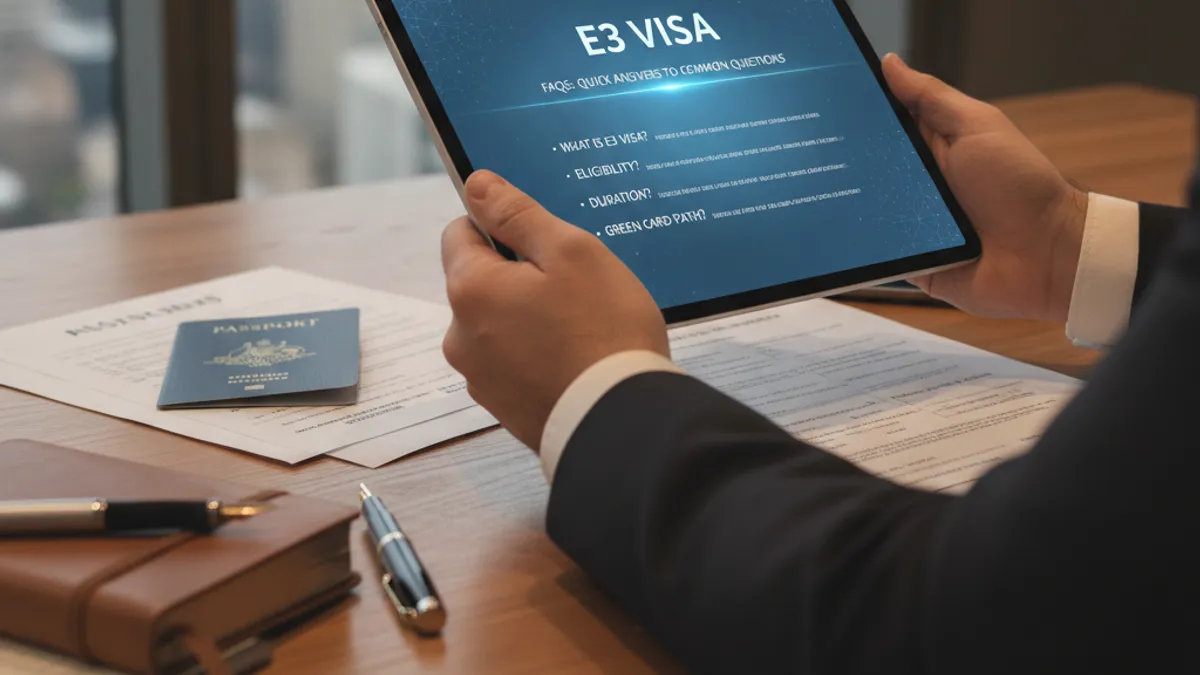
E3 Visa FAQs: Quick Answers to Common Questions
Can I start working immediately after arriving in the U.S. on an E3 visa?
Yes, once you have been admitted into the U.S. in E-3 status at a port of entry, you can begin working for the sponsoring employer as soon as your employment start date arrives.
What happens if my employer withdraws my job offer after I’ve entered the U.S. on an E3?
If your employer withdraws the offer or your employment ends unexpectedly, you generally have a grace period (typically 60 days, or until your I-94 expiration date, whichever is shorter) to find new employment and file for a change of status or depart the U.S. It’s crucial to act quickly.
Can I travel outside the U.S. and re-enter on my E3 visa?
Yes, as long as your E3 visa stamp is still valid and you have a current LCA and job offer from your sponsoring employer, you can usually re-enter the U.S. without issue. It’s always good practice to carry all relevant documentation when traveling internationally.