
Planning to build a life or chase opportunities in Australia starts with a clear understanding of how to apply for an Australian visa from Bangladesh. It's a process that can seem complex, but with the right guidance, it becomes a manageable journey. We've broken down the essentials to help you figure out the best path forward, whether you're dreaming of studying, working, or reuniting with family Down Under.
Thank you for reading this post, don't forget to subscribe!Our research shows that meticulous attention to detail is crucial, especially concerning documentation requirements and eligibility criteria for specific visa subclasses. For example, the English language proficiency requirement for many skilled and student visas often necessitates a minimum score, such as a Band 6.0 in the IELTS exam. Let's dive into what you need to know to get your application on the right track.
Understanding Your Purpose: Which Visa Fits You?

The very first step in applying for any Australian visa from Bangladesh is clarifying your reason for travel. Australia offers a vast array of visa subclasses, each designed for specific purposes, and choosing the wrong one can lead to delays or outright refusal. It's not just about picking a category; it's about ensuring your circumstances truly align with the visa's intent.
For Work, Study, or Visit: Key Visa Categories
When you’re ready to apply, you’ll find that Australia’s visa system is structured around distinct streams. These streams cater to different needs, so identifying which one applies to you is paramount. This initial step is where you set the foundation for your entire application.
- Visitor Visas: These are for people wanting to visit Australia for tourism, to see family and friends, or for short business trips. This stream often includes the Tourist stream (subclass 600) and the eVisitor (subclass 651) or Electronic Travel Authority (ETA) (subclass 601), though eligibility for the latter two depends on nationality and specific agreements.
- Student Visas: If your primary goal is education at an Australian institution, you'll look at the Student visa (subclass 500). This requires enrollment in a registered course and proof of financial capacity to cover tuition, living expenses, and Overseas Student Health Cover (OSHC).
- Skilled Migration Visas: For those with skills and qualifications that Australia needs, these visas are pathways to living and working permanently. They often involve points-based assessments, skills assessments by designated authorities, and English language proficiency. Options include the Skilled Independent visa (subclass 189), Skilled Nominated visa (subclass 190), and Skilled Work Regional (Provisional) visa (subclass 491).
- Family Visas: If you have eligible family members who are Australian citizens or permanent residents, you might qualify for a family visa to join them. These can range from partner visas to parent visas, each with its own set of strict criteria and often long processing times.
- Business Visas: For entrepreneurs and investors looking to establish or manage a business in Australia, various business innovation and investment visas are available. These typically involve significant financial investment and business acumen.
Assessing Your Eligibility: Do You Qualify?
Once you've identified the broad category that fits your purpose, you need to drill down into the specific eligibility requirements for each subclass. This is where the decision tree truly branches out. Each visa subclass has a unique set of criteria that applicants must meet.
- Age Limits: Certain visas, particularly skilled migration ones, have age restrictions, often requiring applicants to be under a specific age, like 45 for some points-tested streams.
- Health Requirements: All applicants must meet Australia's health standards. This usually involves undergoing medical examinations by panel physicians approved by the Department of Home Affairs.
- Character Requirements: Applicants must generally be of good character. This means you'll likely need to provide police certificates from countries you've lived in for a certain period, and any criminal history will be scrutinized.
- English Language Proficiency: Many visa subclasses require applicants to demonstrate a certain level of English ability. This is often proven through standardized tests like the International English Language Testing System (IELTS), TOEFL iBT, or Pearson Test of English (PTE) Academic, with specific score requirements varying by visa type. For instance, some skilled visas might need a "Competent English" level (equivalent to IELTS 6.0), while others might require "Proficient English" (IELTS 7.0 or higher).
- Financial Capacity: You must prove you have enough funds to support yourself and any accompanying family members during your stay, especially for student and some visitor visas.
Failing to meet even one of these core requirements can result in your application being refused. This is why this initial assessment is so critical; it saves you time and money by ensuring you apply for a visa you have a genuine chance of obtaining.
The Roadblocks: Common Visa Application Pitfalls

Many applicants stumble at various stages of the visa process, leading to frustration and, unfortunately, refusals. The Australian Department of Home Affairs is thorough, and even small oversights can have significant consequences. Understanding these common pitfalls beforehand can help you navigate the application much more smoothly. Our editorial analysis of common refusal reasons highlights a few recurring themes that Bangladeshi applicants should be particularly aware of.
Document Drama: What's Really Needed?
One of the most frequent reasons for visa refusal is incomplete or incorrect documentation. It's not enough to just provide a document; it needs to be the right document, in the right format, and often certified. This is where many people get tripped up.
- Birth Certificates: Ensuring these are official, certified copies and include full details is crucial.
- Marriage Certificates: For partner visas, the certificate needs to be the official one issued by the relevant authority.
- Police Certificates: You'll need these from any country where you've lived for 12 months or more in the last 10 years. The exact requirements for these vary by country, so researching your specific country's process is key.
- Identity Documents: Passports, national ID cards, they need to be current and match the details on your application form exactly.
- Financial Evidence: Bank statements, employment contracts, pay slips, these need to clearly demonstrate your financial capacity and genuine employment. They often need to be translated if not in English.
Many applicants fail to provide certified translations for documents not issued in English, or they submit photocopies when certified copies are required. The Department of Home Affairs has very specific guidelines on what constitutes a certified copy, so always check these meticulously.
Honesty is Key: Undeclared Information Risks
Perhaps the most serious mistake an applicant can make is withholding or misrepresenting information. Australia takes its immigration laws very seriously, and any attempt to deceive the authorities can lead to immediate refusal, lengthy bans from applying for future visas, and even revocation of a granted visa.
- Previous Visa Refusals: If you've ever had a visa refused or cancelled for Australia or any other country, you must declare this. Failure to do so is a major red flag.
- Criminal Convictions: Any criminal convictions, no matter how minor or how long ago, must be declared. The Department will assess these against their character requirements.
- Health Issues: Serious medical conditions that could place a burden on Australia's health system might need to be declared and assessed. Attempting to hide these can be seen as misrepresentation.
- Genuine Relationship (for Partner Visas): If you're applying for a partner visa, you must prove your relationship is genuine and ongoing. Fabricating evidence or misrepresenting the nature of your relationship will lead to refusal.
It's always better to declare something potentially concerning and explain it fully, rather than hoping it won't be discovered. The Department has sophisticated ways of cross-referencing information, and undeclared details are often uncovered, leading to severe consequences. As of 2026, immigration policies continue to emphasize integrity and transparency.
Understanding Your Purpose: Which Visa Fits You?

The very first step in applying for any Australian visa from Bangladesh is clarifying your reason for travel. Australia offers a vast array of visa subclasses, each designed for specific purposes, and choosing the wrong one can lead to delays or outright refusal. It's not just about picking a category; it's about ensuring your circumstances truly align with the visa's intent.
For Work, Study, or Visit: Key Visa Categories
When you’re ready to apply, you’ll find that Australia’s visa system is structured around distinct streams. These streams cater to different needs, so identifying which one applies to you is paramount. This initial step is where you set the foundation for your entire application.
- Visitor Visas: These are for people wanting to visit Australia for tourism, to see family and friends, or for short business trips. This stream often includes the Tourist stream (subclass 600) and the eVisitor (subclass 651) or Electronic Travel Authority (ETA) (subclass 601), though eligibility for the latter two depends on nationality and specific agreements.
- Student Visas: If your primary goal is education at an Australian institution, you'll look at the Student visa (subclass 500). This requires enrollment in a registered course and proof of financial capacity to cover tuition, living expenses, and Overseas Student Health Cover (OSHC).
- Skilled Migration Visas: For those with skills and qualifications that Australia needs, these visas are pathways to living and working permanently. They often involve points-based assessments, skills assessments by designated authorities, and English language proficiency. Options include the Skilled Independent visa (subclass 189), Skilled Nominated visa (subclass 190), and Skilled Work Regional (Provisional) visa (subclass 491).
- Family Visas: If you have eligible family members who are Australian citizens or permanent residents, you might qualify for a family visa to join them. These can range from partner visas to parent visas, each with its own set of strict criteria and often long processing times.
- Business Visas: For entrepreneurs and investors looking to establish or manage a business in Australia, various business innovation and investment visas are available. These typically involve significant financial investment and business acumen.
Assessing Your Eligibility: Do You Qualify?
Once you've identified the broad category that fits your purpose, you need to drill down into the specific eligibility requirements for each subclass. This is where the decision tree truly branches out. Each visa subclass has a unique set of criteria that applicants must meet.
- Age Limits: Certain visas, particularly skilled migration ones, have age restrictions, often requiring applicants to be under a specific age, like 45 for some points-tested streams.
- Health Requirements: All applicants must meet Australia's health standards. This usually involves undergoing medical examinations by panel physicians approved by the Department of Home Affairs.
- Character Requirements: Applicants must generally be of good character. This means you'll likely need to provide police certificates from countries you've lived in for a certain period, and any criminal history will be scrutinized.
- English Language Proficiency: Many visa subclasses require applicants to demonstrate a certain level of English ability. This is often proven through standardized tests like the International English Language Testing System (IELTS), TOEFL iBT, or Pearson Test of English (PTE) Academic, with specific score requirements varying by visa type. For instance, some skilled visas might need a "Competent English" level (equivalent to IELTS 6.0), while others might require "Proficient English" (IELTS 7.0 or higher).
- Financial Capacity: You must prove you have enough funds to support yourself and any accompanying family members during your stay, especially for student and some visitor visas.
Failing to meet even one of these core requirements can result in your application being refused. This is why this initial assessment is so critical; it saves you time and money by ensuring you apply for a visa you have a genuine chance of obtaining.
Understanding Your Purpose: Which Visa Fits You?

The very first step in applying for any Australian visa from Bangladesh is clarifying your reason for travel. Australia offers a vast array of visa subclasses, each designed for specific purposes, and choosing the wrong one can lead to delays or outright refusal. It's not just about picking a category; it's about ensuring your circumstances truly align with the visa's intent.
For Work, Study, or Visit: Key Visa Categories
When you’re ready to apply, you’ll find that Australia’s visa system is structured around distinct streams. These streams cater to different needs, so identifying which one applies to you is paramount. This initial step is where you set the foundation for your entire application.
- Visitor Visas: These are for people wanting to visit Australia for tourism, to see family and friends, or for short business trips. This stream often includes the Tourist stream (subclass 600) and the eVisitor (subclass 651) or Electronic Travel Authority (ETA) (subclass 601), though eligibility for the latter two depends on nationality and specific agreements.
- Student Visas: If your primary goal is education at an Australian institution, you'll look at the Student visa (subclass 500). This requires enrollment in a registered course and proof of financial capacity to cover tuition, living expenses, and Overseas Student Health Cover (OSHC).
- Skilled Migration Visas: For those with skills and qualifications that Australia needs, these visas are pathways to living and working permanently. They often involve points-based assessments, skills assessments by designated authorities, and English language proficiency. Options include the Skilled Independent visa (subclass 189), Skilled Nominated visa (subclass 190), and Skilled Work Regional (Provisional) visa (subclass 491).
- Family Visas: If you have eligible family members who are Australian citizens or permanent residents, you might qualify for a family visa to join them. These can range from partner visas to parent visas, each with its own set of strict criteria and often long processing times.
- Business Visas: For entrepreneurs and investors looking to establish or manage a business in Australia, various business innovation and investment visas are available. These typically involve significant financial investment and business acumen.
Assessing Your Eligibility: Do You Qualify?
Once you've identified the broad category that fits your purpose, you need to drill down into the specific eligibility requirements for each subclass. This is where the decision tree truly branches out. Each visa subclass has a unique set of criteria that applicants must meet.
- Age Limits: Certain visas, particularly skilled migration ones, have age restrictions, often requiring applicants to be under a specific age, like 45 for some points-tested streams.
- Health Requirements: All applicants must meet Australia's health standards. This usually involves undergoing medical examinations by panel physicians approved by the Department of Home Affairs.
- Character Requirements: Applicants must generally be of good character. This means you'll likely need to provide police certificates from countries you've lived in for a certain period, and any criminal history will be scrutinized.
- English Language Proficiency: Many visa subclasses require applicants to demonstrate a certain level of English ability. This is often proven through standardized tests like the International English Language Testing System (IELTS), TOEFL iBT, or Pearson Test of English (PTE) Academic, with specific score requirements varying by visa type. For instance, some skilled visas might need a "Competent English" level (equivalent to IELTS 6.0), while others might require "Proficient English" (IELTS 7.0 or higher).
- Financial Capacity: You must prove you have enough funds to support yourself and any accompanying family members during your stay, especially for student and some visitor visas.
Failing to meet even one of these core requirements can result in your application being refused. This is why this initial assessment is so critical; it saves you time and money by ensuring you apply for a visa you have a genuine chance of obtaining.
Understanding Your Purpose: Which Visa Fits You?

The very first step in applying for any Australian visa from Bangladesh is clarifying your reason for travel. Australia offers a vast array of visa subclasses, each designed for specific purposes, and choosing the wrong one can lead to delays or outright refusal. It's not just about picking a category; it's about ensuring your circumstances truly align with the visa's intent.
For Work, Study, or Visit: Key Visa Categories
When you’re ready to apply, you’ll find that Australia’s visa system is structured around distinct streams. These streams cater to different needs, so identifying which one applies to you is paramount. This initial step is where you set the foundation for your entire application.
- Visitor Visas: These are for people wanting to visit Australia for tourism, to see family and friends, or for short business trips. This stream often includes the Tourist stream (subclass 600) and the eVisitor (subclass 651) or Electronic Travel Authority (ETA) (subclass 601), though eligibility for the latter two depends on nationality and specific agreements.
- Student Visas: If your primary goal is education at an Australian institution, you'll look at the Student visa (subclass 500). This requires enrollment in a registered course and proof of financial capacity to cover tuition, living expenses, and Overseas Student Health Cover (OSHC).
- Skilled Migration Visas: For those with skills and qualifications that Australia needs, these visas are pathways to living and working permanently. They often involve points-based assessments, skills assessments by designated authorities, and English language proficiency. Options include the Skilled Independent visa (subclass 189), Skilled Nominated visa (subclass 190), and Skilled Work Regional (Provisional) visa (subclass 491).
- Family Visas: If you have eligible family members who are Australian citizens or permanent residents, you might qualify for a family visa to join them. These can range from partner visas to parent visas, each with its own set of strict criteria and often long processing times.
- Business Visas: For entrepreneurs and investors looking to establish or manage a business in Australia, various business innovation and investment visas are available. These typically involve significant financial investment and business acumen.
Assessing Your Eligibility: Do You Qualify?
Once you've identified the broad category that fits your purpose, you need to drill down into the specific eligibility requirements for each subclass. This is where the decision tree truly branches out. Each visa subclass has a unique set of criteria that applicants must meet.
- Age Limits: Certain visas, particularly skilled migration ones, have age restrictions, often requiring applicants to be under a specific age, like 45 for some points-tested streams.
- Health Requirements: All applicants must meet Australia's health standards. This usually involves undergoing medical examinations by panel physicians approved by the Department of Home Affairs.
- Character Requirements: Applicants must generally be of good character. This means you'll likely need to provide police certificates from countries you've lived in for a certain period, and any criminal history will be scrutinized.
- English Language Proficiency: Many visa subclasses require applicants to demonstrate a certain level of English ability. This is often proven through standardized tests like the International English Language Testing System (IELTS), TOEFL iBT, or Pearson Test of English (PTE) Academic, with specific score requirements varying by visa type. For instance, some skilled visas might need a "Competent English" level (equivalent to IELTS 6.0), while others might require "Proficient English" (IELTS 7.0 or higher).
- Financial Capacity: You must prove you have enough funds to support yourself and any accompanying family members during your stay, especially for student and some visitor visas.
Failing to meet even one of these core requirements can result in your application being refused. This is why this initial assessment is so critical; it saves you time and money by ensuring you apply for a visa you have a genuine chance of obtaining.
Understanding Your Purpose: Which Visa Fits You?
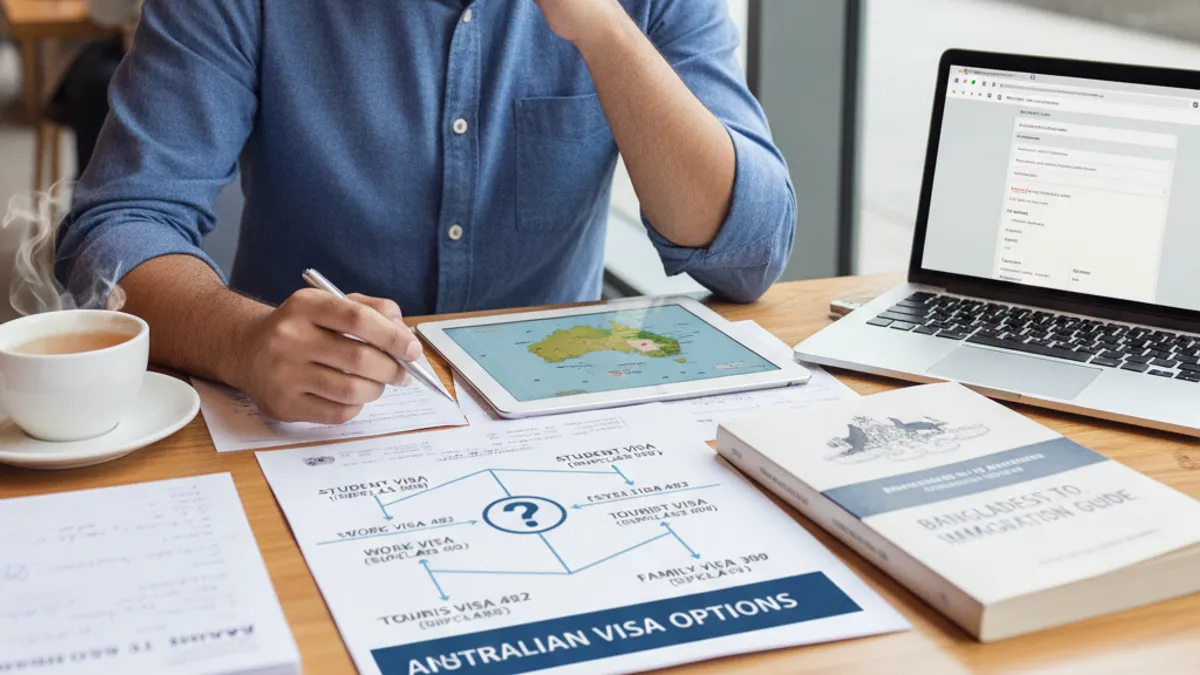
The very first step in applying for any Australian visa from Bangladesh is clarifying your reason for travel. Australia offers a vast array of visa subclasses, each designed for specific purposes, and choosing the wrong one can lead to delays or outright refusal. It's not just about picking a category; it's about ensuring your circumstances truly align with the visa's intent.
For Work, Study, or Visit: Key Visa Categories
When you’re ready to apply, you’ll find that Australia’s visa system is structured around distinct streams. These streams cater to different needs, so identifying which one applies to you is paramount. This initial step is where you set the foundation for your entire application.
- Visitor Visas: These are for people wanting to visit Australia for tourism, to see family and friends, or for short business trips. This stream often includes the Tourist stream (subclass 600) and the eVisitor (subclass 651) or Electronic Travel Authority (ETA) (subclass 601), though eligibility for the latter two depends on nationality and specific agreements.
- Student Visas: If your primary goal is education at an Australian institution, you'll look at the Student visa (subclass 500). This requires enrollment in a registered course and proof of financial capacity to cover tuition, living expenses, and Overseas Student Health Cover (OSHC).
- Skilled Migration Visas: For those with skills and qualifications that Australia needs, these visas are pathways to living and working permanently. They often involve points-based assessments, skills assessments by designated authorities, and English language proficiency. Options include the Skilled Independent visa (subclass 189), Skilled Nominated visa (subclass 190), and Skilled Work Regional (Provisional) visa (subclass 491).
- Family Visas: If you have eligible family members who are Australian citizens or permanent residents, you might qualify for a family visa to join them. These can range from partner visas to parent visas, each with its own set of strict criteria and often long processing times.
- Business Visas: For entrepreneurs and investors looking to establish or manage a business in Australia, various business innovation and investment visas are available. These typically involve significant financial investment and business acumen.
Assessing Your Eligibility: Do You Qualify?
Once you've identified the broad category that fits your purpose, you need to drill down into the specific eligibility requirements for each subclass. This is where the decision tree truly branches out. Each visa subclass has a unique set of criteria that applicants must meet.
- Age Limits: Certain visas, particularly skilled migration ones, have age restrictions, often requiring applicants to be under a specific age, like 45 for some points-tested streams.
- Health Requirements: All applicants must meet Australia's health standards. This usually involves undergoing medical examinations by panel physicians approved by the Department of Home Affairs.
- Character Requirements: Applicants must generally be of good character. This means you'll likely need to provide police certificates from countries you've lived in for a certain period, and any criminal history will be scrutinized.
- English Language Proficiency: Many visa subclasses require applicants to demonstrate a certain level of English ability. This is often proven through standardized tests like the International English Language Testing System (IELTS), TOEFL iBT, or Pearson Test of English (PTE) Academic, with specific score requirements varying by visa type. For instance, some skilled visas might need a "Competent English" level (equivalent to IELTS 6.0), while others might require "Proficient English" (IELTS 7.0 or higher).
- Financial Capacity: You must prove you have enough funds to support yourself and any accompanying family members during your stay, especially for student and some visitor visas.
Failing to meet even one of these core requirements can result in your application being refused. This is why this initial assessment is so critical; it saves you time and money by ensuring you apply for a visa you have a genuine chance of obtaining.
Understanding Your Purpose: Which Visa Fits You?

The very first step in applying for any Australian visa from Bangladesh is clarifying your reason for travel. Australia offers a vast array of visa subclasses, each designed for specific purposes, and choosing the wrong one can lead to delays or outright refusal. It's not just about picking a category; it's about ensuring your circumstances truly align with the visa's intent.
For Work, Study, or Visit: Key Visa Categories
When you’re ready to apply, you’ll find that Australia’s visa system is structured around distinct streams. These streams cater to different needs, so identifying which one applies to you is paramount. This initial step is where you set the foundation for your entire application.
- Visitor Visas: These are for people wanting to visit Australia for tourism, to see family and friends, or for short business trips. This stream often includes the Tourist stream (subclass 600) and the eVisitor (subclass 651) or Electronic Travel Authority (ETA) (subclass 601), though eligibility for the latter two depends on nationality and specific agreements.
- Student Visas: If your primary goal is education at an Australian institution, you'll look at the Student visa (subclass 500). This requires enrollment in a registered course and proof of financial capacity to cover tuition, living expenses, and Overseas Student Health Cover (OSHC).
- Skilled Migration Visas: For those with skills and qualifications that Australia needs, these visas are pathways to living and working permanently. They often involve points-based assessments, skills assessments by designated authorities, and English language proficiency. Options include the Skilled Independent visa (subclass 189), Skilled Nominated visa (subclass 190), and Skilled Work Regional (Provisional) visa (subclass 491).
- Family Visas: If you have eligible family members who are Australian citizens or permanent residents, you might qualify for a family visa to join them. These can range from partner visas to parent visas, each with its own set of strict criteria and often long processing times.
- Business Visas: For entrepreneurs and investors looking to establish or manage a business in Australia, various business innovation and investment visas are available. These typically involve significant financial investment and business acumen.
Assessing Your Eligibility: Do You Qualify?
Once you've identified the broad category that fits your purpose, you need to drill down into the specific eligibility requirements for each subclass. This is where the decision tree truly branches out. Each visa subclass has a unique set of criteria that applicants must meet.
- Age Limits: Certain visas, particularly skilled migration ones, have age restrictions, often requiring applicants to be under a specific age, like 45 for some points-tested streams.
- Health Requirements: All applicants must meet Australia's health standards. This usually involves undergoing medical examinations by panel physicians approved by the Department of Home Affairs.
- Character Requirements: Applicants must generally be of good character. This means you'll likely need to provide police certificates from countries you've lived in for a certain period, and any criminal history will be scrutinized.
- English Language Proficiency: Many visa subclasses require applicants to demonstrate a certain level of English ability. This is often proven through standardized tests like the International English Language Testing System (IELTS), TOEFL iBT, or Pearson Test of English (PTE) Academic, with specific score requirements varying by visa type. For instance, some skilled visas might need a "Competent English" level (equivalent to IELTS 6.0), while others might require "Proficient English" (IELTS 7.0 or higher).
- Financial Capacity: You must prove you have enough funds to support yourself and any accompanying family members during your stay, especially for student and some visitor visas.
Failing to meet even one of these core requirements can result in your application being refused. This is why this initial assessment is so critical; it saves you time and money by ensuring you apply for a visa you have a genuine chance of obtaining.
The Roadblocks: Common Visa Application Pitfalls

Many applicants stumble at various stages of the visa process, leading to frustration and, unfortunately, refusals. The Australian Department of Home Affairs is thorough, and even small oversights can have significant consequences. Our editorial analysis of common refusal reasons highlights a few recurring themes that Bangladeshi applicants should be particularly aware of.
Document Drama: What's Really Needed?
One of the most frequent reasons for visa refusal is incomplete or incorrect documentation. It's not enough to just provide a document; it needs to be the right document, in the right format, and often certified. This is where many people get tripped up.
- Birth Certificates: Ensuring these are official, certified copies and include full details is crucial.
- Marriage Certificates: For partner visas, the certificate needs to be the official one issued by the relevant authority.
- Police Certificates: You'll need these from any country where you've lived for 12 months or more in the last 10 years. The exact requirements for these vary by country, so researching your specific country's process is key.
- Identity Documents: Passports, national ID cards, they need to be current and match the details on your application form exactly.
- Financial Evidence: Bank statements, employment contracts, pay slips, these need to clearly demonstrate your financial capacity and genuine employment. They often need to be translated if not in English.
Many applicants fail to provide certified translations for documents not issued in English, or they submit photocopies when certified copies are required. The Department of Home Affairs has very specific guidelines on what constitutes a certified copy, so always check these meticulously.
Honesty is Key: Undeclared Information Risks
Perhaps the most serious mistake an applicant can make is withholding or misrepresenting information. Australia takes its immigration laws very seriously, and any attempt to deceive the authorities can lead to immediate refusal, lengthy bans from applying for future visas, and even revocation of a granted visa.
- Previous Visa Refusals: If you've ever had a visa refused or cancelled for Australia or any other country, you must declare this. Failure to do so is a major red flag.
- Criminal Convictions: Any criminal convictions, no matter how minor or how long ago, must be declared. The Department will assess these against their character requirements.
- Health Issues: Serious medical conditions that could place a burden on Australia's health system might need to be declared and assessed. Attempting to hide these can be seen as misrepresentation.
- Genuine Relationship (for Partner Visas): If you're applying for a partner visa, you must prove your relationship is genuine and ongoing. Fabricating evidence or misrepresenting the nature of your relationship will lead to refusal.
It's always better to declare something potentially concerning and explain it fully, rather than hoping it won't be discovered. The Department has sophisticated ways of cross-referencing information, and undeclared details are often uncovered, leading to severe consequences. As of 2026, immigration policies continue to emphasize integrity and transparency.
Your Step-by-Step Australian Visa Application Plan

Embarking on the application process requires a clear, sequential approach. While specific steps can vary slightly depending on the visa subclass, a general workflow applies to most applications submitted by Bangladeshi citizens. Following these stages methodically will help you manage the complexity and increase your chances of a successful outcome. This is where the actual work of applying begins.
Step 1: Navigating ImmiAccount and the Department of Home Affairs
The primary gateway for most Australian visa applications is the Department of Home Affairs' online portal, known as ImmiAccount. This is where you'll create your profile, fill out forms, upload documents, and track your application's progress. Familiarizing yourself with ImmiAccount early on is essential.
- Account Creation: Visit the Department of Home Affairs website to set up a secure ImmiAccount. You'll need a valid email address, which will be used for all official communications.
- Visa Finder Tool: The Department provides a "Visa Finder" tool, which can help you identify potential visa subclasses based on your eligibility and purpose of travel directly on their site.
- Application Form: Once you select your visa subclass, you'll start filling out the online application form. This is a detailed form requiring information about your personal details, travel history, education, work experience, and family.
It's critical to ensure all information entered into ImmiAccount is accurate and consistent with your supporting documents. Any discrepancies can trigger further scrutiny or even lead to refusal.
Step 2: Gathering Your Essential Documents
With your ImmiAccount set up and visa subclass identified, the next major task is compiling all the necessary supporting documents. This is an area where applicants frequently encounter difficulties due to specific certification and translation requirements. The Department of Home Affairs website for your chosen visa subclass will list the exact documents needed, but generally, you'll be looking at:
Proof of Identity:
- Current Passport (showing photograph, personal details, and expiry date)
- National Identity Card
Evidence of English Proficiency:
- Test results from an approved English language testing provider (e.g., IELTS, PTE Academic). Ensure your score meets the minimum requirement for your visa subclass.
Evidence of Skills and Qualifications (for Skilled Visas):
- Educational certificates and transcripts
- Skills assessment reports from relevant Australian assessing authorities
- Employment references and payslips
Financial Capacity Evidence:
- Bank statements showing sufficient funds for your stay
- Payslips, employment contracts, or sponsorship letters
Health and Character Documents:
- Police certificates from countries of residence
- Medical examination results (obtained from a panel physician)
All documents not in English must be accompanied by a certified translation from a registered translator. The certification must clearly state that the translation is an accurate rendition of the original document.
Step 3: Health Checks and Biometrics: What to Expect
Australia has strict health and character requirements for visa applicants. These assessments are designed to protect the Australian community and ensure that individuals applying for visas do not pose a health risk or a threat to security.
- Medical Examinations: Depending on the visa subclass and your intended stay duration, you may be required to undergo a medical examination. This is usually performed by a panel physician who is approved by the Australian government. You will typically be directed to a specific clinic in Bangladesh that is authorized for these examinations. The results are then sent directly to the Department of Home Affairs.
- Biometrics: Many visa applicants, including those from Bangladesh, are now required to provide biometrics, usually fingerprints and a facial photograph. This is collected at a Visa Application Centre (VAC). Providing accurate biometrics is a mandatory step in the application process and is used for identity verification.
It's important to arrange these steps promptly once you begin your application, as they can sometimes involve waiting times for appointments.
Step 4: Submitting Your Application and Paying the Fees
Once all your documents are gathered, translated, certified, and you have completed your health examinations and biometrics collection, you are ready to submit your application. This is done through your ImmiAccount.
- Upload Documents: Meticulously upload all required documents into your ImmiAccount. Double-check that you are uploading the correct files and that they are clear and legible.
- Application Fees: You will need to pay the Visa Application Charge (VAC) at the time of submission. The cost varies significantly depending on the visa subclass. Payment is typically made online using a credit or debit card.
- Final Review: Before hitting the submit button, take a final moment to review all sections of your application and ensure all uploaded documents are attached correctly. Once submitted, you cannot make changes to the core information without express permission or unless specifically requested by the Department.
After submission, you will receive a confirmation, and your application will be assigned a reference number. This is when the waiting period truly begins.
When DIY Isn't Enough: The Role of Migration Agents

While it's possible to manage your Australian visa application yourself, many applicants find the process overwhelming. This is where engaging a Registered Migration Agent can be invaluable. These professionals are regulated and licensed to provide immigration assistance, ensuring they adhere to strict ethical standards and are up-to-date with constantly changing migration laws.
Choosing a Registered Agent: What to Look For
Selecting the right migration agent is crucial. Not all agents are the same, and using an unregistered or disreputable agent can lead to significant problems, including financial loss and visa refusal.
- Registration: Always ensure that the agent is registered with the Office of the Migration Agents Registration Authority (OMARA) in Australia. You can verify their registration status on the OMARA website.
- Experience: Look for agents who have specific experience with Bangladeshi applicants and the visa subclasses you are interested in.
- Transparency: A good agent will be upfront about their fees, the services they offer, and the realistic chances of your visa application's success. They should provide a written service agreement.
- Communication: They should communicate clearly and regularly, explaining each step of the process and answering your questions patiently.
Using an unregistered agent is illegal in Australia and can invalidate your application.
Working with an Agent: The Process
If you decide to use a registered migration agent, they will guide you through the entire application process. They essentially act as your advocate and intermediary with the Department of Home Affairs.
- Initial Consultation: You'll typically have an initial consultation to discuss your situation, eligibility for different visas, and the agent's services.
- Service Agreement: If you proceed, you’ll sign a contract outlining the scope of services, costs, and payment schedule.
- Application Preparation: The agent will help you understand all requirements, assist in gathering and preparing documents, and complete the application forms, ensuring they are accurate and comprehensive.
- Submission and Follow-up: They will lodge your application and documents and then liaise with the Department of Home Affairs on your behalf, responding to any requests for further information.
While agents charge fees for their services, for many, the peace of mind and increased accuracy they provide can be well worth the investment, especially for complex visa types or for applicants who are not confident navigating the bureaucratic landscape alone.